
We read your photo as:
Oxygen (molar mass 32kg/kmol) is compressed reversible and poly tropically in the cylinder from 1.05 bar to 4.2 bar in such a way that one-third of work input is rejected as heat to the cylinder walls. Calculate the final temperature of oxygen. Assume oxygen to be a perfect gas and take Cv = 0.649
ScanSolve AI Answer
Answer
Step-by-step solution
5 stepsTo calculate the final temperature of oxygen, we need to determine the polytropic index and assume an initial temperature, as it is not provided in the problem.
Calculate the specific gas constant for oxygen.
The molar mass of oxygen () is . The universal gas constant () is .
Calculate the specific heat at constant pressure and the adiabatic index .
Given . For a perfect gas, .
The adiabatic index is:
Determine the polytropic index .
The first law of thermodynamics for a closed system is , where is work done on the system and is heat added to the system.
Work input () is done on the system, so .
Heat rejected () means heat leaves the system, so .
The problem states that "one-third of work input is rejected as heat", so .
Therefore, .
Substituting into the first law:For a perfect gas, . For a polytropic process, work input .
Equating these expressions:Assuming , we can simplify to:
Rearranging to solve for :
Assume an initial temperature .
The problem does not provide an initial temperature. We will assume a standard room temperature of .
Calculate the final temperature .
For a polytropic process, the relation between temperature and pressure is:
Given and .
First, calculate the exponent :Now, substitute the values into the temperature-pressure relation:
The final temperature of oxygen is approximately .
Try one yourself
A new problem that tests the same skill.
Still stuck on this one?
Ask a follow-up, and the answer starts from this question.
More Physics Questions
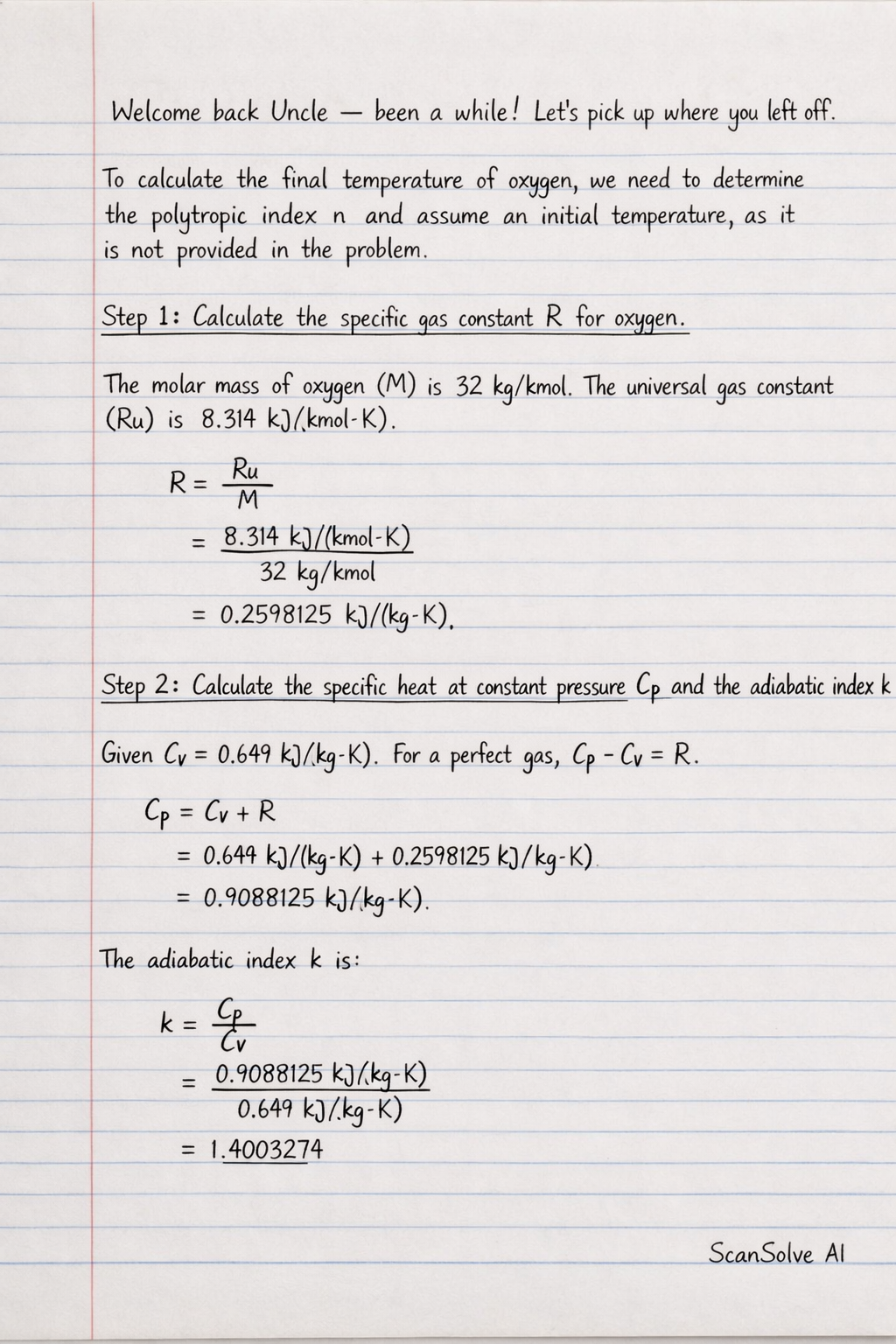
Handwritten Step-by-Step Solution
Get this as a handwritten image on WhatsApp — like a tutor wrote it for you.
Try on WhatsApp