
We read your photo as:
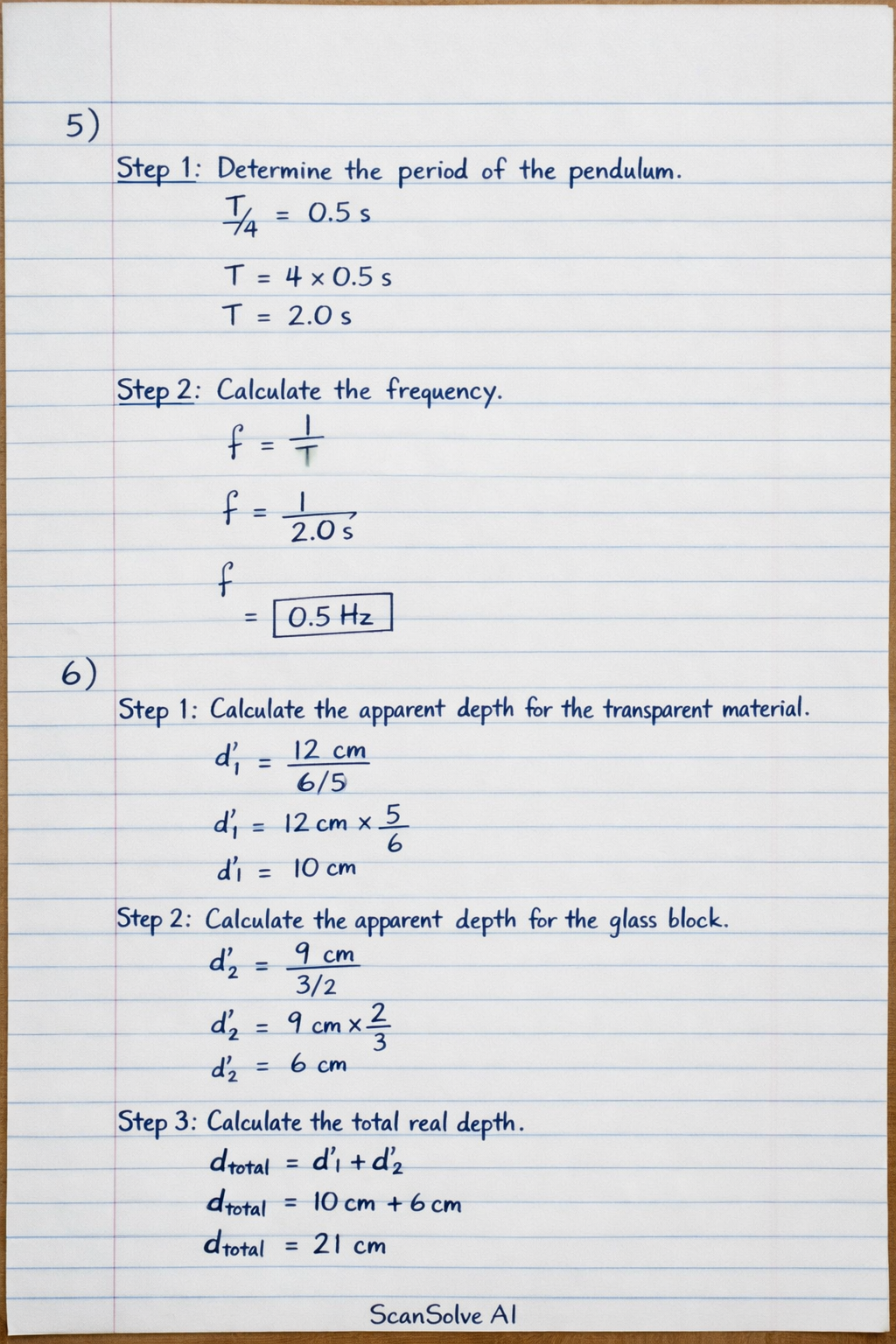
Determine the period of the pendulum.
ScanSolve AI Answer
Answer
Step-by-step solution
10 steps5)
Determine the period of the pendulum.
The time taken to move from the mean position to a maximum displacement is one-quarter of a full oscillation.
Calculate the frequency.
Frequency () is the reciprocal of the period ().
6)
Calculate the apparent depth for the transparent material.
The formula for apparent depth () is , where is the real depth and is the refractive index.
For the transparent material:Calculate the apparent depth for the glass block.
For the glass block:
Calculate the total real depth.
Calculate the total apparent depth.
Calculate the vertical displacement of the object.
Vertical displacement is the difference between the total real depth and the total apparent depth.
7)
To reverse bias a diode, the positive terminal of the dry cell is connected to the cathode (the bar side of the diode symbol), and the negative terminal is connected to the anode (the triangle side of the diode symbol).\begin{tikzpicture}[scale=0.8] % Dry cell \draw (0,0) to (0,0.5); \draw[line width=1.5pt] (0,0.5) to (0,0.8); % Positive terminal \draw (0,0) to (0,-0.5); \draw[line width=0.5pt] (0,-0.5) to (0,-0.8); % Negative terminal \node at (0.5, 0.65) {$+$}; \node at (0.5, -0.65) {$-$}; % Wires \draw (0,0.8) -- (2,0.8); \draw (0,-0.8) -- (2,-0.8); % Diode (reverse biased) \draw (2,0.8) -- (3,0.8); \draw (3,-0.8) -- (2,-0.8); \draw (3,0.8) -- (3,-0.8); % Cathode bar \draw[fill=white] (3,0) -- (2,0.8) -- (2,-0.8) -- cycle; % Anode triangle \node at (2.5, 0) {$\blacktriangleright$}; % Arrow for diode direction % Connecting wires \draw (3,0.8) -- (4,0.8); \draw (3,-0.8) -- (4,-0.8); \end{tikzpicture}8)
Determine the object and image distances using magnification.
The image is real and half the size of the object, so the magnification () is (negative for a real, inverted image).
For a real image formed by a converging lens, and are positive distances. The negative sign in magnification indicates inversion.
So, the magnitude of the image distance is half the magnitude of the object distance:The distance between the object and the image is . For a real image, the object and image are on opposite sides of the lens, so the distance between them is .
Solve for and .
Substitute into the equation:
Now find :
Use the lens formula to find the focal length ().
For a converging lens forming a real image, the lens formula is:
Find a common denominator:
Try one yourself
A new problem that tests the same skill.
Still stuck on this one?
Ask a follow-up, and the answer starts from this question.
More Physics Questions
Handwritten Step-by-Step Solution
Get this as a handwritten image on WhatsApp — like a tutor wrote it for you.
Try on WhatsApp