
We read your photo as:
Which phenomenon explains heat transfer through solids like metal rods, and what state of matter expands the most when heated? Calculate the linear expansion of a 2m rod heated from 20C to 120C if its
ScanSolve AI Answer
Answer
Step-by-step solution
8 stepshere are the solutions for questions 7 through 16.
-
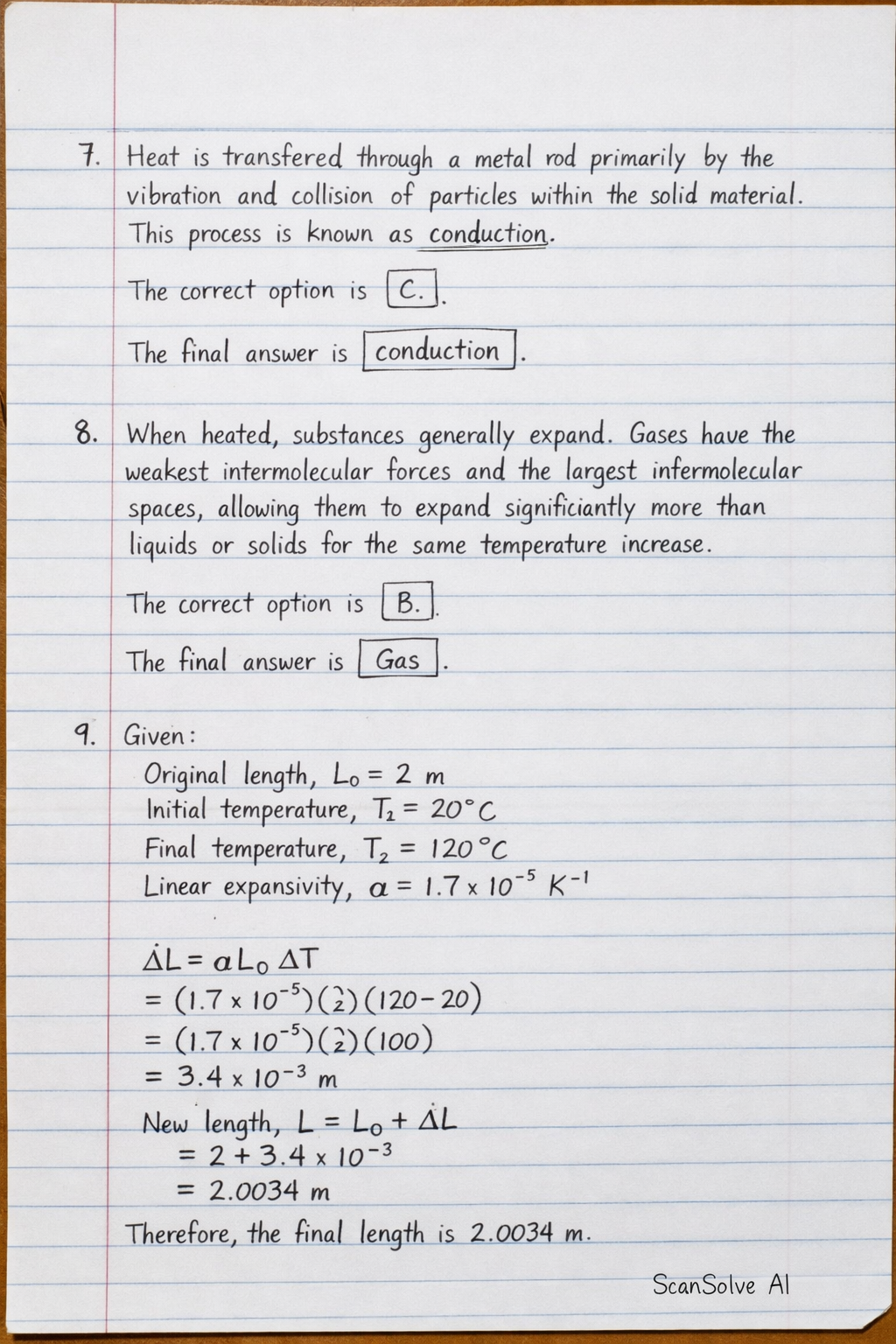
Heat is transferred through a metal rod primarily by the vibration and collision of particles within the solid material. This process is known as conduction. The correct option is C. The final answer is .
-
When heated, substances generally expand. Gases have the weakest intermolecular forces and the largest intermolecular spaces, allowing them to expand significantly more than liquids or solids for the same temperature increase. The correct option is B. The final answer is .
-
Given: Original length, Initial temperature, Final temperature, Linear expansivity,
Calculate the change in temperature ().
$$ \Delta T = T_2 - T_1 = 120^\circ\text{C} - 20^\circ\text{C} = 100^\circ\text{C} $$ Since a change of $1^\circ\text{C}$ is equal to a change of $1 \text{ K}$, $\Delta T = 100 \text{ K}$.Use the formula for linear thermal expansion.
$$ \Delta L = L_0 \alpha \Delta T $$Substitute the values and calculate the increase in length ().
$$ \Delta L = (2 \text{ m}) \times (1.7 \times 10^{-5} \text{ K}^{-1}) \times (100 \text{ K}) $$ $$ \Delta L = 3.4 \times 10^{-3} \text{ m} $$Convert the increase in length to millimeters (mm).
$$ \Delta L = 3.4 \times 10^{-3} \text{ m} \times \frac{1000 \text{ mm}}{1 \text{ m}} $$ $$ \Delta L = 3.4 \text{ mm} $$ The correct option is **A**. The final answer is $\boxed{3.4 \text{ mm}}$.10. Sea breeze is caused by the differential heating of land and sea. During the day, land heats up faster than water, causing the air above the land to warm, expand, and rise. Cooler, denser air from over the sea then moves in to replace the rising air, creating a breeze. This process of heat transfer through the movement of fluids (air) is called convection. The correct option is D. The final answer is .
- Given: Frequency, Wavelength,
Recall the wave speed formula.
$$ v = f\lambda $$Substitute the given values and calculate the speed ().
$$ v = (250 \text{ Hz}) \times (1.2 \text{ m}) $$ $$ v = 300 \text{ m/s} $$ The correct option is **A**. The final answer is $\boxed{300 \text{ m/s}}$.12. The pitch of a sound is determined by its frequency. A higher frequency corresponds to a higher pitch, and a lower frequency corresponds to a lower pitch. The correct option is B. The final answer is .
-
Sound travels fastest in media where particles are closest together and most rigidly connected, allowing vibrations to be transmitted most efficiently. This typically means sound travels fastest in solids, then liquids, and slowest in gases. Among the given options, steel is a solid. The correct option is C. The final answer is .
-
Given: Time for echo to be heard, Speed of sound,
-
Determine the time it takes for the sound to travel one way to the cliff.
Since the echo involves sound traveling to the cliff and back, the one-way time is half of the total time. $$ t_{\text{one-way}} = \frac{t}{2} = \frac{4 \text{ s}}{2} = 2 \text{ s} $$Calculate the distance to the cliff using the formula distance = speed time.
$$ d = v \times t_{\text{one-way}} $$ $$ d = (330 \text{ m/s}) \times (2 \text{ s}) $$ $$ d = 660 \text{ m} $$ The correct option is **A**. The final answer is $\boxed{660 \text{ m}}$.15. An image formed by a plane mirror is always virtual (cannot be projected onto a screen) and erect (upright, not inverted). It is also laterally inverted and the same size as the object. The correct option is D. The final answer is .
- A convex lens is characterized by being thicker at its center and thinner at its edges. It is a converging lens, meaning it converges parallel rays of light to a focal point. The correct option is B. The final answer is .
Try one yourself
A new problem that tests the same skill.
Still stuck on this one?
Ask a follow-up, and the answer starts from this question.
More Physics Questions
Handwritten Step-by-Step Solution
Get this as a handwritten image on WhatsApp — like a tutor wrote it for you.
Try on WhatsApp