
We read your photo as:
Explain the phenomenon of atmospheric refraction and calculate the time difference between actual and apparent sunset due to this effect.
ScanSolve AI Answer
Answer
Step-by-step solution
3 steps29.
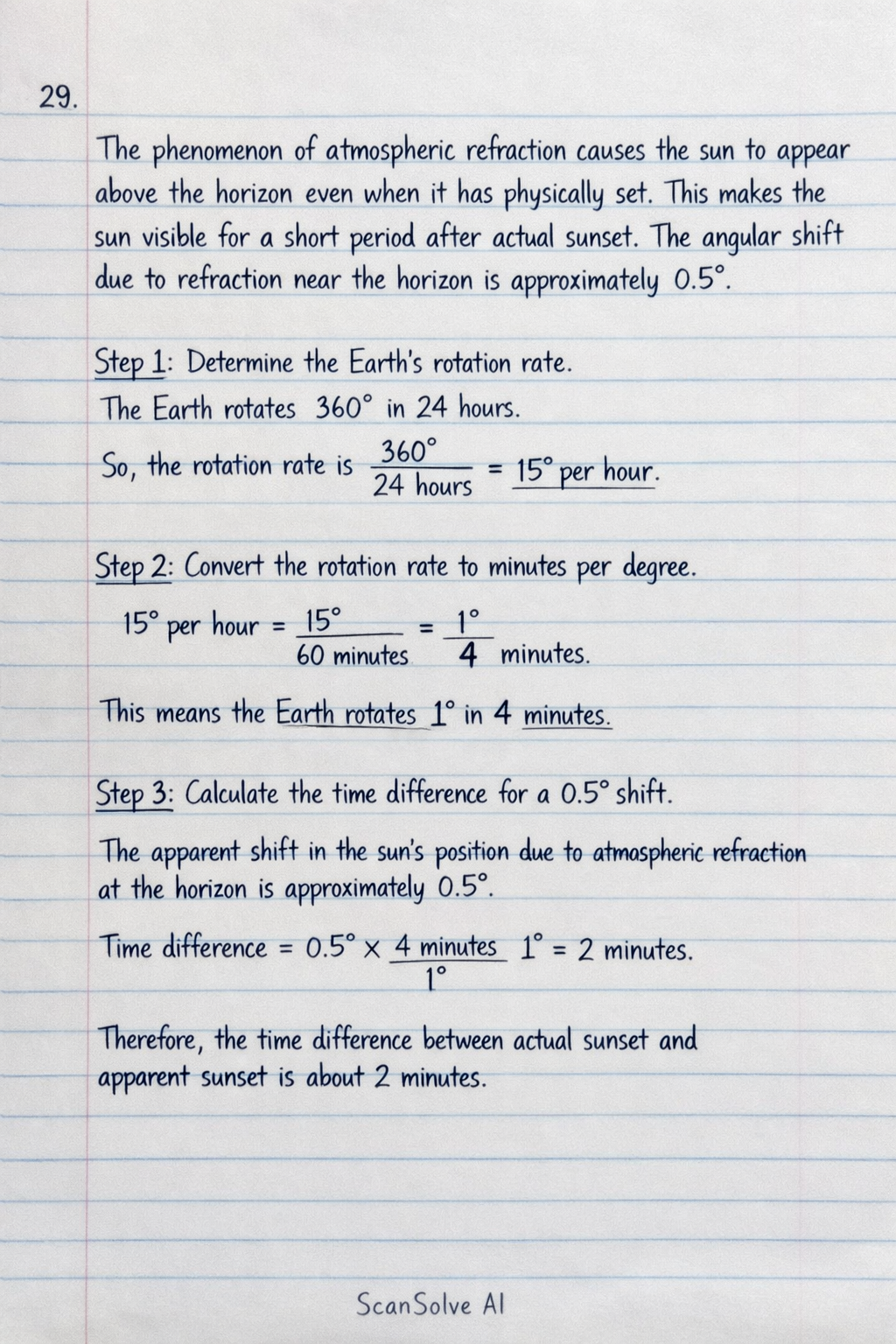
The phenomenon of atmospheric refraction causes the sun to appear above the horizon even when it has physically set. This makes the sun visible for a short period after actual sunset. The angular shift due to refraction near the horizon is approximately .
Determine the Earth's rotation rate.
The Earth rotates in 24 hours.
So, the rotation rate is .Convert the rotation rate to minutes per degree.
.
This means the Earth rotates in 4 minutes.Calculate the time difference for a shift.
The apparent shift in the sun's position due to atmospheric refraction at the horizon is approximately .
Time difference .Therefore, the time difference between actual sunset and apparent sunset is about 2 minutes.
The correct option is (B).
The time difference between actual sunset and apparent sunset is about .
Try one yourself
A new problem that tests the same skill.
Still stuck on this one?
Ask a follow-up, and the answer starts from this question.
More Physics Questions
Handwritten Step-by-Step Solution
Get this as a handwritten image on WhatsApp — like a tutor wrote it for you.
Try on WhatsApp