

This physics problem tests your understanding of fundamental physical laws and their applications. The step-by-step solution below breaks down the problem using relevant equations and physical reasoning.
ScanSolve AI Answer
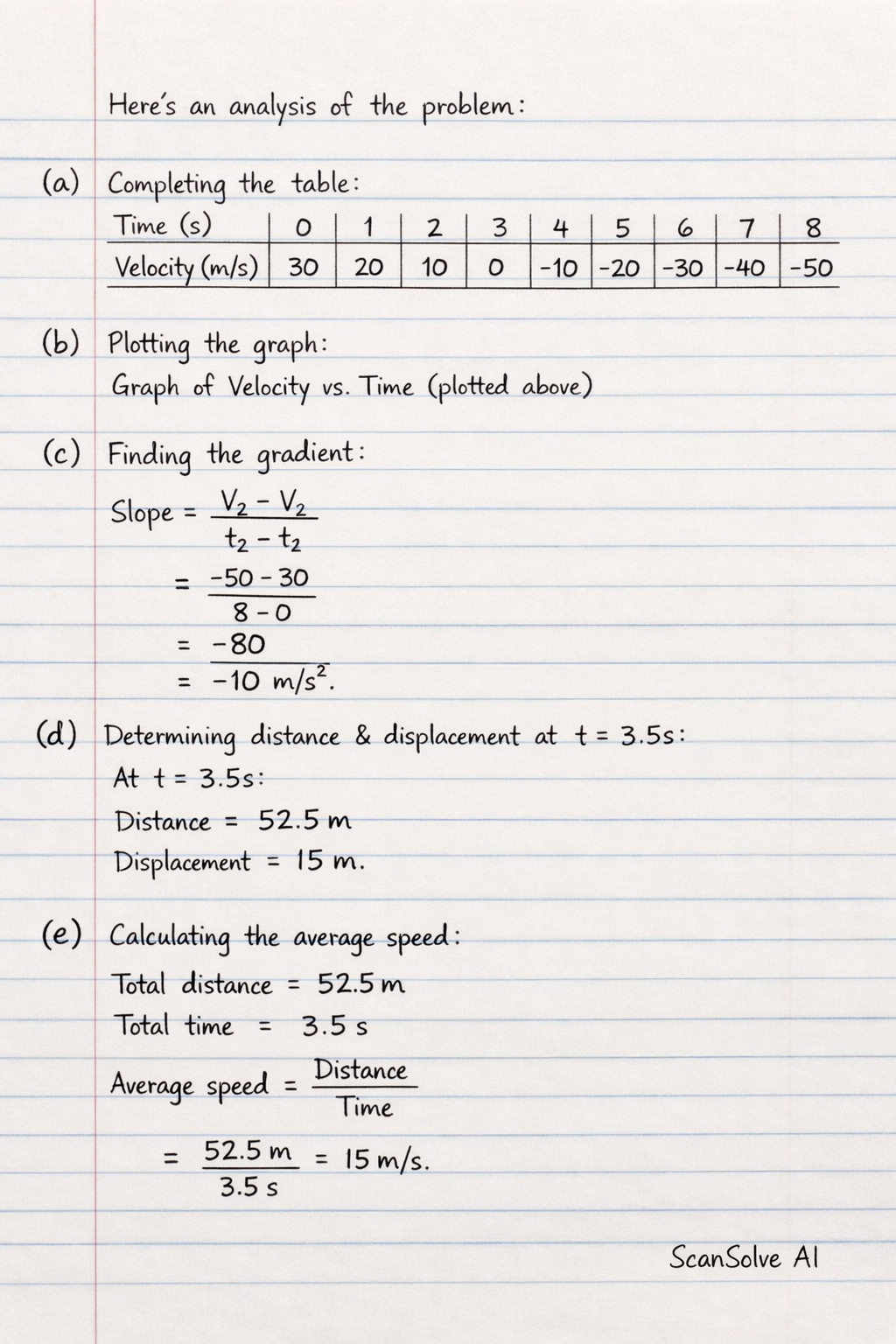
Here's a breakdown of the problem: Problem: The following table shows data obtained by a student in an experiment to measure the motion of a stone thrown vertically upwards. Take g = 10 m/s^2. | Time (s) | 0 | 1 | 2 | 3 | 4 | 5 | 6 | 7 | 8 | |---|---|---|---|---|---|---|---|---|---| | Velocity (m/s) | 30 | 20 | 10 | 0 | -10 | -20 | -30 | -40 | -50 | a) Complete the table with values of velocity. b) Plot a graph of velocity versus time using the data in the table. c) Use the graph to determine the gradient of the graph. d) Use the graph to determine the total distance and respective displacement at t = 3.5 s. e) Calculate the average speed of the stone. --- a) Complete the table with values of velocity. The provided table is already complete with velocity values for each time point. We can verify these values using the equation of motion v = u + at, where u = 30 m/s (initial velocity) and a = -g = -10 m/s^2 (acceleration due to gravity, negative as it opposes upward motion). For example, at t=1 s, v = 30 + (-10)(1) = 20 m/s. At t=4 s, v = 30 + (-10)(4) = -10 m/s. All values in the table are consistent with this constant acceleration. The completed table is: |c|c|c|c|c|c|c|c|c|c| Time (s) & 0 & 1 & 2 & 3 & 4 & 5 & 6 & 7 & 8 \\ Velocity (m/s) & 30 & 20 & 10 & 0 & -10 & -20 & -30 & -40 & -50 \\ b) Plot a graph of velocity versus time using the data in the table. To plot the graph: • Draw a horizontal axis (x-axis) for Time (s) and a vertical axis (y-axis) for Velocity (m/s). • Label the x-axis from 0 to 8 seconds and the y-axis from -50 m/s to 30 m/s. • Plot the points from the table: (0, 30), (1, 20), (2, 10), (3, 0), (4, -10), (5, -20), (6, -30), (7, -40), (8, -50). • Draw a straight line connecting these points. The graph will be a straight line with a negative slope. c) Use the graph to determine the gradient of the graph. The gradient of a velocity-time graph represents the acceleration. We can calculate it using any two points from the table. Let's use (t_1, v_1) = (0 s, 30 m/s) and (t_2, v_2) = (8 s, -50 m/s). Step 1: Write the formula for the gradient. Gradient = ( v)/( t) = (v_2 - v_1)/(t_2 - t_1) Step 2: Substitute the values and calculate the gradient. Gradient = -50 m/s - 30 m/s8 s - 0 s = -80 m/s8 s = -10 m/s^2 The gradient of the graph is the acceleration of the stone. Gradient = -10 m/s^2 d) Use the graph to determine the total distance and respective displacement at t = 3.5 s. The initial velocity is u = 30 m/s and acceleration is a = -10 m/s^2. Step 1: Calculate the displacement at t = 3.5 s. Displacement s can be calculated using the kinematic equation s = ut + (1)/(2)at^2. s = (30 m/s)(3.5 s) + (1)/(2)(-10 m/s^2)(3.5 s)^2 s = 105 m - 5 m/s^2 (12.25 s^2) s = 105 m - 61.25 m s = 43.75 m The displacement at t = 3.5 s is 43.75 m. Step 2: Calculate the total distance at t = 3.5 s. The stone reaches its maximum height when its velocity is 0 m/s. From the table, this occurs at t = 3 s. First, calculate the distance traveled upwards from t=0 to t=3 s. s_up = (30 m/s)(3 s) + (1)/(2)(-10 m/s^2)(3 s)^2 s_up = 90 m - 5 m/s^2 (9 s^2) s_up = 90 m - 45 m = 45 m Next, calculate the distance traveled downwards from t=3 s to t=3.5 s. For this segment, the initial velocity is 0 m/s (at t=3 s) and the time duration is 3.5 - 3 = 0.5 s. s_down = (0 m/s)(0.5 s) + (1)/(2)(-10 m/s^2)(0.5 s)^2 s_down = -5 m/s^2 (0.25 s^2) s_down = -1.25 m The magnitude of the distance traveled downwards is 1.25 m. Total distance is the sum of the magnitudes of distances traveled: Total distance = |s_up| + |s_down| = 45 m + 1.25 m = 46.25 m The total distance at t = 3.5 s is 46.25 m. e) Calculate the average speed of the stone. Average speed is defined as the total distance traveled divided by the total time taken. We will calculate this for the entire duration given in the table, from t=0 to t=8 s. Step 1: Determine the total time. Total time = 8 s Step 2: Calculate the total distance traveled from t=0 to t=8 s. The stone travels upwards for 3 s and then downwards for 8 - 3 = 5 s. Distance traveled upwards (from t=0 to t=3 s) is 45 m (calculated in part d). Distance traveled downwards (from t=3 s to t=8 s): For this segment, the initial velocity is 0 m/s (at t=3 s) and the time duration is 5 s. s_down\_total = (0 m/s)(5 s) + (1)/(2)(-10 m/s^2)(5 s)^2 s_down\_total = -5 m/s^2 (25 s^2) s_down\_total = -125 m The magnitude of the distance traveled downwards is 125 m. Total distance = Distance up + Distance down = 45 m + 125 m = 170 m Step 3: Calculate the average speed. Average speed = Total distanceTotal time Average speed = 170 m8 s Average speed = 21.25 m/s The average speed of the stone is 21.25 m/s. Send me the next one 📸