
This physics problem tests your understanding of fundamental physical laws and their applications. The step-by-step solution below breaks down the problem using relevant equations and physical reasoning.
ScanSolve AI Answer
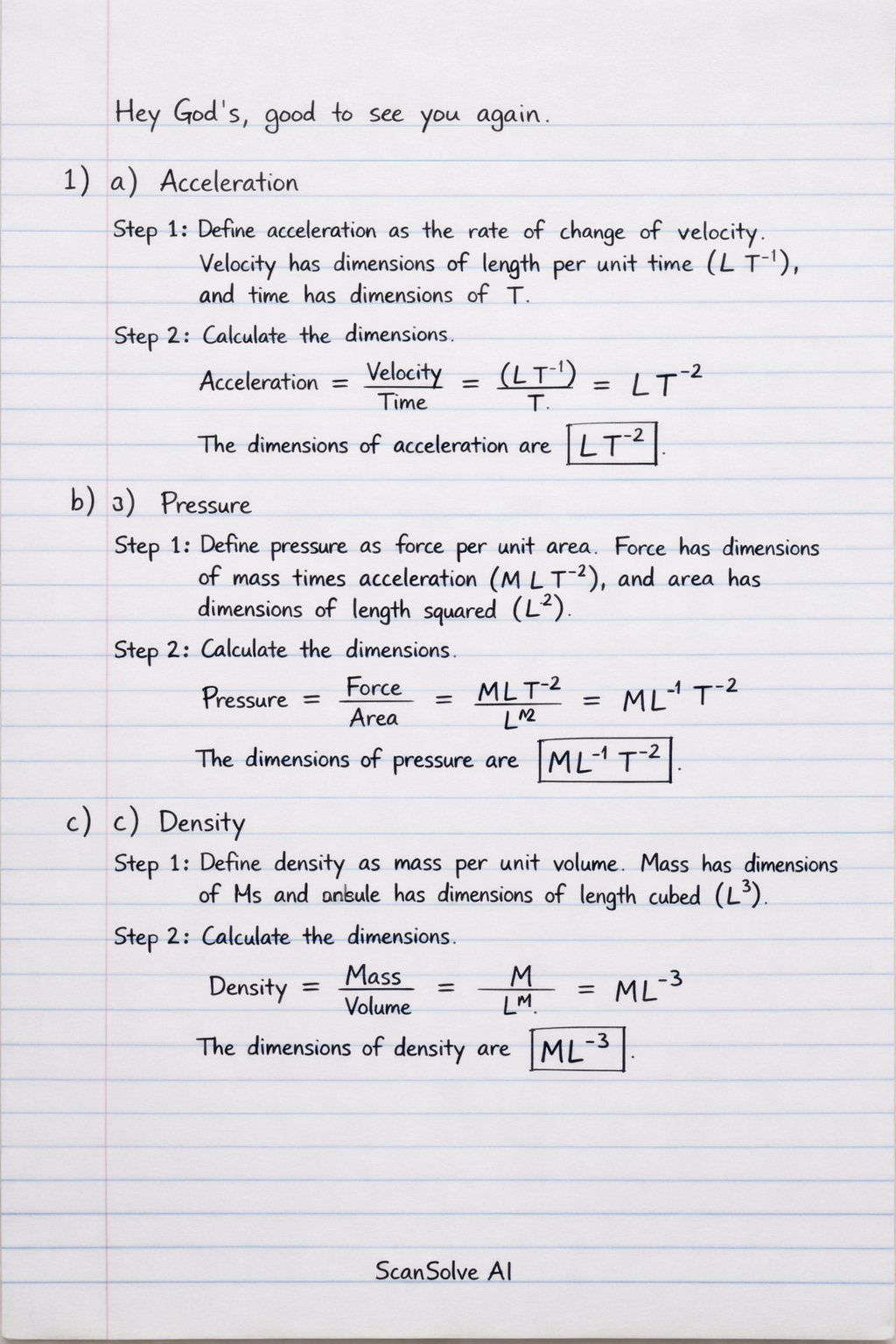
Hey God's, good to see you again. 1) a) Acceleration Step 1: Define acceleration as the rate of change of velocity. Velocity has dimensions of length per unit time (L T^-1), and time has dimensions of T. Step 2: Calculate the dimensions. Acceleration = VelocityTime = L T^-1T = L T^-2 The dimensions of acceleration are L T^-2. b) Pressure Step 1: Define pressure as force per unit area. Force has dimensions of mass times acceleration (M L T^-2), and area has dimensions of length squared (L^2). Step 2: Calculate the dimensions. Pressure = ForceArea = M L T^-2L^2 = M L^-1 T^-2 The dimensions of pressure are M L^-1 T^-2. c) Density Step 1: Define density as mass per unit volume. Mass has dimensions of M, and volume has dimensions of length cubed (L^3). Step 2: Calculate the dimensions. Density = MassVolume = (M)/(L^3) = M L^-3 The dimensions of density are M L^-3. 2) Step 1: Identify the given values. Initial velocity, u = 42 ms^-1 Angle of projection, = 30^ Acceleration due to gravity, g = 10 ms^-2 Step 2: Use the formula for maximum height (H) in projectile motion. H = ((u )^2)/(2g) Step 3: Substitute the values into the formula. H = ((42 30^)^2)/(2 × 10) H = ((42 × 0.5)^2)/(20) H = ((21)^2)/(20) H = (441)/(20) H = 22.05 m The maximum attainable height is 22.05 m. 3) Mercury does not wet glass because the cohesive forces (forces between mercury molecules) are much stronger than the adhesive forces (forces between mercury molecules and glass molecules). This causes mercury to minimize its contact with the glass, forming spherical droplets. Water, on the other hand, wets glass because its adhesive forces with glass are stronger than its cohesive forces, allowing it to spread out over the surface. 4) a) Tensile stress Tensile stress is the internal restoring force per unit cross-sectional area of a body when it is subjected to an external deforming force that tends to increase its length. It is calculated as the applied force divided by the cross-sectional area. b) Young’s modulus Young's modulus is a measure of the stiffness of an elastic material. It is defined as the ratio of tensile stress to tensile strain within the elastic limit of the material. It quantifies the material's resistance to elastic deformation under tension or compression. 5) Step 1: Identify the given values. Charge of electron, q = 1.60 × 10^-19 C Potential difference, V = 1.0 × 10^5 V Step 2: Use the formula for the energy (E) gained by a charge accelerated through a potential difference. E = qV Step 3: Substitute the values into the formula. E = (1.60 × 10^-19 C) × (1.0 × 10^5 V) E = 1.60 × 10^(-19+5) J E = 1.60 × 10^-14 J The energy of the electron is 1.60 × 10^-14 J. 6) Three observations in support of de Broglie’s assumption that moving particles behave like waves are: • Electron diffraction: Electrons, when passed through a crystal lattice, produce diffraction patterns similar to those produced by X-rays, demonstrating their wave-like nature. • Neutron diffraction: Neutrons also exhibit diffraction when scattered by crystalline materials, confirming their wave properties. • Atomic interference experiments: Experiments with atoms and molecules (like C60 fullerenes) showing interference patterns further support the wave-particle duality of matter. 7(a)i) Relative motion refers to the motion of an object as observed from a particular reference frame. It describes how the position, velocity, or acceleration of an object appears to an observer who might also be in motion. 7(a)ii) Step 1: Identify the given velocities. Velocity of the first car, v_1 = 80 kmh^-1 Velocity of the second car, v_2 = 60 kmh^-1 Since they are moving in opposite directions, we can assign one direction as positive and the other as negative. Let v_1 be positive. Step 2: Calculate the velocity of the first car relative to the second car. When objects move in opposite directions, their relative speed is the sum of their individual speeds. v_relative = v_1 - (-v_2) = v_1 + v_2 v_relative = 80 kmh^-1 + 60 kmh^-1 v_relative = 140 kmh^-1 The velocity of the first car relative to the second car is 140 kmh^-1. 7(b)i) Force is a push or a pull that can cause an object to accelerate, decelerate, change direction, or deform. It is a vector quantity, having both magnitude and direction. 7(b)ii) • Push: Contact force • Tension: Contact force • Gravitational force: Field force • Electrostatic force: Field force • Reaction: Contact force • Magnetic force: Field force 7(c)i) Velocity-time graph for the motion: The graph will consist of three segments: 1. An upward sloping line from t=0 to t=2 s (uniform acceleration). 2. A horizontal line for some time (constant speed). 3. A downward sloping line until velocity becomes zero (uniform retardation). % Axes [->] (0,0) -- (8,0) node[below] Time (s); [->] (0,0) -- (0,3) node[left] Velocity (ms^-1); % Phase 1: Acceleration (A) at (0,0); (B) at (2,2); % v = u + at = 0 + 1*2 = 2 m/s [blue, thick] (A) -- (B); [below] at (0,0) 0; [below] at (2,0) 2; [left] at (0,2) 2; % Phase 2: Constant speed (C) at (5,2); % Assuming t2 = 3s for drawing [blue, thick] (B) -- (C); [below] at (5,0) t_1+t_2; % Phase 3: Retardation (D) at (7,0); % Assuming t3 = 2s for drawing [blue, thick] (C) -- (D); [below] at (7,0) T; % Labels for phases at (1,2.5) Phase 1; at (3.5,2.5) Phase 2; at (6,2.5) Phase 3; 7(c)ii) (α) Velocity attained at the end of 2 s Step 1: Identify values for the first phase of motion. Initial velocity, u = 0 ms^-1 (starts from rest) Acceleration, a = 1 ms^-2 Time, t = 2 s Step 2: Use the equation of motion v = u + at. v = 0 + (1 ms^-2)(2 s) v = 2 ms^-1 The velocity attained at the end of 2 s is 2 ms^-1. (β) Total time taken for the journey Step 1: Calculate the distance covered in the first phase (s_1). s_1 = ut + (1)/(2)at^2 s_1 = (0)(2) + (1)/(2)(1)(2)^2 s_1 = 0 + (1)/(2)(1)(4) s_1 = 2 m Step 2: Calculate the time taken for the third phase (t_3) and the distance covered in the third phase (s_3). The initial velocity for the third phase is the velocity attained at the end of the first phase, u_3 = 2 ms^-1. The final velocity for the third phase is v_3 = 0 ms^-1 (comes to rest). Retardation, a_3 = -2 ms^-2. Using v = u + at: 0 = 2 + (-2)t_3 2t_3 = 2 t_3 = 1 s Using v^2 = u^2 + 2as: 0^2 = (2)^2 + 2(-2)s_3 0 = 4 - 4s_3 4s_3 = 4 s_3 = 1 m Step 3: Calculate the distance covered in the second phase (s_2). Total distance, S = 15 m. S = s_1 + s_2 + s_3 15 = 2 + s_2 + 1 15 = 3 + s_2 s_2 = 12 m Step 4: Calculate the time taken for the second phase (t_2). During the second phase, the speed is constant at 2 ms^-1. s_2 = v t_2 12 = 2 t_2 t_2 = (12)/(2) = 6 s Step 5: Calculate the total time taken for the journey (T). T = t_1 + t_2 + t_3 T = 2 s + 6 s + 1 s T = 9 s The total time taken for the journey is 9 s. Send me the next one 📸