
We read your photo as:
Describe the procedure for an experiment to determine the mass of an object using an uncalibrated spring balance.
Physics
ScanSolve AI Answer
Answer
Step-by-step solution
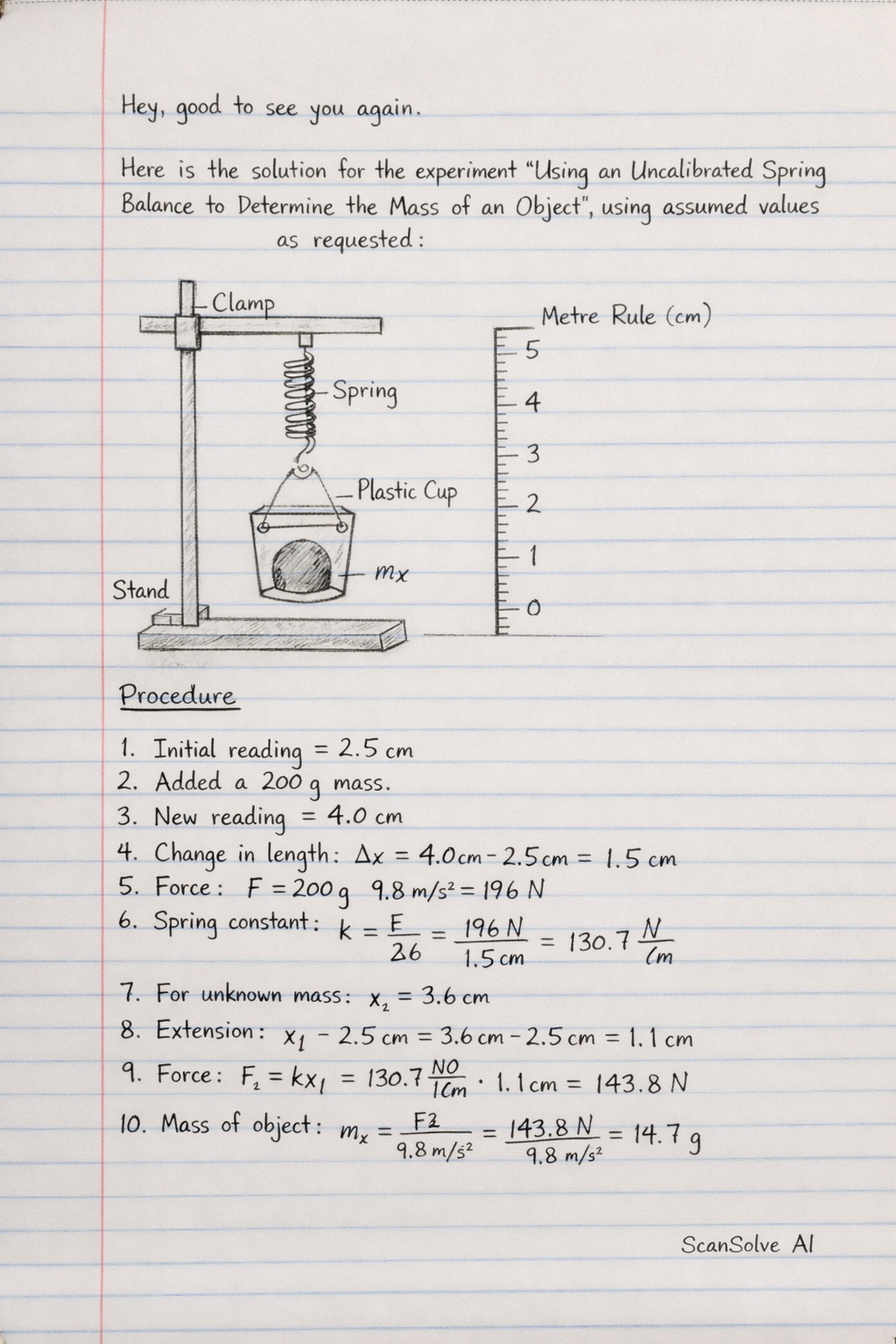
3 stepsHere is the solution for the experiment "Using an Uncalibrated Spring Balance to Determine the Mass of an Object", using assumed values as requested:
Diagram
\begin{tikzpicture}[scale=1.0]
    % Clamp stand
    \draw[thick] (0,0) -- (0,5);
    \draw[thick] (-1,5) -- (1,5);
    \draw[thick] (0,0) -- (2,0);
    \node at (0.5,5.3) {Clamp};
    \node at (1,0.3) {Stand};

    % Spring
    \draw[thick, decorate, decoration={coil,aspect=0.3,segment length=3mm,amplitude=3mm}] (0,4.5) -- (0,2.5);
    \node at (0.5,3.5) {Spring};

    % Plastic cup
    \draw (0,2.5) -- (0,2) -- (1,2) -- (1,2.5) -- cycle;
    \draw[thick] (0.5,2.5) -- (0.5,2);
    \node at (0.5,1.7) {Plastic Cup};

    % Metre rule
    \draw[thick] (1.5,0) -- (1.5,5);
    \foreach \y in {0,1,2,3,4,5}
        \draw (1.5,\y) -- (1.6,\y) node[right] {\y};
    \node at (1.8,2.5) {Metre Rule (cm)};

    % Unknown mass (stone) in cup
    \fill[gray!50] (0.5,2.1) circle (0.3);
    \node at (0.5,2.1) {$m_x$};
\end{tikzpicture}
Procedure
- Set up the clamp and stand. Securely attach the helical spring to the clamp.
- Attach the plastic cup to the free end of the spring using the twine.
- Position the metre rule vertically alongside the spring and cup, ensuring the zero mark is at a convenient reference point (e.g., the top of the spring or the bottom of the cup). Record the initial reading () of the bottom of the empty cup.
- Carefully place the standard mass () into the plastic cup.
- Allow the spring to settle and record the new reading () of the bottom of the cup.
- Remove the standard mass from the cup.
- Place the stone of unknown mass () into the plastic cup.
- Allow the spring to settle and record the new reading () of the bottom of the cup.
- Remove the stone and dismantle the apparatus.
Observations/Results
- Standard mass,
| Item in Cup | Reading of Bottom of Cup () | Extension () |
|---|---|---|
| Empty Cup | ||
| Standard Mass () | ||
| Unknown Mass () |
Calculations
Calculate the extension caused by the standard mass.
Calculate the extension caused by the unknown mass.
Determine the unknown mass using the principle of proportionality (Hooke's Law, , where ).
Since the extension is directly proportional to the mass, we can write:
Rearrange to solve for :
Substitute the observed values:
Conclusion
The mass of the unknown stone, , was determined to be .
Precautions
- Ensure the spring is securely clamped and hangs freely without touching the stand or table.
- Read the metre rule at eye level to avoid parallax errors when measuring the positions.
- Allow the spring to come to a complete rest before taking any readings to ensure accurate measurements of extension.
- Ensure the plastic cup is stable and does not swing while taking readings.
- Use a standard mass that is within the elastic limit of the spring to avoid permanent deformation.
- Record all readings carefully and accurately.
Was this helpful?
Try one yourself
A new problem that tests the same skill.
Still stuck on this one?
Ask a follow-up, and the answer starts from this question.
Got a different question?Ask your own question
More Physics Questions
QRead the magnitude of the force from the spring balance.Q1.2 Determine (1) the horizontal component and (2) the vertical component of a force that is exerted…QCalculate the spring constant of a spring given a force and extension, and set up the equation for a…QThis question outlines a physics experiment involving a mass-spring system and asks for a graph to…QWhat is the procedure to determine the density of a wire using a metre rule, micrometer screw gauge…
Handwritten Step-by-Step Solution
Get this as a handwritten image on WhatsApp — like a tutor wrote it for you.
Try on WhatsApp