
We read your photo as:
Describe the production of equal and opposite charges by induction and the effect on a charged conductor of the approach of an earthed conductor.
ScanSolve AI Answer
Step-by-step solution
7 stepshere are the descriptions for the electrostatic experiments.
26.
Part a· 4 steps
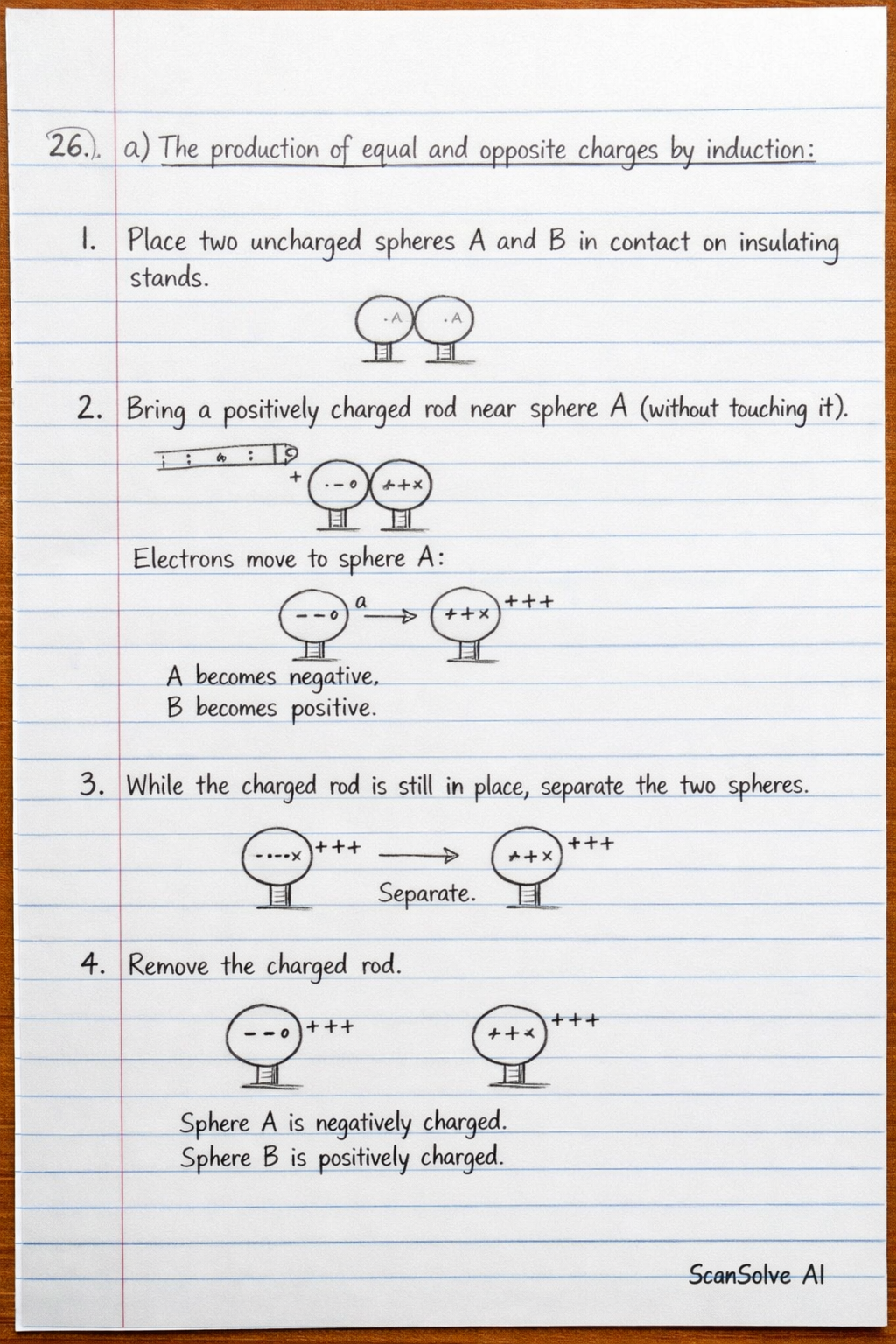
The production of equal and opposite charges by induction
Place two uncharged conducting spheres, A and B, in contact on insulating stands.
Bring a positively charged rod near sphere A without touching it.
Electrons in the spheres are attracted to sphere A, making it negatively charged, while sphere B becomes positively charged.
While the charged rod is still in place, separate the two spheres.
Remove the charged rod.
Sphere A will be negatively charged, and sphere B will be positively charged, with equal magnitudes.
Part b· 3 steps
The effect on a charged conductor of the approach of an earthed conductor
Charge an isolated conductor (e.g., a metal sphere on an insulating stand) positively.
Bring an uncharged conductor, which is connected to the Earth (e.g., by a wire or finger), near the positively charged sphere without touching it.
Electrons from the Earth are attracted to the earthed conductor due to the positive charge on the sphere.
These electrons then move towards the positively charged sphere, effectively reducing its net positive charge. The electric potential of the charged conductor decreases.
Still stuck on this one?
Ask a follow-up, and the answer starts from this question.
More Physics Questions
Handwritten Step-by-Step Solution
Get this as a handwritten image on WhatsApp — like a tutor wrote it for you.
Try on WhatsApp