
Q3) you are provided with two(1.5V) batteries, a battery holder,a known resistor, an ammeter, voltmeter an some crocodile clips.use the equipment to determine the internal resistance of one of the battery
ScanSolve AI Answer
Answer
Step-by-step solution
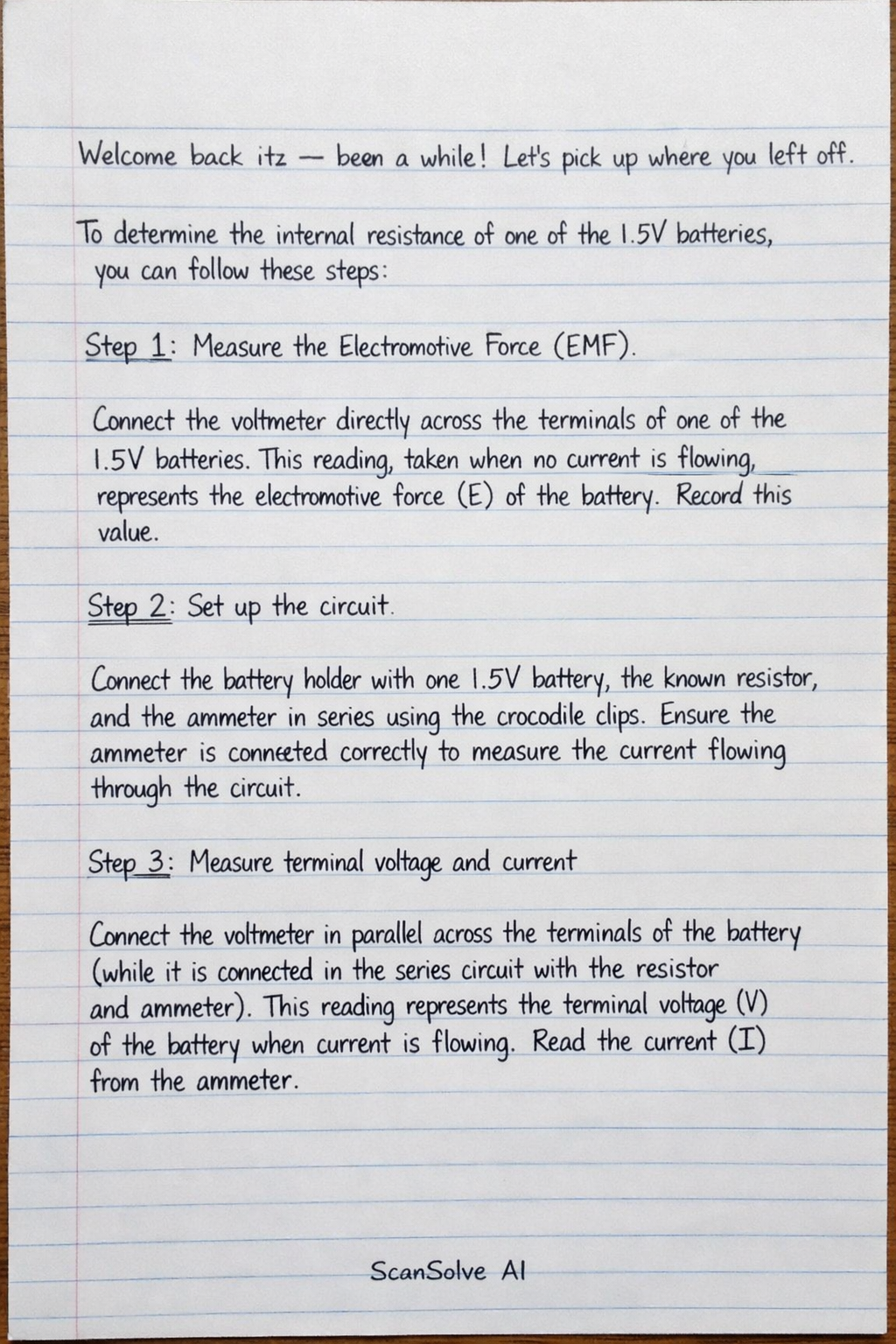
4 stepsTo determine the internal resistance of one of the 1.5V batteries, you can follow these steps:
Measure the Electromotive Force (EMF)
Connect the voltmeter directly across the terminals of one of the 1.5V batteries. This reading, taken when no current is flowing, represents the electromotive force () of the battery. Record this value.
Set up the circuit
Connect the battery holder with one 1.5V battery, the known resistor, and the ammeter in series using the crocodile clips. Ensure the ammeter is connected correctly to measure the current flowing through the circuit.
Measure terminal voltage and current
Connect the voltmeter in parallel across the terminals of the battery (while it is connected in the series circuit with the resistor and ammeter). This reading represents the terminal voltage () of the battery when current is flowing. Read the current () from the ammeter.
Calculate the internal resistance
The relationship between EMF (), terminal voltage (), current (), and internal resistance () is given by the formula:
Rearrange the formula to solve for the internal resistance ():
Substitute the values you measured for , , and into this equation to calculate the internal resistance of the battery.
Try one yourself
A new problem that tests the same skill.
Still stuck on this one?
Ask a follow-up, and the answer starts from this question.
More Physics Questions
Handwritten Step-by-Step Solution
Get this as a handwritten image on WhatsApp — like a tutor wrote it for you.
Try on WhatsApp