

This physics problem tests your understanding of fundamental physical laws and their applications. The step-by-step solution below breaks down the problem using relevant equations and physical reasoning.
ScanSolve AI Answer
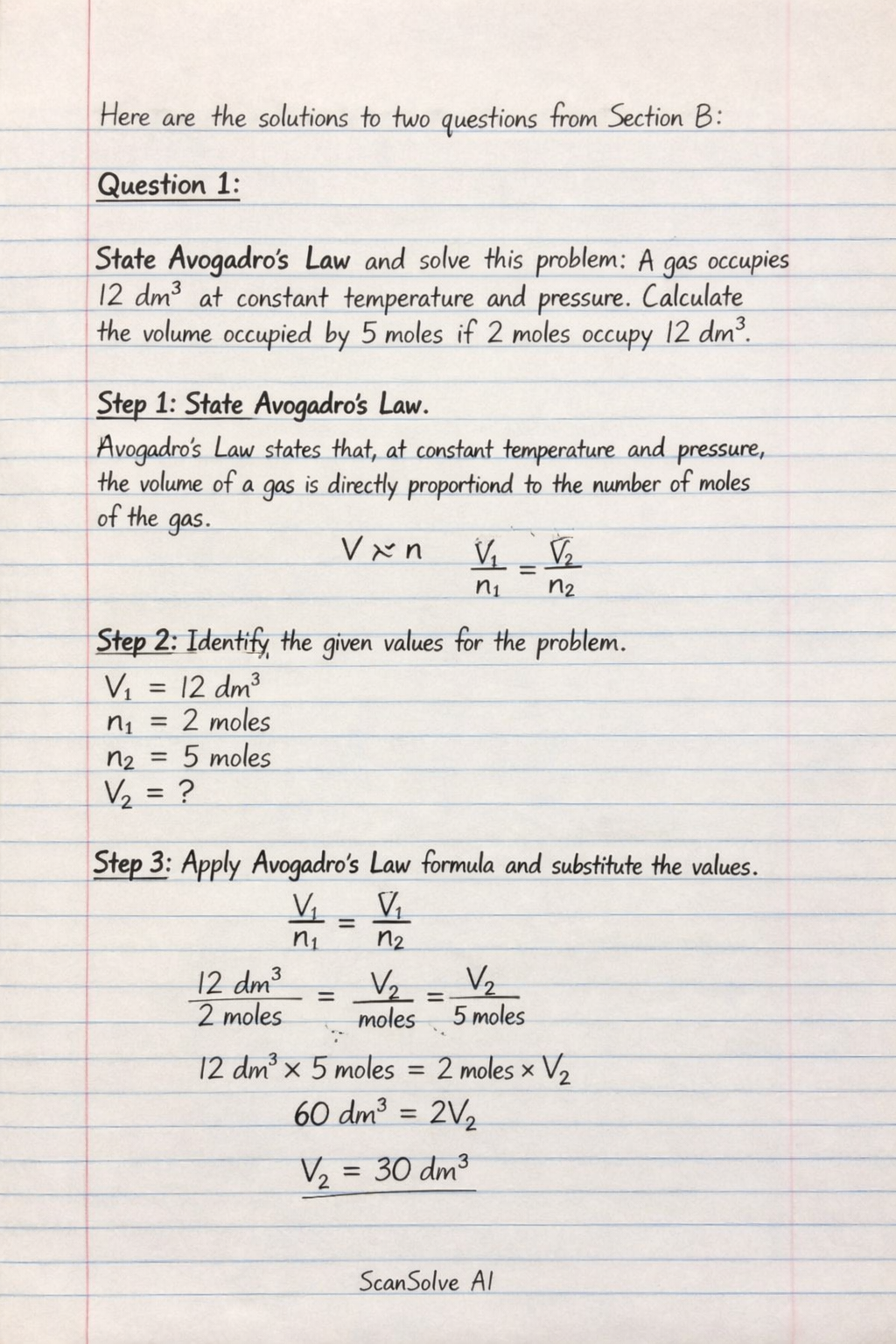
Here are the solutions to two questions from Section B: Question 1: State Avogadro's Law and solve this problem: A gas occupies 12 dm^3 at constant temperature and pressure. Calculate the volume occupied by 5 moles if 2 moles occupy 12 dm^3. Step 1: State Avogadro's Law. Avogadro's Law states that, at constant temperature and pressure, the volume of a gas is directly proportional to the number of moles of the gas. Mathematically, this can be expressed as V n or (V_1)/(n_1) = (V_2)/(n_2). Step 2: Identify the given values for the problem. Initial volume (V_1) = 12 dm^3 Initial number of moles (n_1) = 2 moles Final number of moles (n_2) = 5 moles Final volume (V_2) = ? Step 3: Apply Avogadro's Law formula and substitute the values. (V_1)/(n_1) = (V_2)/(n_2) 12 dm^32 moles = (V_2)/(5 moles) Step 4: Solve for V_2. V_2 = 12 dm^3 × 5 moles2 moles V_2 = 60 dm^32 V_2 = 30 dm^3 The volume occupied by 5 moles of the gas is 30 dm^3. Question 2: State Gay-Lussac's Law and calculate the final pressure of a gas initially at 150 kPa and 300 K when heated to 600 K at constant volume. Step 1: State Gay-Lussac's Law. Gay-Lussac's Law (also known as Amontons's Law) states that for a fixed mass and volume of gas, the pressure is directly proportional to its absolute (Kelvin) temperature. Mathematically, this can be expressed as P T or (P_1)/(T_1) = (P_2)/(T_2). Step 2: Identify the given values for the problem. Initial pressure (P_1) = 150 kPa Initial temperature (T_1) = 300 K Final temperature (T_2) = 600 K Final pressure (P_2) = ? Step 3: Apply Gay-Lussac's Law formula and substitute the values. (P_1)/(T_1) = (P_2)/(T_2) 150 kPa300 K = (P_2)/(600 K) Step 4: Solve for P_2. P_2 = 150 kPa × 600 K300 K P_2 = 90000 kPa300 P_2 = 300 kPa The final pressure of the gas is 300 kPa. What's next? Send 'em!