

This mathematics problem involves applying core mathematical principles and formulas. Below you will find a complete step-by-step solution with detailed explanations for each step, helping you understand not just the answer but the method behind it.
ScanSolve AI Answer
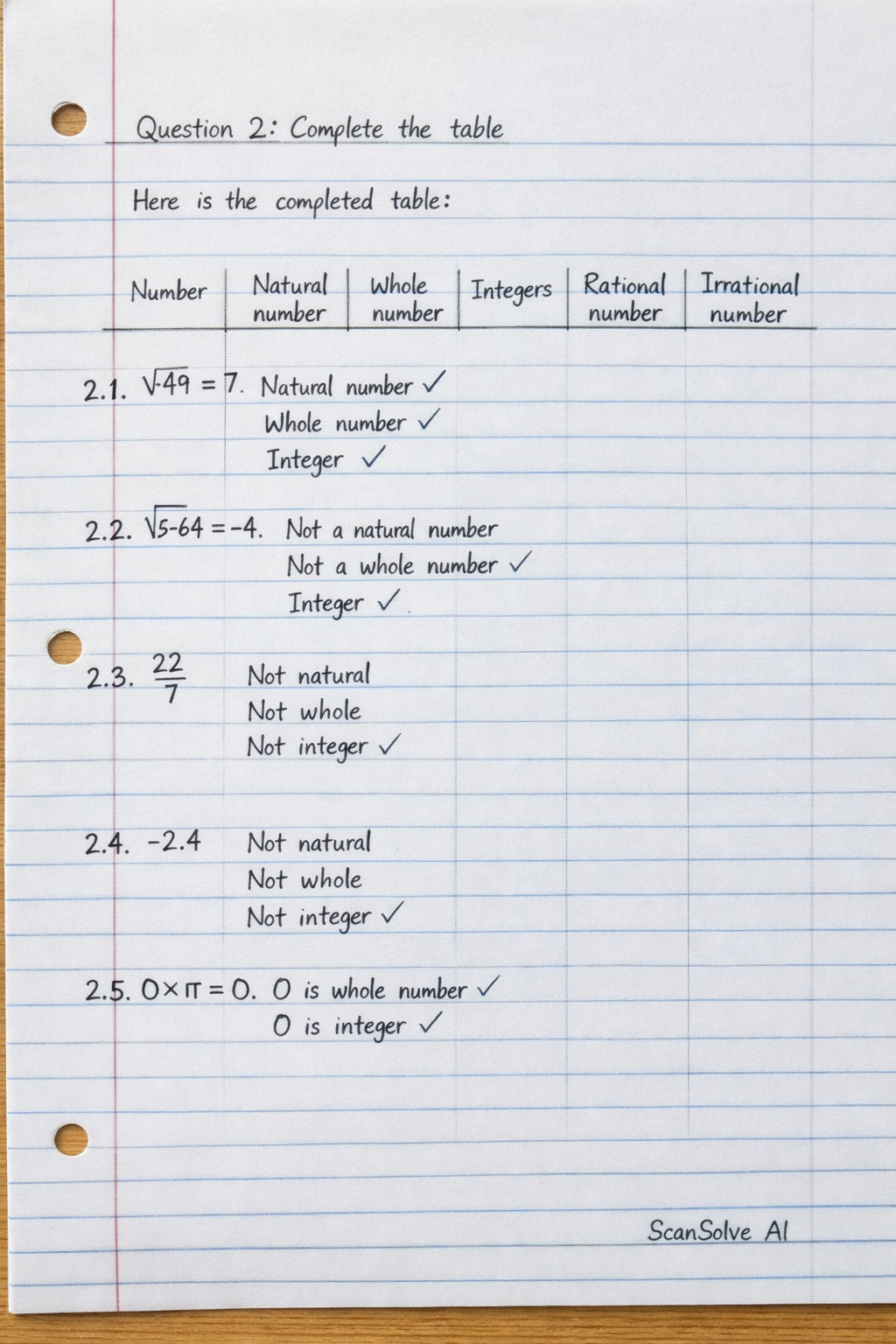
Question 2: Complete the table Here is the completed table: | Number | Natural number | Whole number | Integers | Rational number | Irrational number | | :-------------- | :------------- | :----------- | :------- | :-------------- | :---------------- | | 2.1 sqrt(49) | | | | | | | 2.2 [3]-64 | | | | | | | 2.3 (22)/(7) | | | | | | | 2.4 -2.4 | | | | | | | 2.5 0 × | | | | | | Explanation for each row: 2.1 sqrt(49): sqrt(49) = 7. This is a positive whole number, so it is a natural number, whole number, integer, and rational number ((7)/(1)). 2.2 [3]-64: [3]-64 = -4. This is a negative whole number, so it is an integer and a rational number ((-4)/(1)). It is not a natural or whole number. 2.3 (22)/(7): This is a fraction of two integers, so it is a rational number. It is not a natural number, whole number, or integer. 2.4 -2.4: This is a terminating decimal, which can be written as a fraction (-24)/(10) = (-12)/(5). Therefore, it is a rational number. It is not a natural number, whole number, or integer. 2.5 0 × : 0 × = 0. This is a whole number, an integer, and a rational number ((0)/(1)). It is not a natural number. --- Question 3.1: Use prime factorisation to determine LCM and HCF of 540 and 1800. Step 1: Find the prime factorisation of 540. 540 = 54 × 10 = (2 × 27) × (2 × 5) = (2 × 3^3) × (2 × 5) = 2^2 × 3^3 × 5^1 Step 2: Find the prime factorisation of 1800. 1800 = 18 × 100 = (2 × 9) × (10^2) = (2 × 3^2) × (2 × 5)^2 = (2 × 3^2) × (2^2 × 5^2) = 2^3 × 3^2 × 5^2 Step 3: Determine the HCF (Highest Common Factor). The HCF is the product of the common prime factors raised to the lowest power. HCF = 2^(2,3) × 3^(3,2) × 5^(1,2) HCF = 2^2 × 3^2 × 5^1 HCF = 4 × 9 × 5 HCF = 36 × 5 HCF = 180 Step 4: Determine the LCM (Lowest Common Multiple). The LCM is the product of all prime factors raised to the highest power. LCM = 2^(2,3) × 3^(3,2) × 5^(1,2) LCM = 2^3 × 3^3 × 5^2 LCM = 8 × 27 × 25 LCM = 216 × 25 LCM = 5400 The HCF of 540 and 1800 is 180. The LCM of 540 and 1800 is 5400. --- Question 3.2: Alex and Thomas share 30 sweets. They divide them in the ratio 3:2. How many sweets does Thomas have? Step 1: Find the total number of parts in the ratio. Total parts = 3 + 2 = 5 parts. Step 2: Determine the value of one part. Value per part = Total sweetsTotal parts = (30)/(5) = 6 sweets per part. Step 3: Calculate Thomas's share. Thomas's share is 2 parts. Thomas's sweets = 2 × 6 = 12 sweets. Thomas has 12 sweets. --- Question 3.3: The number of mechanics versus the number of fixed cars in a day is shown in the table below. | Number of mechanics | 24 | 12 | 6 | | :------------------ | :-- | :-- | :- | | Number of cars | 36 | 18 | 9 | Question 3.3.1: Is this an example of direct or inverse proportion? Step 1: Check for direct proportion by calculating the ratio Number of mechanicsNumber of cars. For the first pair: (24)/(36) = (2)/(3) For the second pair: (12)/(18) = (2)/(3) For the third pair: (6)/(9) = (2)/(3) Since the ratio is constant, the relationship is a direct proportion. This is an example of direct proportion. Question 3.3.2: Find the number of mechanics required to fix 108 cars. Step 1: Use the constant ratio from the direct proportion. Let M be the number of mechanics and C be the number of cars. We found that (M)/(C) = (2)/(3). Step 2: Substitute the given number of cars (C = 108) into the proportion. (M)/(108) = (2)/(3) Step 3: Solve for M. M = (2)/(3) × 108 M = 2 × (108)/(3) M = 2 × 36 M = 72 The number of mechanics required to fix 108 cars is 72 mechanics.