QUESTION 8: HEAT. Calculate the increase in volume of the aluminium block, calculate the mass of the gas, calculate the mass of carbon dioxide that was added, calculate the volume of toluene that will overflow when the temperature increases to 48 °C.

Physics
QUESTION 8: HEAT. Calculate the increase in volume of the aluminium block, calculate the mass of the gas, calculate the mass of carbon dioxide that was added, calculate the volume of toluene that will overflow when the temperature increases to 48 °C.

ScanSolve AI Answer

Answer

0.00174 m3\text{0.00174 m}^3

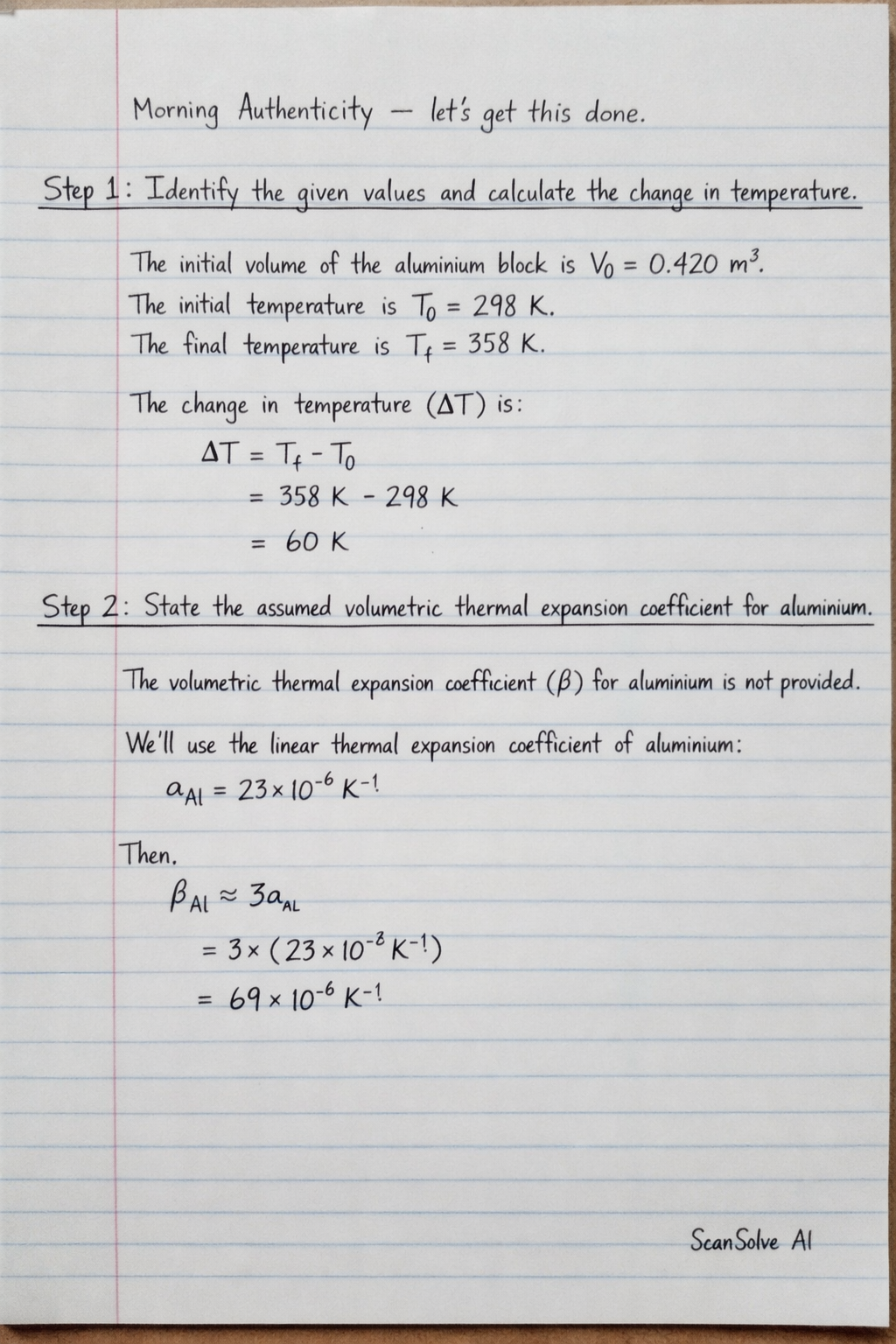
Step 1: Identify the given values and calculate the change in temperature. The initial volume of the aluminium block is V0=0.420m3V_0 = 0.420 m^3. The initial temperature is T0=298 KT_0 = 298 \text{ K}. The final temperature is Tf=358 KT_f = 358 \text{ K}. The change in temperature (ΔT\Delta T) is: ΔT=TfT0=358K298K=60K\Delta T = T_f - T_0 = 358 K - 298 K = 60 K

Step 2: State the assumed volumetric thermal expansion coefficient for aluminium. The volumetric thermal expansion coefficient (β\beta) for aluminium is not provided in the question. We will use a standard value for the linear thermal expansion coefficient of aluminium, αAl=23×106K1\alpha_{Al} = 23 \times 10^{-6} K^{-1}. The volumetric thermal expansion coefficient is approximately three times the linear thermal expansion coefficient: βAl=3αAl=3×(23×106K1)=69×106K1\beta_{Al} = 3 \alpha_{Al} = 3 \times (23 \times 10^{-6} K^{-1}) = 69 \times 10^{-6} K^{-1}

Step 3: Calculate the increase in volume. The formula for the increase in volume (ΔV\Delta V) due to thermal expansion is: ΔV=V0βAlΔT\Delta V = V_0 \beta_{Al} \Delta T Substitute the values: ΔV=(0.420m3)×(69×106K1)×(60K)\Delta V = (0.420 m^3) \times (69 \times 10^{-6} K^{-1}) \times (60 K) ΔV=1738.8×106m3\Delta V = 1738.8 \times 10^{-6} m^3 ΔV=0.0017388m3\Delta V = 0.0017388 m^3 Rounding to three significant figures, the increase in volume is: \Delta V = \text{0.00174 m^3}

Send me the next one 📸

Was this helpful?

Need help with your own homework?

Get instant step-by-step solutions to any question. Free to start.

Ask Your Question
Handwritten step-by-step solution preview

Handwritten Step-by-Step Solution

Get this as a handwritten image on WhatsApp — like a tutor wrote it for you.

Try on WhatsApp

Still have questions?

Quick Answer

Identify the given values and calculate the change in temperature. The initial volume of the aluminium block is V_0 = 0.420 m^3.

QUESTION 8: HEAT. Calculate the increase in volume of the aluminium block, calculate the mass of the gas, calculate the mass of carbon dioxide that was added, calculate the volume of toluene that will overflow when the temperature increases to 48 °C.
Physics

This physics problem tests your understanding of fundamental physical laws and their applications. The step-by-step solution below breaks down the problem using relevant equations and physical reasoning.

ScanSolve AI Answer
Step 1: Identify the given values and calculate the change in temperature. The initial volume of the aluminium block is V_0 = 0.420 m^3. The initial temperature is T_0 = 298 K. The final temperature is T_f = 358 K. The change in temperature ( T) is: T = T_f - T_0 = 358 K - 298 K = 60 K Step 2: State the assumed volumetric thermal expansion coefficient for aluminium. The volumetric thermal expansion coefficient () for aluminium is not provided in the question. We will use a standard value for the linear thermal expansion coefficient of aluminium, _Al = 23 × 10^-6 K^-1. The volumetric thermal expansion coefficient is approximately three times the linear thermal expansion coefficient: _Al = 3 _Al = 3 × (23 × 10^-6 K^-1) = 69 × 10^-6 K^-1 Step 3: Calculate the increase in volume. The formula for the increase in volume ( V) due to thermal expansion is: V = V_0 _Al T Substitute the values: V = (0.420 m^3) × (69 × 10^-6 K^-1) × (60 K) V = 1738.8 × 10^-6 m^3 V = 0.0017388 m^3 Rounding to three significant figures, the increase in volume is: V = 0.00174 m^3 Send me the next one 📸