

This physics problem tests your understanding of fundamental physical laws and their applications. The step-by-step solution below breaks down the problem using relevant equations and physical reasoning.
ScanSolve AI Answer
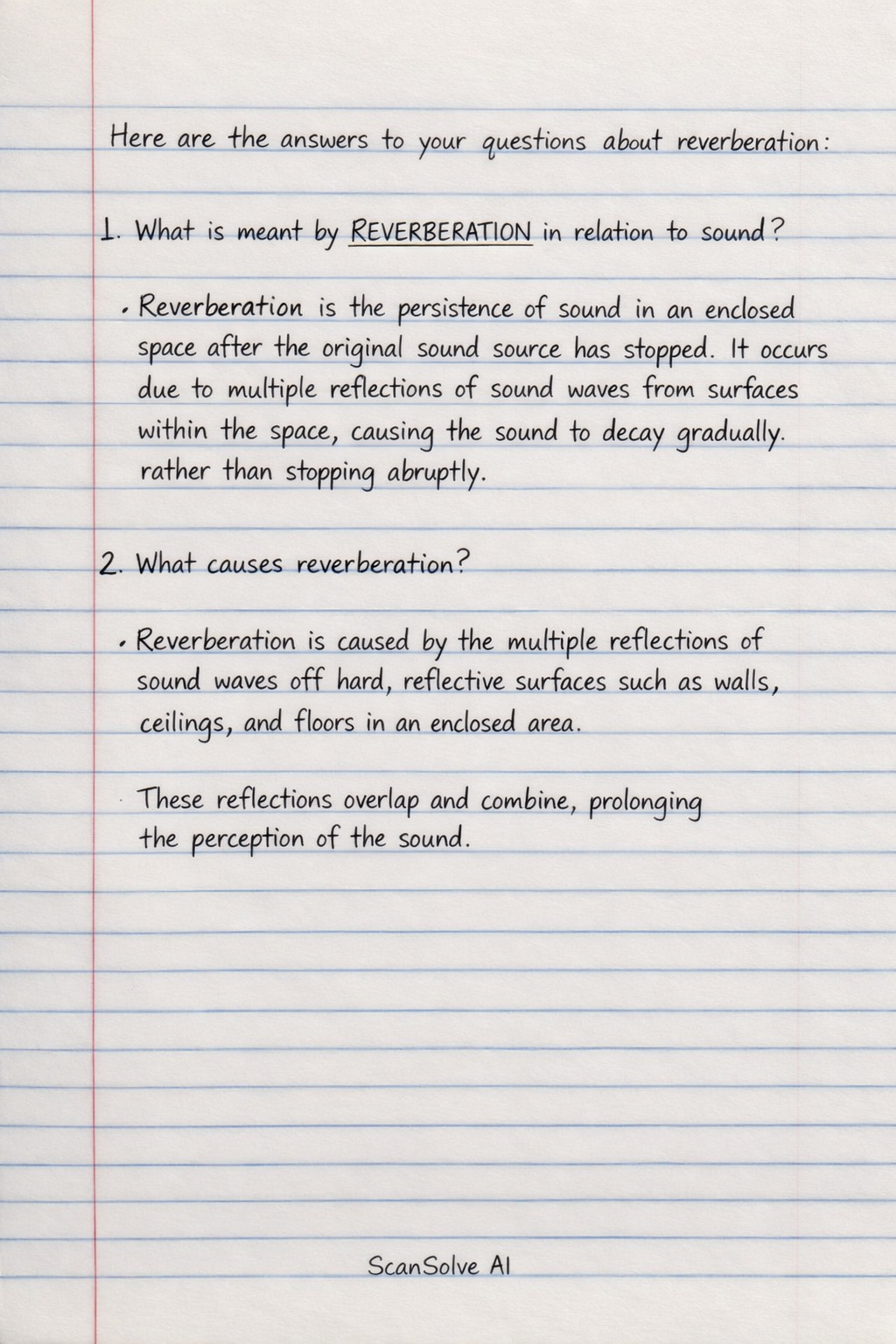
Here are the answers to your questions about reverberation: 1. What is meant by REVERBERATION in relation to sound? Reverberation* is the persistence of sound in an enclosed space after the original sound source has stopped. It occurs due to multiple reflections of sound waves from surfaces within the space, causing the sound to decay gradually rather than stopping abruptly. 2. What causes reverberation? Reverberation is caused by the multiple reflections* of sound waves off hard, reflective surfaces such as walls, ceilings, and floors in an enclosed area. These reflections overlap and combine, prolonging the perception of the sound. 3. State the advantages and disadvantages of Reverberation. Advantages: It adds richness and fullness* to music and speech, often desired in concert halls and theaters. It can make sound seem louder and more encompassing*, enhancing the listening experience for certain types of performances. Disadvantages: Excessive reverberation can make speech unclear and difficult to understand*, as words blend into each other. It can create a noisy and uncomfortable environment*, especially in large, empty rooms or classrooms, hindering communication. 4. How can Reverberation be minimized? Reverberation can be minimized by using sound-absorbing materials* on surfaces. Examples include: Acoustic panels* on walls and ceilings. Carpets and rugs* on floors. Heavy curtains* over windows. Upholstered furniture*. Additionally, designing rooms with irregular surfaces* can help scatter sound waves, reducing direct reflections and thus minimizing reverberation.