
We read your photo as:
Explain thermal expansion, apparent weight changes in a lift, and the Pressure Law with experimental details.
ScanSolve AI Answer
-
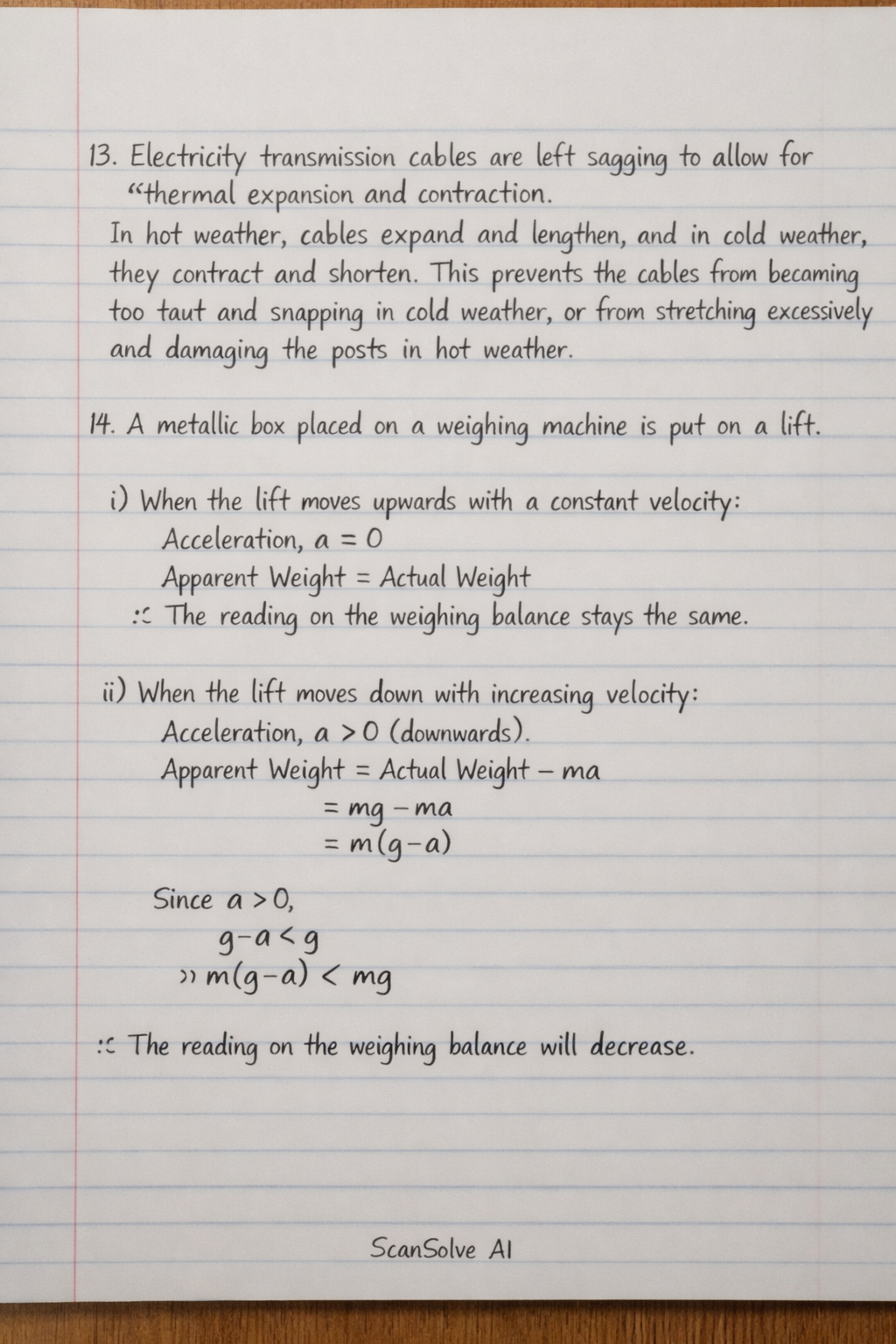
Electricity transmission cables are left sagging to allow for thermal expansion and contraction. During hot weather, the cables expand and lengthen, and during cold weather, they contract and shorten. Sagging prevents the cables from becoming too taut and snapping in cold weather, or from stretching excessively and damaging the posts in hot weather.
-
A metallic box placed on a weighing machine is put on a lift.
i) When the lift moves upwards with a constant velocity, the acceleration is zero. Therefore, the reading on the weighing balance will remain the same (equal to the actual weight of the box).
ii) When the lift moves down with an increasing velocity, the lift is accelerating downwards. The apparent weight will be less than the actual weight. Therefore, the reading on the weighing balance will decrease.
- a) Pressure Law (Gay-Lussac's Law) states that for a fixed mass of gas at constant volume, the pressure of the gas is directly proportional to its absolute temperature. Mathematically, or (where is in Kelvin).
b)
i) The measurements that should be taken in the experiment are:
- The temperature of the dry air inside the flask (read from the thermometer).
- The pressure of the dry air inside the flask (read from the pressure gauge).
ii) To verify pressure law, the following steps would be taken:
- Record several pairs of corresponding pressure and temperature readings as the water cools down (or heats up).
- Convert all temperature readings from Celsius to Kelvin ().
- Plot a graph of pressure (P) against absolute temperature (T). If the pressure law is verified, the graph should be a straight line passing through the origin, indicating that . Alternatively, calculate the ratio for each pair of readings; if the law holds, this ratio should be approximately constant.
Still stuck on this one?
Ask a follow-up, and the answer starts from this question.
More Physics Questions
Handwritten Step-by-Step Solution
Get this as a handwritten image on WhatsApp — like a tutor wrote it for you.
Try on WhatsApp