

This physics problem tests your understanding of fundamental physical laws and their applications. The step-by-step solution below breaks down the problem using relevant equations and physical reasoning.
ScanSolve AI Answer
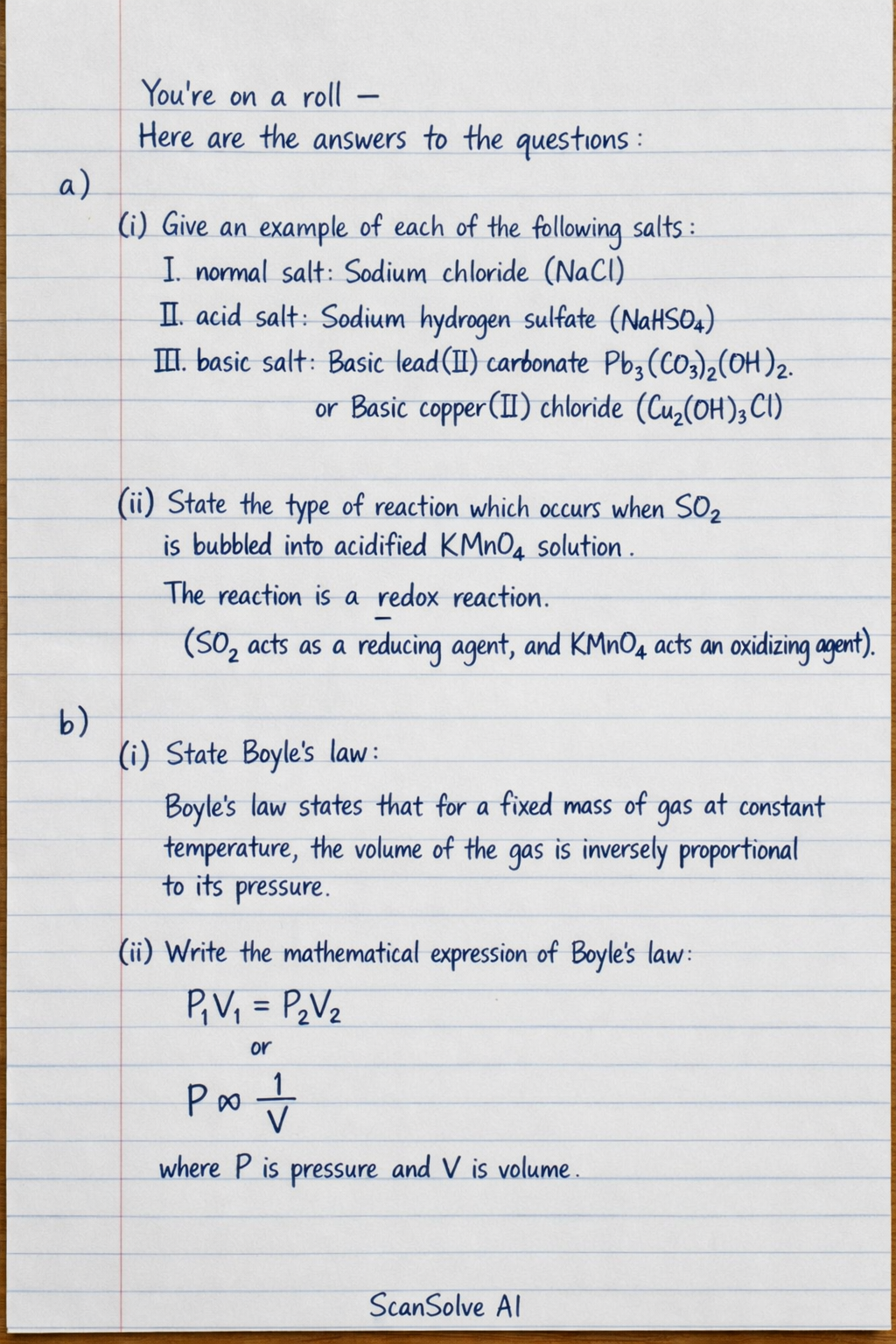
Here are the answers to the questions: a) (i) Give an example of each of the following salts: I. normal salt: Sodium chloride (NaCl) II. acid salt: Sodium hydrogen sulfate (NaHSO_4) III. basic salt: Basic lead(II) carbonate (Pb_3(CO_3)_2(OH)_2) or Basic copper(II) chloride (Cu_2(OH)_3Cl) (ii) State the type of reaction which occurs when SO_2 is bubbled into acidified KMnO_4 solution. The reaction is a redox reaction (specifically, SO_2 acts as a reducing agent, and KMnO_4 acts as an oxidizing agent). b) (i) State Boyle's law. Boyle's law states that for a fixed mass of gas at constant temperature, the volume of the gas is inversely proportional to its pressure. (ii) Write the mathematical expression of Boyle's law. P_1V_1 = P_2V_2 or P (1)/(V) where P is pressure and V is volume. (iii) Give two reasons why real gases deviate from ideal behaviour. 1. Real gas particles have finite volume, unlike ideal gas particles which are assumed to have negligible volume. 2. There are intermolecular forces of attraction between real gas particles, which are assumed to be absent in ideal gases. (iv) State three postulates of the kinetic theory of gases. 1. Gases consist of a large number of tiny particles (atoms or molecules) that are in constant, random motion. 2. The volume occupied by the gas particles themselves is negligible compared to the total volume of the container. 3. There are no attractive or repulsive forces between gas particles. 4. Collisions between gas particles and the container walls are perfectly elastic, meaning no kinetic energy is lost during collisions. 5. The average kinetic energy of the gas particles is directly proportional to the absolute temperature of the gas. d) Describe Rutherford's model of the atom. Rutherford's model, also known as the nuclear model, proposed that an atom consists of a dense, positively charged nucleus at its center. The nucleus contains most of the atom's mass. Negatively charged electrons orbit this nucleus in a much larger empty space, similar to planets orbiting the sun. The atom as a whole is electrically neutral because the number of positive charges in the nucleus equals the number of negative charges from the electrons. What's next?