
We read your photo as:
What are the key features, discoveries, and drawbacks of Rutherford's Atomic Model?
ScanSolve AI Answer
Here are the answers to .12:
-
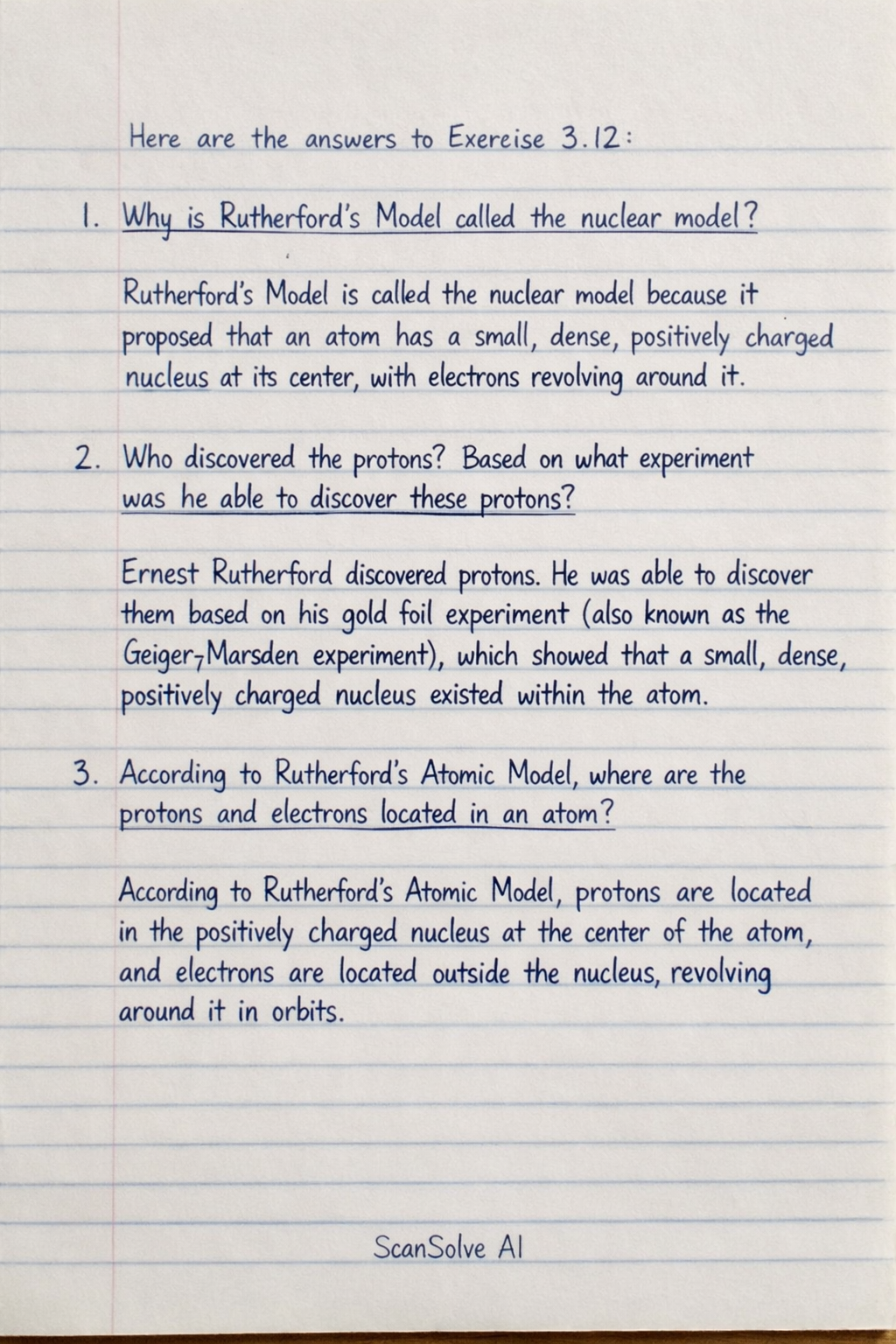
Why is Rutherford's Model called the nuclear model? Rutherford's Model is called the nuclear model because it proposed that an atom has a small, dense, positively charged nucleus at its center, with electrons revolving around it.
-
Who discovered the protons? Based on what experiment was he able to discover these protons? Ernest Rutherford discovered protons. He was able to discover them based on his gold foil experiment (also known as the Geiger-Marsden experiment), which showed that a small, dense, positively charged nucleus existed within the atom.
-
According to Rutherford's Atomic Model, where are the protons and electrons located in an atom? According to Rutherford's Atomic Model, protons are located in the positively charged nucleus at the center of the atom, and electrons are located outside the nucleus, revolving around it in orbits.
-
What are the drawbacks of Rutherford's Atomic Model? The drawbacks of Rutherford's Atomic Model are:
- It could not explain the stability of the atom. According to classical electrodynamics, an electron revolving in a circular orbit should continuously emit energy and spiral into the nucleus, causing the atom to collapse.
- It could not explain the atomic spectra, specifically the line spectra observed for elements.
-
Describe Rutherford's Atomic Model. Rutherford's Atomic Model proposed that an atom consists of a very small, dense, positively charged nucleus at its center, which contains most of the atom's mass. Negatively charged electrons revolve around this nucleus in circular orbits, similar to planets orbiting the sun. Most of the atom's volume is empty space.
-
If Rutherford's Atomic Model is correct, then the atom should collapse. Explain? If Rutherford's Atomic Model were correct, the atom should collapse because, according to the principles of classical electrodynamics, a charged particle (electron) moving in a circular orbit should continuously radiate energy. As the electron loses energy, its orbit would shrink, causing it to spiral inwards and eventually fall into the positively charged nucleus. This would lead to the collapse of the atom.
Still stuck on this one?
Ask a follow-up, and the answer starts from this question.
More Physics Questions
Handwritten Step-by-Step Solution
Get this as a handwritten image on WhatsApp — like a tutor wrote it for you.
Try on WhatsApp