
We read your photo as:
What are the key postulates and features of Bohr's Atomic Model, including electron orbits and energy levels?
Physics
ScanSolve AI Answer
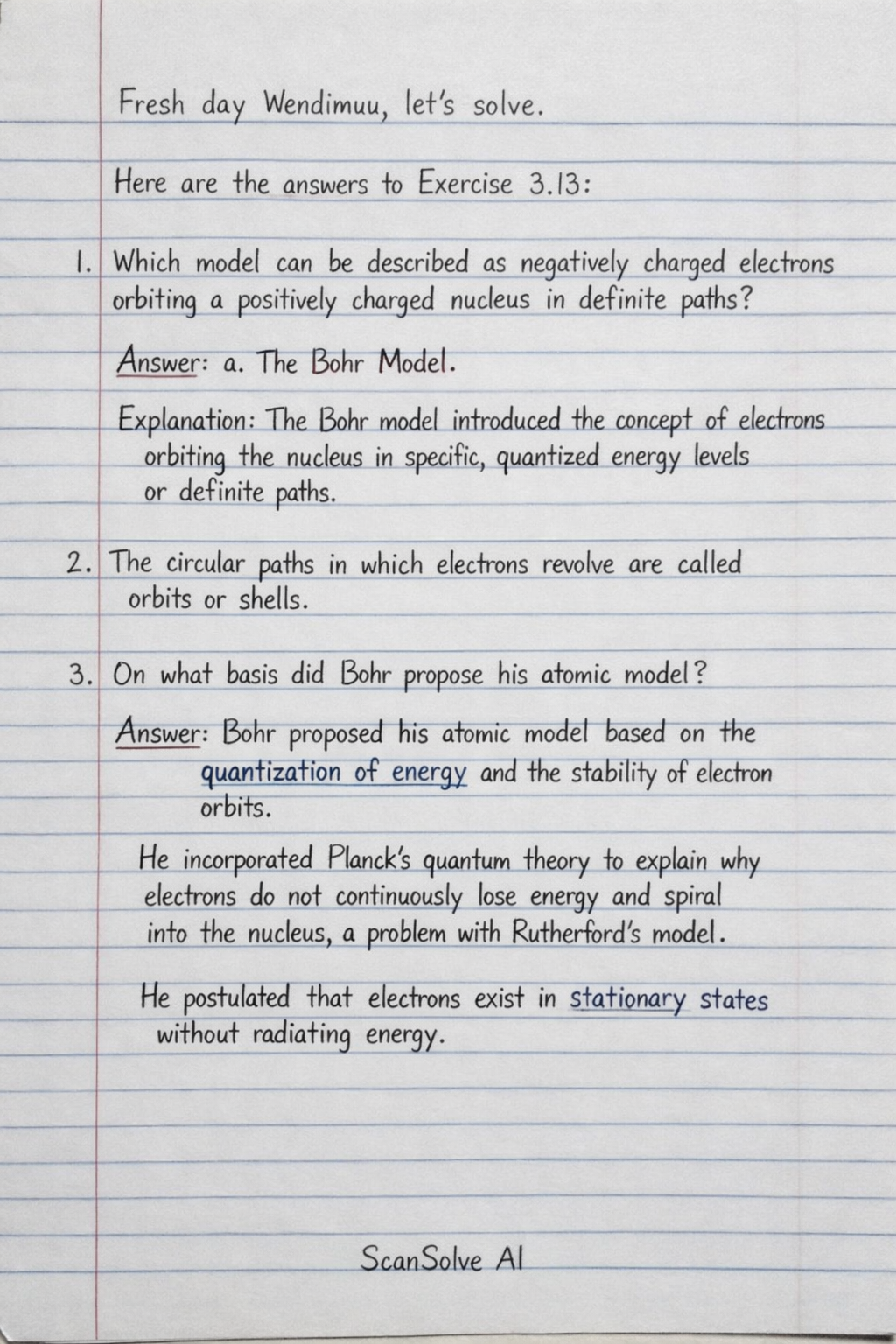
Here are the answers to .13:
-
Which model can be described as negatively charged electrons orbiting a positively charged nucleus in definite paths?
- Answer: a. The Bohr Model.
- Explanation: The Bohr model introduced the concept of electrons orbiting the nucleus in specific, quantized energy levels or definite paths.
-
The circular paths in which electrons revolve are called orbits or shells.
-
On what basis did Bohr propose his atomic model?
- Answer: Bohr proposed his atomic model based on the quantization of energy and the stability of electron orbits. He incorporated Planck's quantum theory to explain why electrons do not continuously lose energy and spiral into the nucleus, a problem with Rutherford's model. He postulated that electrons exist in stationary states without radiating energy.
-
What are the orbits and why are they called stationary orbits?
- Answer: The orbits (also known as electron shells or energy levels) are specific, fixed circular paths around the nucleus where electrons can reside. They are called stationary orbits because, according to Bohr's postulates, electrons in these orbits do not radiate energy. This means their energy remains constant as long as they stay in that orbit, preventing the atom from collapsing.
-
Explain Bohr's Atomic Model.
- Answer: Bohr's Atomic Model, proposed in 1913, describes the atom as a small, positively charged nucleus surrounded by electrons that travel in specific, fixed circular paths called orbits or shells. Key postulates include:
- Electrons can only exist in certain discrete orbits, each with a definite energy level.
- Electrons in these orbits do not radiate energy, hence they are called stationary orbits.
- Energy is absorbed when an electron jumps from a lower energy orbit to a higher one, and energy is emitted (as light) when an electron falls from a higher energy orbit to a lower one.
- The angular momentum of an electron in an orbit is quantized.
- Answer: Bohr's Atomic Model, proposed in 1913, describes the atom as a small, positively charged nucleus surrounded by electrons that travel in specific, fixed circular paths called orbits or shells. Key postulates include:
Was this helpful?
Still stuck on this one?
Ask a follow-up, and the answer starts from this question.
Got a different question?Ask your own question
More Physics Questions
QExplain the postulates and shortcomings of Bohr's atomic model.QUsing Bohr's model, derive expressions for the kinetic, potential, and total energy of an electron…QWhat are the successes and failures of the Bohr atomic model?QExplain Bohr's atomic model postulates and shortcomings. Calculate the longest wavelength in the…QWhat are the key features, discoveries, and drawbacks of Rutherford's Atomic Model?
Browse by topic:Quantum Physics
Handwritten Step-by-Step Solution
Get this as a handwritten image on WhatsApp — like a tutor wrote it for you.
Try on WhatsApp