
We read your photo as:
Explain Bohr's atomic model postulates and shortcomings. Calculate the longest wavelength in the Balmer series.
ScanSolve AI Answer
Answers
2 partsStep-by-step solution
6 stepsPart a(i)
Postulates of Bohr's atomic model
- Electrons revolve around the nucleus in specific circular orbits called stationary states without radiating energy.
- Electrons can only exist in orbits where their angular momentum is an integral multiple of , i.e., .
- Energy is absorbed when an electron jumps from a lower energy orbit to a higher energy orbit, and energy is emitted when it jumps from a higher energy orbit to a lower energy orbit. The energy difference is given by .
Part a(ii)
Shortcomings of Bohr's atomic model
- It could only explain the spectra of hydrogen and hydrogen-like ions (e.g., , ) but failed for multi-electron atoms.
- It could not explain the splitting of spectral lines into finer lines in the presence of a magnetic field (Zeeman effect) or an electric field (Stark effect).
- It did not account for the wave nature of electrons (de Broglie hypothesis) or the Heisenberg uncertainty principle.
Part b
Identify the series and transition for the longest wavelength.
For the Balmer series, the final energy level is .
For the longest wavelength (smallest energy difference), the electron transitions from the next highest energy level, which is .Use the Rydberg formula to calculate the wave number.
The Rydberg formula for the wave number () is:
where is the Rydberg constant.
Substitute the values and calculate.
The wave number of the longest wavelength transition in the Balmer series is
Part c(i)
Identify the given values.
Planck's constant,
Mass of neutron,
Speed of light,
Velocity of neutron,Apply the de Broglie wavelength formula.
The de Broglie wavelength () is given by:
Substitute the values and calculate.
The de Broglie wavelength for the neutron is
Part c(ii)
Water () is liquid at room temperature while hydrogen sulfide () is a gas, despite having a higher molecular weight. This is due to the presence of strong hydrogen bonding in . Oxygen is highly electronegative, leading to highly polar O-H bonds and allowing hydrogen atoms to form strong intermolecular hydrogen bonds. Sulfur is less electronegative than oxygen, so does not form hydrogen bonds. Instead, molecules are held together by weaker dipole-dipole interactions and London dispersion forces. The stronger hydrogen bonds in require more energy to overcome, resulting in a higher boiling point and thus being liquid at room temperature.
Try one yourself
A new problem that tests the same skill.
Still stuck on this one?
Ask a follow-up, and the answer starts from this question.
More Physics Questions
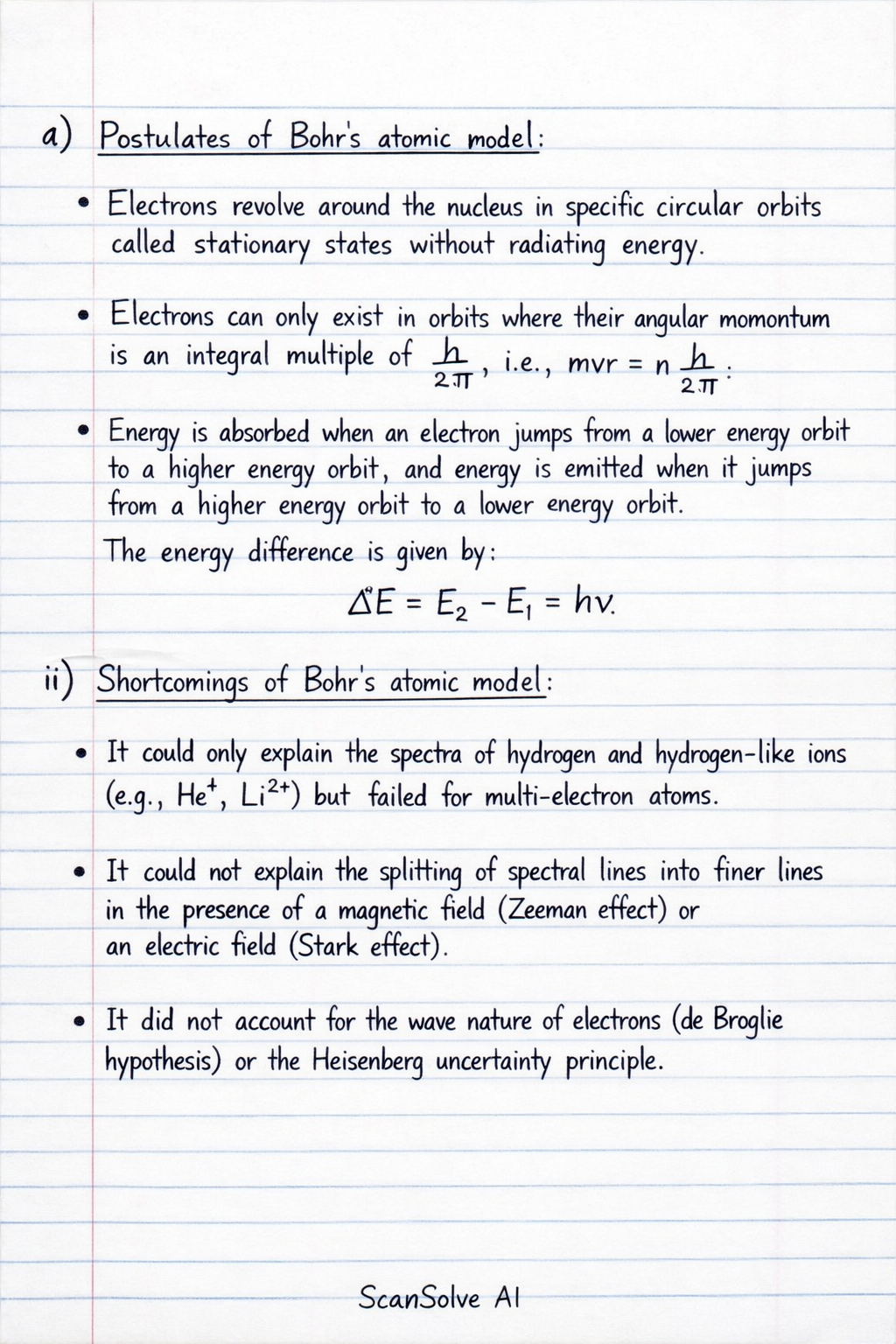
Handwritten Step-by-Step Solution
Get this as a handwritten image on WhatsApp — like a tutor wrote it for you.
Try on WhatsApp