
We read your photo as:
Using Bohr's model, derive expressions for the kinetic, potential, and total energy of an electron orbiting a nucleus.
ScanSolve AI Answer
Answers
3 partsStep-by-step solution
10 steps3.
Part c· 5 steps
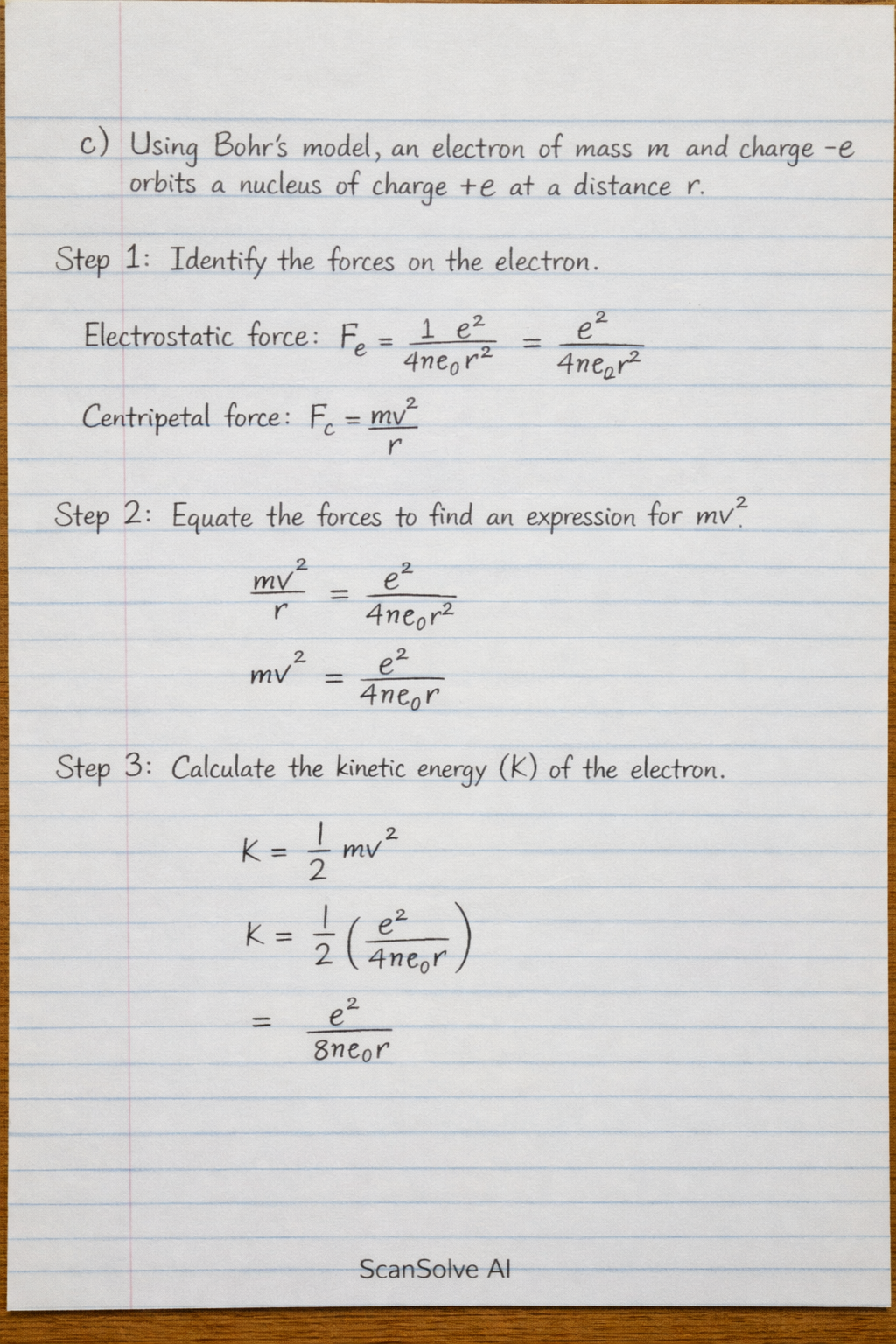
Using Bohr's model, an electron of mass and charge orbits a nucleus of charge at a distance .
Identify the forces acting on the electron.
The electrostatic force of attraction between the electron and the nucleus provides the centripetal force for the electron's circular motion.
Electrostatic force ():Centripetal force ():
Equate the forces to find an expression for .
Calculate the kinetic energy () of the electron.
Substitute the expression for :
Calculate the potential energy () of the electron.
The potential energy of an electron (charge ) in the electric field of a nucleus (charge ) at a distance is:
Calculate the total energy ().
The total energy is the sum of the kinetic and potential energies:
To combine these terms, find a common denominator:
Thus, the total energy of an electron in a hydrogen atom is .
Part d· 1 step
Given:
Energy of radiation,
Planck's constant,
Speed of light,
Conversion factor,
Convert the energy from electron volts (eV) to Joules (J).
Part d(i)
Calculate the wavelength () of the emitted radiation.
Use the formula relating energy, Planck's constant, speed of light, and wavelength
.
Rearrange to solve for :Substitute the values and calculate .
Rounding to two significant figures:
Part d(ii)
Calculate the momentum () of the photons.
Use the formula relating momentum, energy, and speed of light
.
Substitute the values and calculate .
Rounding to two significant figures:
Try one yourself
A new problem that tests the same skill.
Still stuck on this one?
Ask a follow-up, and the answer starts from this question.
More Physics Questions
Handwritten Step-by-Step Solution
Get this as a handwritten image on WhatsApp — like a tutor wrote it for you.
Try on WhatsApp