
We read your photo as:
What are the successes and failures of the Bohr atomic model?
Physics
ScanSolve AI Answer
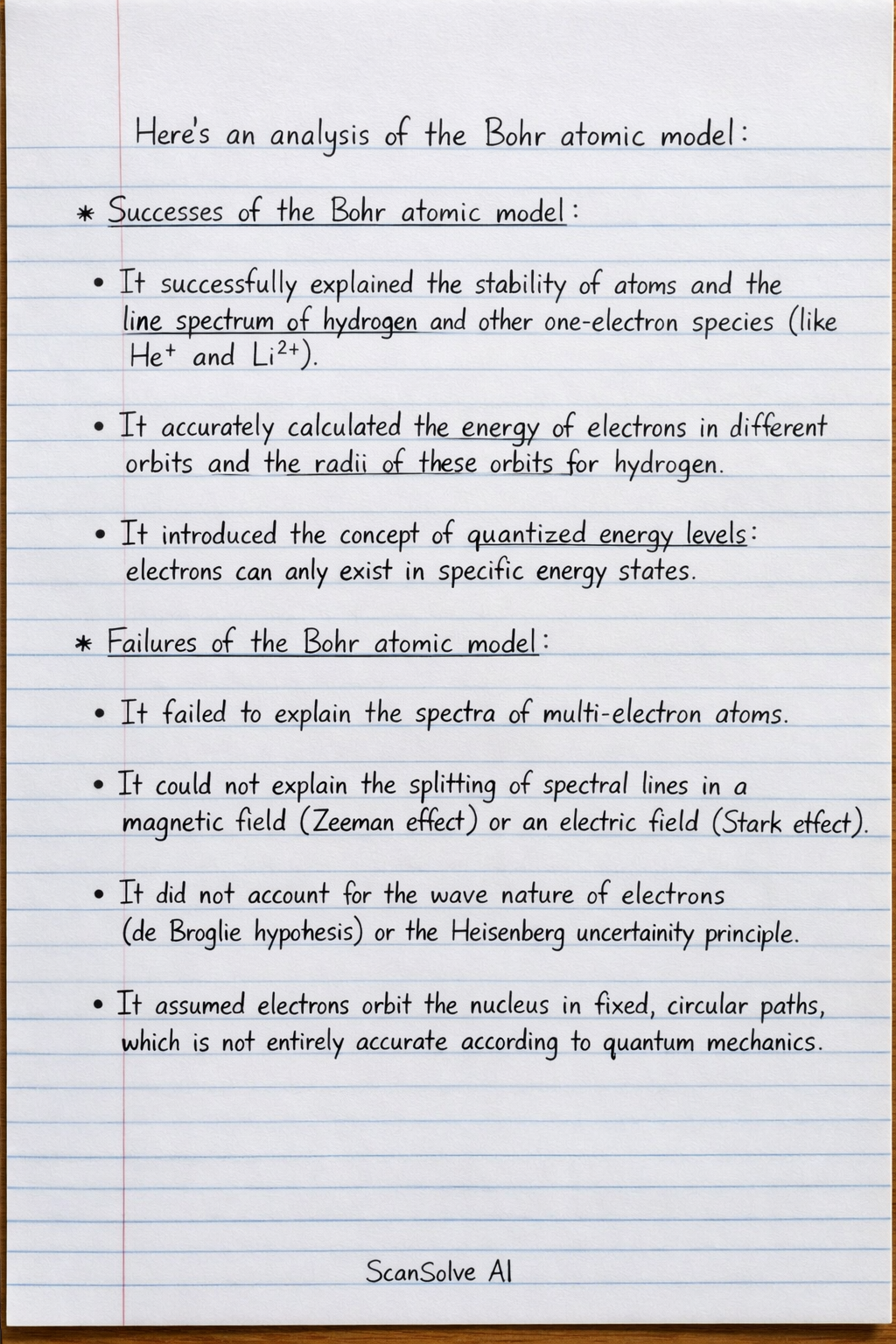
Here are the successes and failures of the Bohr atomic model:
-
Successes of the Bohr atomic model:
- It successfully explained the stability of atoms and the line spectrum of hydrogen and other one-electron species (like He and Li).
- It accurately calculated the energy of electrons in different orbits and the radii of these orbits for hydrogen.
- It introduced the concept of quantized energy levels, meaning electrons can only exist in specific energy states.
-
Failures of the Bohr atomic model:
- It failed to explain the spectra of multi-electron atoms.
- It could not explain the splitting of spectral lines in the presence of a magnetic field (Zeeman effect) or an electric field (Stark effect).
- It did not account for the wave nature of electrons (de Broglie hypothesis) or the Heisenberg uncertainty principle.
- It assumed electrons orbit the nucleus in fixed, circular paths, which is not entirely accurate according to quantum mechanics.
Was this helpful?
Still stuck on this one?
Ask a follow-up, and the answer starts from this question.
Got a different question?Ask your own question
More Physics Questions
QExplain the postulates and shortcomings of Bohr's atomic model.QWhat are the key postulates and features of Bohr's Atomic Model, including electron orbits and…QExplain Bohr's atomic model postulates and shortcomings. Calculate the longest wavelength in the…QWhat are the key features, discoveries, and drawbacks of Rutherford's Atomic Model?QUsing Bohr's model, derive expressions for the kinetic, potential, and total energy of an electron…
Browse by topic:Quantum Physics
Handwritten Step-by-Step Solution
Get this as a handwritten image on WhatsApp — like a tutor wrote it for you.
Try on WhatsApp