

This physics problem tests your understanding of fundamental physical laws and their applications. The step-by-step solution below breaks down the problem using relevant equations and physical reasoning.
ScanSolve AI Answer
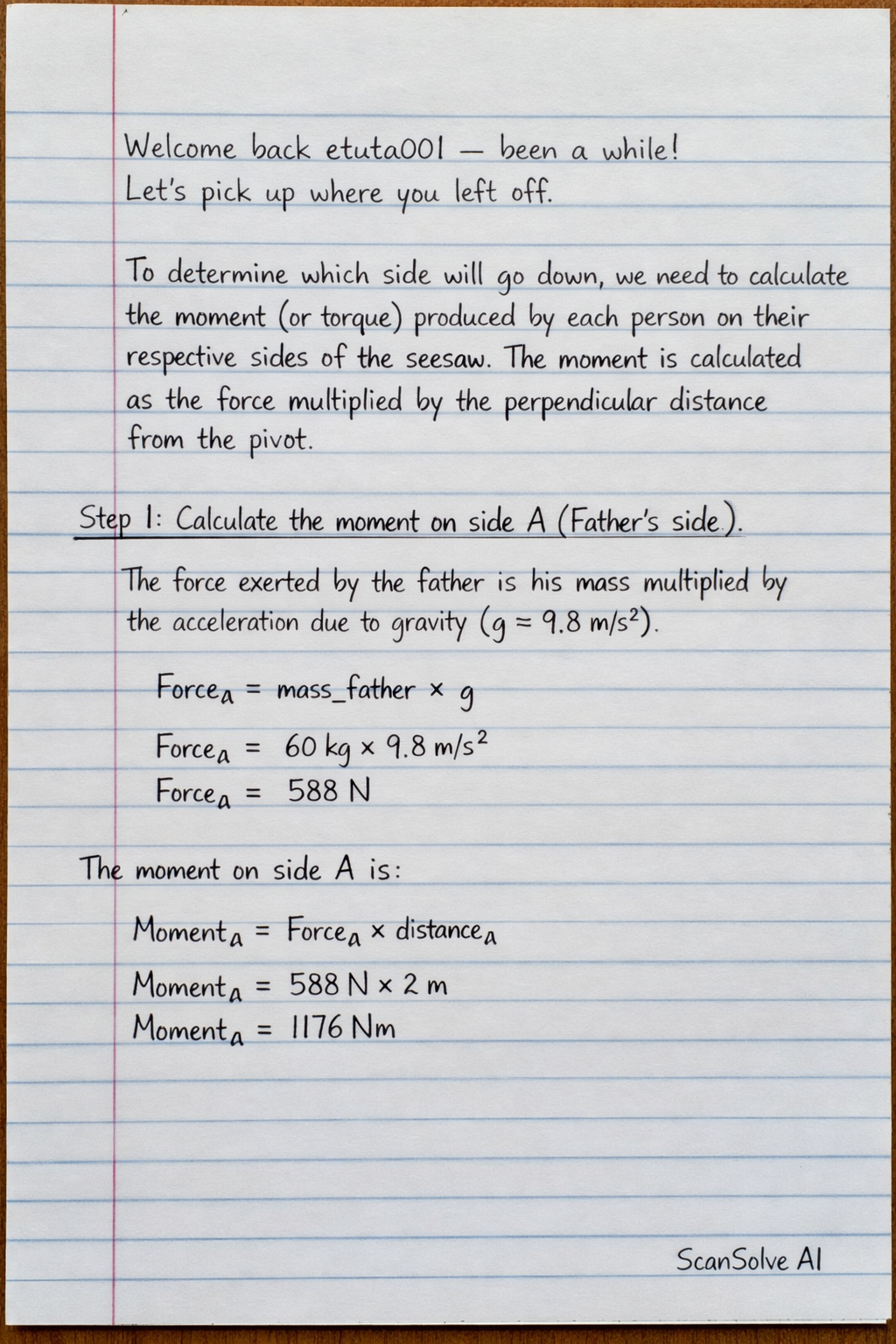
To determine which side will go down, we need to calculate the moment (or torque) produced by each person on their respective sides of the seesaw. The moment is calculated as the force multiplied by the perpendicular distance from the pivot. Step 1: Calculate the moment on side A (Father's side). The force exerted by the father is his mass multiplied by the acceleration due to gravity (g ≈ 9.8 \, m/s^2). Force_A = mass_father × g = 60 \, kg × 9.8 \, m/s^2 = 588 \, N The moment on side A is: Moment_A = Force_A × distance_A = 588 \, N × 2 \, m = 1176 \, Nm Step 2: Calculate the moment on side B (Daughter's side). The force exerted by the daughter is her mass multiplied by the acceleration due to gravity. Force_B = mass_daughter × g = 25 \, kg × 9.8 \, m/s^2 = 245 \, N The moment on side B is: Moment_B = Force_B × distance_B = 245 \, N × 5 \, m = 1225 \, Nm Step 3: Compare the moments. Moment_A = 1176 \, Nm Moment_B = 1225 \, Nm Since Moment_B > Moment_A, the side with the greater moment will go down. The side that will go down is: Side B Send me the next one 📸