
We read your photo as:
What is Simple Harmonic Motion, motion of a simple pendulum, and Sound Intensity Level?
ScanSolve AI Answer
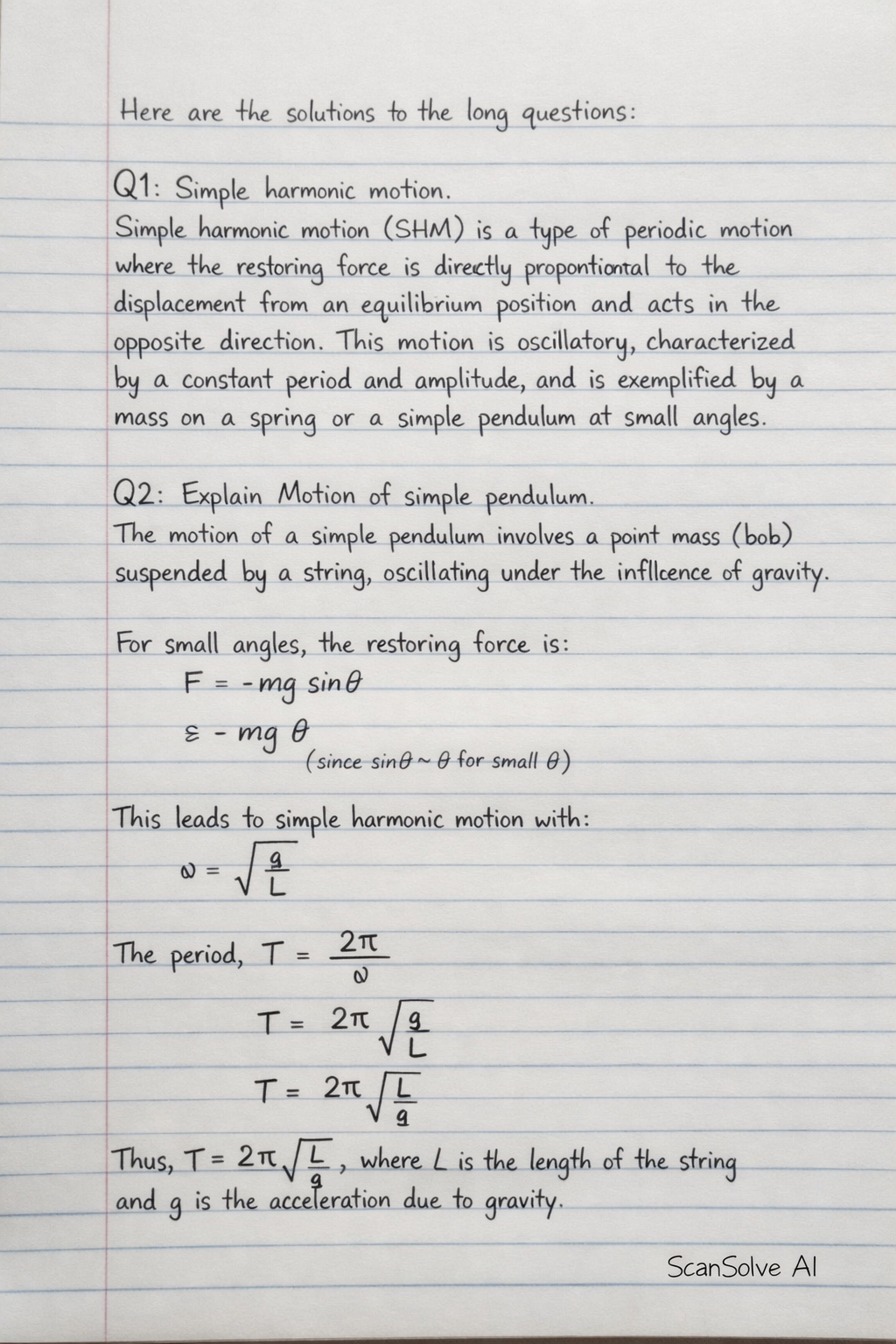
Here are the solutions to the long questions:
Q:1 Simple harmonic motion.
Simple harmonic motion (SHM) is a type of periodic motion where the restoring force is directly proportional to the displacement from an equilibrium position and acts in the opposite direction. This motion is oscillatory, characterized by a constant period and amplitude, and is exemplified by a mass on a spring or a simple pendulum at small angles.
Q:2 Explain Motion of simple pendulum.
The motion of a simple pendulum involves a point mass (bob) suspended by a string, oscillating under the influence of gravity. For small angular displacements, the restoring force component is approximately proportional to the displacement, causing the pendulum to exhibit simple harmonic motion. Its period of oscillation depends on the length of the string and the acceleration due to gravity.
Q:3 What is Sound Intensity Level and Explain it.
Sound intensity level is a logarithmic measure of the sound intensity relative to a reference intensity, typically the threshold of human hearing. It is measured in decibels (dB). This logarithmic scale is used because the human ear perceives sound intensity over a vast range. The formula is , where is the sound intensity and is the reference intensity ().
Q:4 Explain characteristics of sound.
The main characteristics of sound are pitch, loudness, and quality (timbre). Pitch is determined by the frequency of the sound wave, with higher frequencies producing higher pitches. Loudness is determined by the amplitude of the sound wave, relating to its intensity. Quality or timbre allows us to distinguish between different sound sources producing the same pitch and loudness, due to the presence and relative intensities of overtones.
Q:5 Define Reflection of light and explain it.
Reflection of light is the phenomenon where light rays bounce off a surface when they strike it, changing their direction but remaining in the same medium. It obeys two laws: the angle of incidence equals the angle of reflection, and the incident ray, the reflected ray, and the normal to the surface all lie in the same plane. Reflection can be specular (from smooth surfaces) or diffuse (from rough surfaces).
Q:6 Explain the Attached to mass of spring for simple harmonic motion.
When a mass is attached to a spring and displaced from its equilibrium position, the spring exerts a restoring force proportional to the displacement, as described by Hooke's Law (). This force always acts towards the equilibrium position. If damping forces are negligible, the mass will oscillate back and forth, undergoing simple harmonic motion, with a period determined by the mass and the spring constant.
Q:7 Define lens and describe its types.
A lens is a transparent optical device that focuses or disperses light rays by means of refraction. Lenses are typically made of glass or plastic and have at least one curved surface. The two main types are convex lenses (converging lenses), which are thicker in the middle and converge parallel light rays to a focal point, and concave lenses (diverging lenses), which are thinner in the middle and diverge parallel light rays.
Q:8 What is meant by series combination of resistors? Write down its three characteristics.
Series combination of resistors means connecting resistors end-to-end so that the same current flows through each resistor sequentially.
Characteristics:
- The total resistance is the sum of individual resistances ().
- The current is the same through each resistor.
- The potential difference across the combination is the sum of the potential differences across individual resistors ().
Q:9 Discuss the main features of parallel & Series combination of resistors.
Series Combination of Resistors:
- Resistors are connected end-to-end, providing a single path for current.
- The current is the same through all resistors.
- The total resistance is the sum of individual resistances ().
- The voltage divides across each resistor. Parallel Combination of Resistors:
- Resistors are connected across the same two points, providing multiple paths for current.
- The voltage is the same across all resistors.
- The reciprocal of the total resistance is the sum of the reciprocals of individual resistances ().
- The current divides among the branches.
Q:10 Define specific resistance and prove that R=pL/A.
Specific resistance, also known as resistivity (), is an intrinsic property of a material that quantifies how strongly it resists the flow of electric current. It is defined as the resistance of a conductor of unit length and unit cross-sectional area.
Proof for :
The resistance () of a conductor is directly proportional to its length () and inversely proportional to its cross-sectional area ().
Combining these proportionalities:
Introducing a constant of proportionality, which is the specific resistance or resistivity ():
where is resistance in ohms (), is resistivity in ohm-meters (), is length in meters (), and is cross-sectional area in square meters ().
**Q:11 Define Spherical
Still stuck on this one?
Ask a follow-up, and the answer starts from this question.
More Physics Questions
Handwritten Step-by-Step Solution
Get this as a handwritten image on WhatsApp — like a tutor wrote it for you.
Try on WhatsApp