
We read your photo as:
Sixty complete waves pass a particular point in 4s. If the distance between three successive troughs of the waves is 15cm, calculate the speed of the waves. The period of a wave is 0.02 seconds. Calcu
ScanSolve AI Answer
Step-by-step solution
6 stepsHere are the solutions to the problems:
:
Sixty complete waves pass a particular point in 4s. If the distance between three successive troughs of the waves is 15cm, calculate the speed of the waves.
Calculate the frequency ().
Frequency is the number of waves per unit time.
Calculate the wavelength ().
The distance between three successive troughs corresponds to two complete wavelengths.
Convert wavelength to meters:
Calculate the speed of the waves ().
The speed of a wave is given by the product of its frequency and wavelength.
The speed of the waves is .
:
The period of a wave is 0.02 seconds. Calculate its wavelength if its speed is 330m/s.Use the wave speed formula relating speed, wavelength, and period.
The speed of a wave () is its wavelength () divided by its period ().
Rearrange to solve for wavelength:
Substitute the given values:
The wavelength is .
:
A stationary wave in a spring is fixed at both ends. If the frequency of the wave is 256Hz and the distance N1N2 equals to 1.5m, calculate the speed of the wave.Determine the wavelength ().
In a stationary wave, the distance between two successive nodes (N1N2) is half a wavelength ().
Calculate the speed of the wave ().
The speed of a wave is the product of its frequency and wavelength.
The speed of the wave is .
Still stuck on this one?
Ask a follow-up, and the answer starts from this question.
More Physics Questions
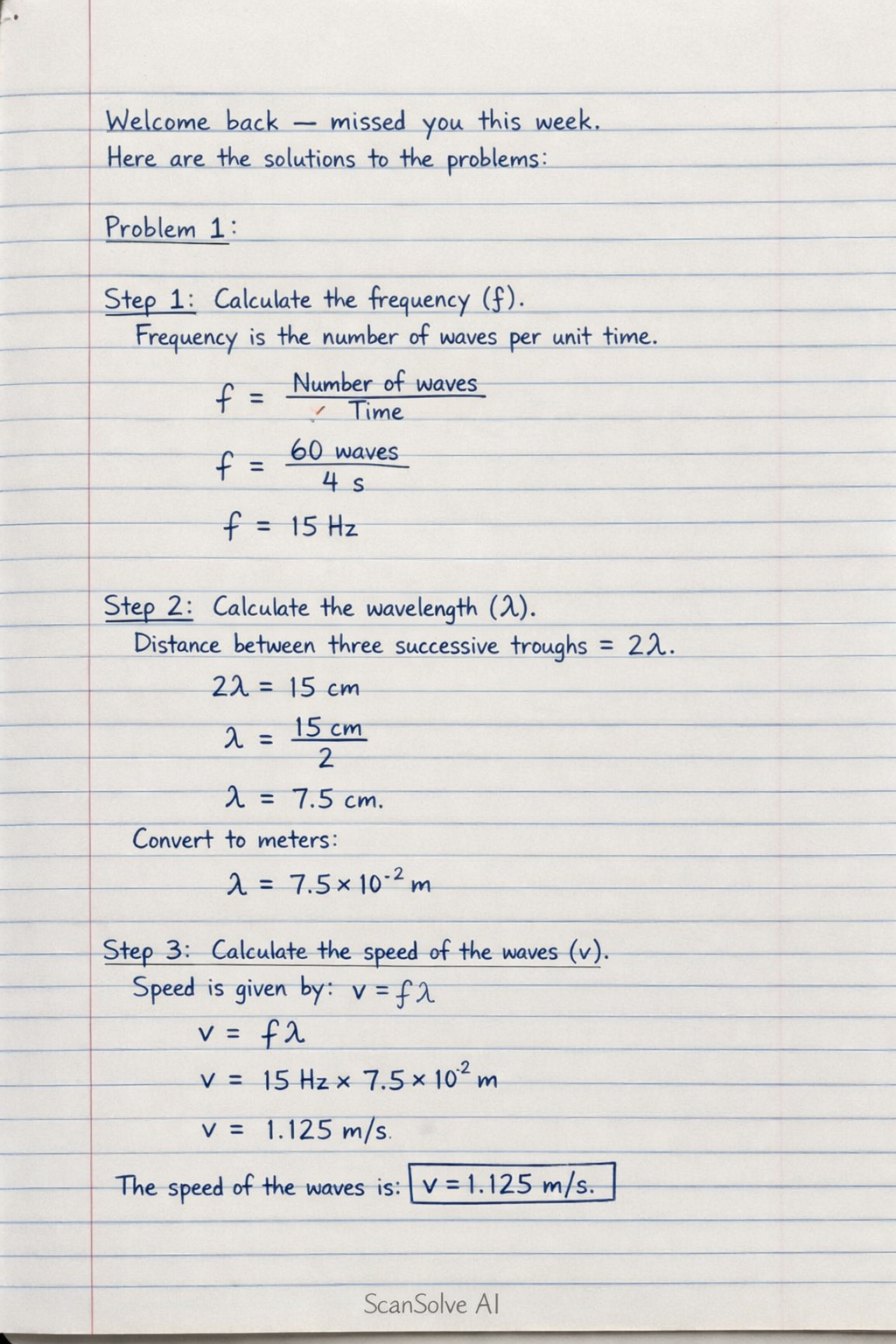
Handwritten Step-by-Step Solution
Get this as a handwritten image on WhatsApp — like a tutor wrote it for you.
Try on WhatsApp