
We read your photo as:
Define specific latent heat of vaporization. Explain why water's specific latent heat of vaporization is much larger than its specific heat capacity. Identify the thermometric property of a mercury th
ScanSolve AI Answer
Answer
Step-by-step solution
3 stepsPart a
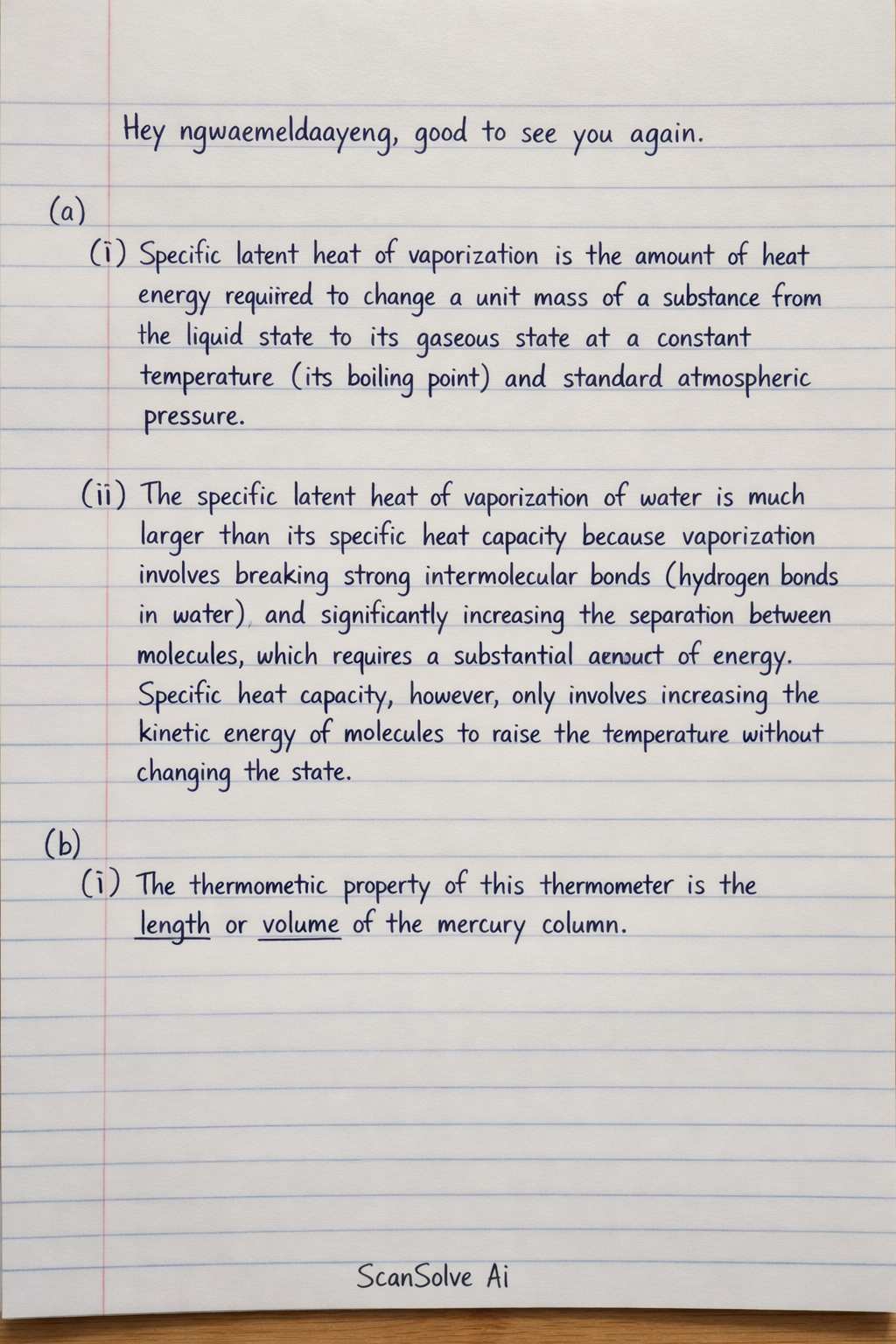
i) Specific latent heat of vaporization is the amount of heat energy required to change a unit mass of a substance from its liquid state to its gaseous state at a constant temperature (its boiling point) and standard atmospheric pressure.
ii) The specific latent heat of vaporization of water is much larger than its specific heat capacity because vaporization involves breaking strong intermolecular bonds (hydrogen bonds in water) and significantly increasing the separation between molecules, which requires a substantial amount of energy. Specific heat capacity, however, only involves increasing the kinetic energy of molecules to raise the temperature without changing the state.
Part b(i)
The thermometric property of this thermometer is the length or volume of the mercury column.
Part b(ii)
Identify the given lengths and corresponding temperatures.
The length of the mercury column at (melting ice) is .
The length of the mercury column at (boiling water) is .
The length of the mercury column at the unknown temperature is .Use the formula for temperature on a linear scale.
Substitute the values and calculate the unknown temperature.
The unknown temperature is .
Try one yourself
A new problem that tests the same skill.
Still stuck on this one?
Ask a follow-up, and the answer starts from this question.
More Physics Questions
Handwritten Step-by-Step Solution
Get this as a handwritten image on WhatsApp — like a tutor wrote it for you.
Try on WhatsApp