
We read your photo as:
Which statement correctly defines Newton's second law of motion and relates gravitational acceleration on two planets?
ScanSolve AI Answer
Answer
Step-by-step solution
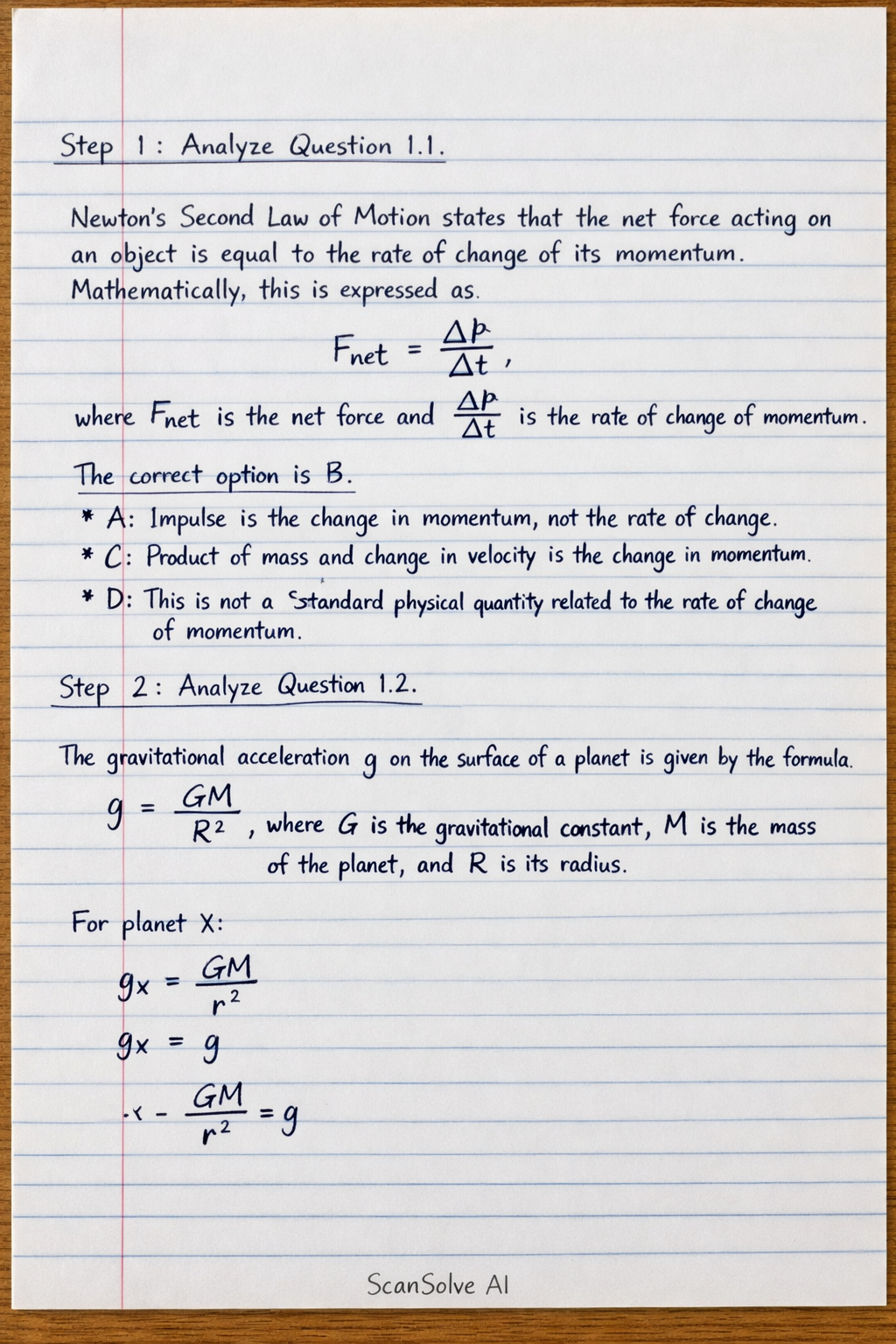
3 stepsAnalyze Question 1.1.
Newton's Second Law of Motion states that the net force acting on an object is equal to the rate of change of its momentum. Mathematically, this is expressed as , where is the net force and is the rate of change of momentum.
The correct option is B.
- A: Impulse is the change in momentum, not the rate of change.
- C: Product of mass and change in velocity is the change in momentum.
- D: This is not a standard physical quantity related to the rate of change of momentum.
Analyze Question 1.2.
The gravitational acceleration on the surface of a planet is given by the formula , where is the gravitational constant, is the mass of the planet, and is its radius.
For planet X:
For planet Y, the mass is and the radius is . Let be the gravitational acceleration on planet Y.
Since , we have:
The correct option is D.
Analyze Question 1.3.
The graph shows a physical quantity that remains constant over time () for an object in free fall, ignoring air friction.
- A: Velocity changes linearly with time due to constant gravitational acceleration ().
- B: Position changes quadratically with time ().
- C: Weight is the force of gravity on an object, . Since both mass () and gravitational acceleration () are constant in free fall (ignoring air friction and altitude changes), the weight remains constant.
- D: Momentum is . Since velocity changes, momentum also changes.
The only quantity that remains constant is weight.
The correct option is C.
- 1.1: The rate of change of momentum of an object is equal to the B net force acting on the object.
- 1.2: The gravitational acceleration on the surface of planet Y is D .
- 1.3: The physical quantity that can be the label on the y-axis is C Weight.
Try one yourself
A new problem that tests the same skill.
Still stuck on this one?
Ask a follow-up, and the answer starts from this question.
More Physics Questions
Handwritten Step-by-Step Solution
Get this as a handwritten image on WhatsApp — like a tutor wrote it for you.
Try on WhatsApp