
We read your photo as:
Study the given table. a. If equal mass of these objects are heated to the same temperature and exposed in air, which one cools the fastest and why?
ScanSolve AI Answer
Answer
Step-by-step solution
6 stepsHere are the solutions to question 20:
20. Study the given table
| Substance | Specific heat capacity |
|---|---|
| A | |
| B | |
| C |
Part a· 3 steps
If equal mass of these objects are heated to the same temperature and exposed in air, which one cools the fastest and why?
Understand specific heat capacity.
Specific heat capacity is the amount of heat energy required to raise the temperature of 1 kg of a substance by . A substance with a lower specific heat capacity requires less energy to change its temperature.
Compare the specific heat capacities.
Substance C has the lowest specific heat capacity () compared to Substance B () and Substance A ().
Determine which cools fastest.
A substance with a lower specific heat capacity will lose heat energy more quickly for a given temperature drop when exposed to cooler surroundings. Therefore, it will cool down faster.
- Answer: Substance C cools the fastest.
- Reason: Substance C has the lowest specific heat capacity. This means it stores less heat energy per unit mass per degree Celsius change in temperature, and thus loses its stored heat more rapidly to the surroundings, leading to faster cooling.
Part b
If the temperature of substance A of 20 kg mass is increased by , how much heat energy is to be supplied?
Identify the given values.
- Mass of substance A () =
- Change in temperature () =
- Specific heat capacity of substance A () = (from the table)
Use the formula for heat energy.
The amount of heat energy () supplied is given by the formula:
Substitute the values and calculate.
- Answer: The heat energy to be supplied is (or ).
Try one yourself
A new problem that tests the same skill.
Still stuck on this one?
Ask a follow-up, and the answer starts from this question.
More Physics Questions
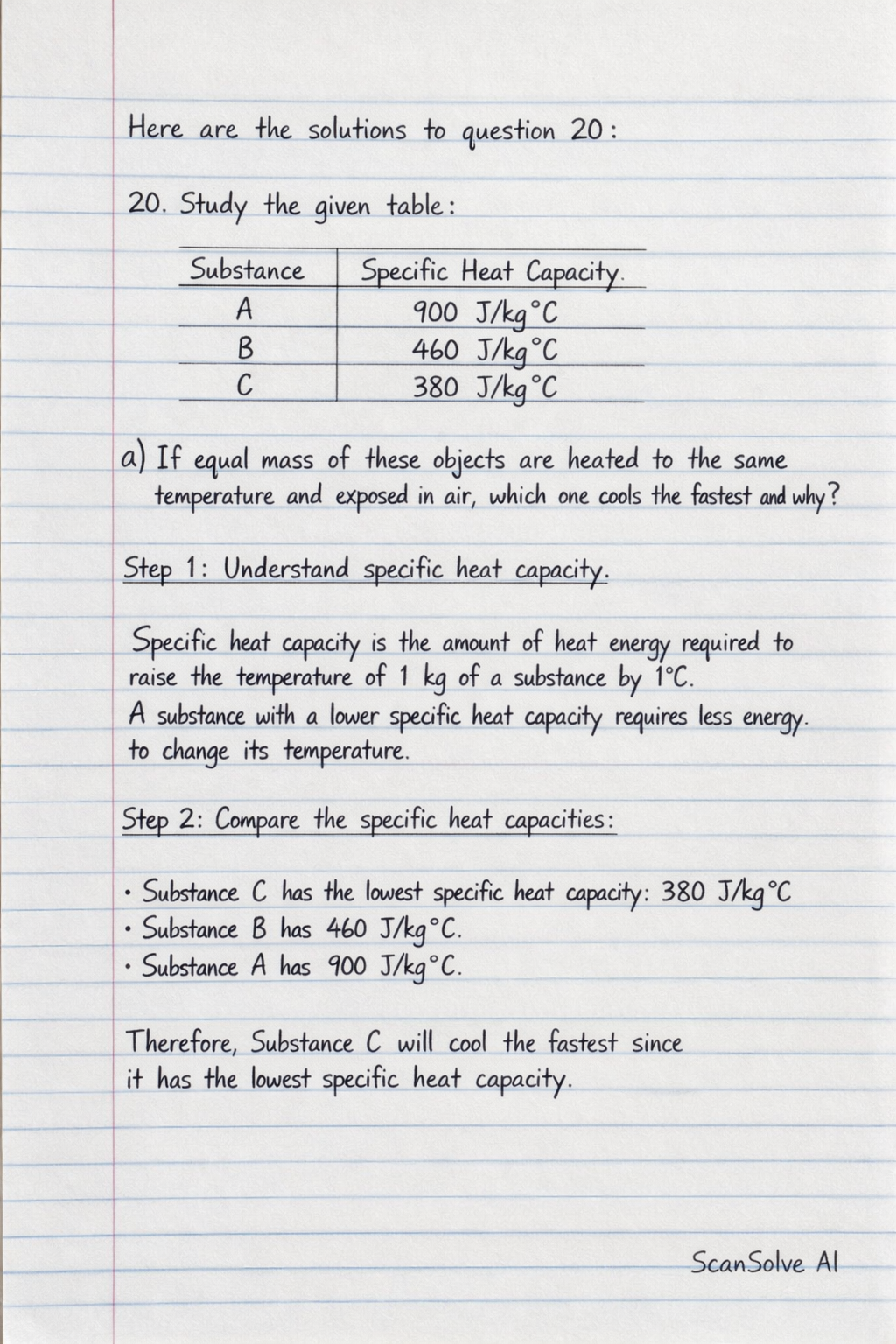
Handwritten Step-by-Step Solution
Get this as a handwritten image on WhatsApp — like a tutor wrote it for you.
Try on WhatsApp