
We read your photo as:
Explain the terms potential difference and electromotive force, and why the emf of a cell is greater than the p.d. across it when supplying current.
ScanSolve AI Answer
Step-by-step solution
2 stepsb)
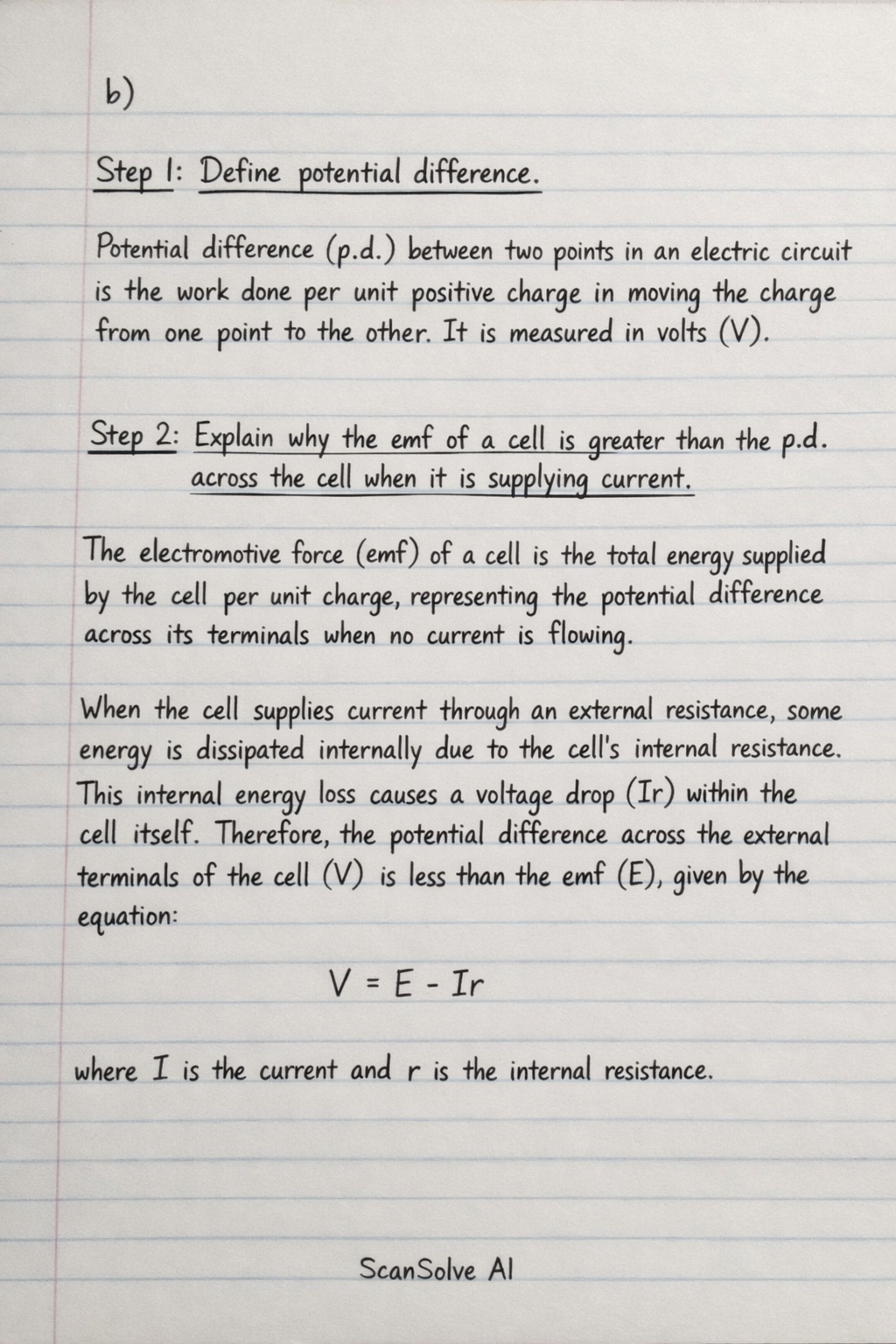
Define potential difference.
Potential difference (p.d.) between two points in an electric circuit is the work done per unit positive charge in moving the charge from one point to the other. It is measured in volts (V).
Explain why the emf of a cell is greater than the p.d.
across the cell when it is supplying current.
The electromotive force (emf) of a cell is the total energy supplied by the cell per unit charge, representing the potential difference across its terminals when no current is flowing. When the cell supplies current through an external resistance, some energy is dissipated internally due to the cell's internal resistance. This internal energy loss causes a voltage drop () within the cell itself. Therefore, the potential difference across the external terminals of the cell () is less than the emf (), given by the equation:where is the current and is the internal resistance.
Still stuck on this one?
Ask a follow-up, and the answer starts from this question.
More Physics Questions
Handwritten Step-by-Step Solution
Get this as a handwritten image on WhatsApp — like a tutor wrote it for you.
Try on WhatsApp