
Current Electricity Topics: (i) electromagnetic force (emf), potential difference (p.d.), current, internal resistance of a cell and lost Volt (ii) Ohm's law (iii) measurement of resistance (iv) meter bridge (v) resistance in series and in parallel and their combination (vi) the potentiometer method of measuring emf, current and internal resistance of a cell. (v) electrical networks
ScanSolve AI Answer
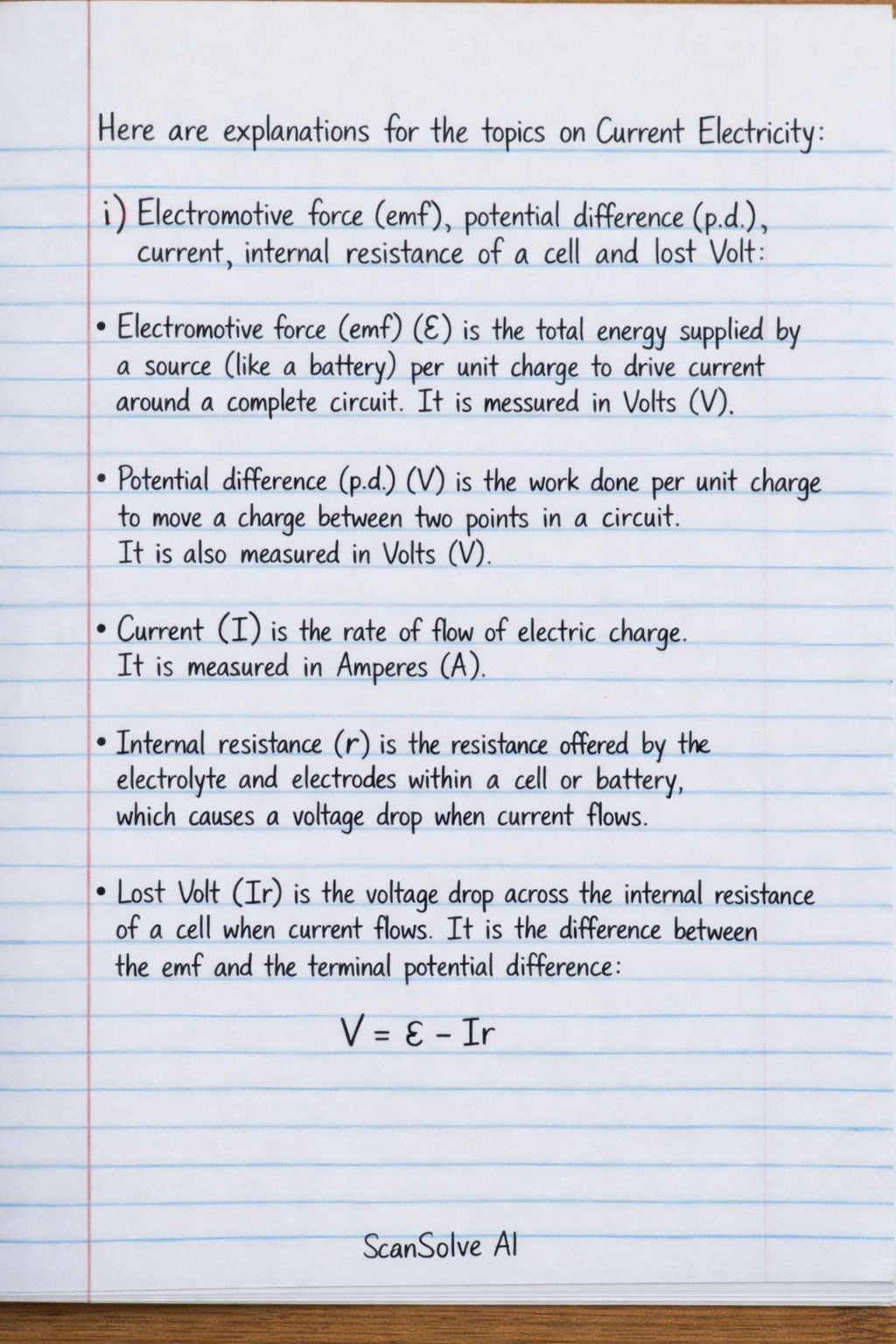
Here are explanations for the topics on Current Electricity:
-
i) Electromagnetic force (emf), potential difference (p.d.), current, internal resistance of a cell and lost Volt:
- Electromotive force (emf) () is the total energy supplied by a source (like a battery) per unit charge to drive current around a complete circuit. It is measured in Volts (V).
- Potential difference (p.d.) () is the work done per unit charge to move a charge between two points in a circuit. It is also measured in Volts (V).
- Current () is the rate of flow of electric charge. It is measured in Amperes (A).
- Internal resistance () is the resistance offered by the electrolyte and electrodes within a cell or battery, which causes a voltage drop when current flows.
- Lost Volt () is the voltage drop across the internal resistance of a cell when current flows. It is the difference between the emf and the terminal potential difference ().
-
ii) Ohm's law: Ohm's law states that the current () flowing through a conductor between two points is directly proportional to the potential difference () across the two points, provided the temperature and other physical conditions remain constant. The relationship is given by:
where is the resistance of the conductor.
-
iii) Measurement of resistance: Resistance can be measured using an ammeter (to measure current) and a voltmeter (to measure potential difference) in conjunction with Ohm's law (). Alternatively, a multimeter can directly measure resistance.
-
iv) Meter bridge: A meter bridge (or slide-wire bridge) is a device used to measure an unknown electrical resistance. It works on the principle of the Wheatstone bridge, where a balance point is found along a uniform resistance wire, allowing the unknown resistance to be calculated using the ratio of lengths.
-
v) Resistance in series and in parallel and their combination:
- When resistors are connected in series, the total resistance () is the sum of individual resistances:
- When resistors are connected in parallel, the reciprocal of the total resistance () is the sum of the reciprocals of individual resistances:
- Combinations involve circuits with both series and parallel arrangements, which are simplified step-by-step using these formulas.
-
vi) The potentiometer method of measuring emf, current and internal resistance of a cell: A potentiometer is a device used to measure emf, potential difference, and internal resistance accurately without drawing any current from the source being measured at the point of balance.
- To measure emf, the unknown cell's emf is balanced against the potential drop across a certain length of the potentiometer wire, which is then compared to a standard cell's emf.
- To measure internal resistance, the cell's emf is first balanced, then a known external resistance is connected, and the terminal potential difference is balanced. The internal resistance can then be calculated from the two balance lengths and the external resistance.
-
vii) Electrical networks: Electrical networks refer to complex circuits consisting of multiple components like resistors, capacitors, inductors, and voltage/current sources, interconnected in various ways. Analyzing these networks often involves applying Kirchhoff's laws (Kirchhoff's current law and Kirchhoff's voltage law) to determine unknown currents and voltages within the circuit.
Still stuck on this one?
Ask a follow-up, and the answer starts from this question.
More Physics Questions
Handwritten Step-by-Step Solution
Get this as a handwritten image on WhatsApp — like a tutor wrote it for you.
Try on WhatsApp