
We read your photo as:
Show that the potential energy gained by a body of mass m lifted vertically through a height h is E = mgh. Calculate the height to which a 350 kg ball must be raised to deliver 10 kJ of energy.
ScanSolve AI Answer
Answer
Step-by-step solution
3 stepsAnswer Question 15 (a).
To show that the potential energy gained by a body of mass lifted vertically through a height is :
When a body is lifted, work is done against the force of gravity.
The force of gravity (weight) acting on the body is given by:Where is the mass of the body and is the gravitational field strength.
The work done () in lifting the body through a vertical height is the product of the force and the distance moved in the direction of the force:Substituting the force :
This work done against gravity is stored in the body as gravitational potential energy ().
Therefore, the potential energy gained by the body is:This completes the derivation.
Answer Question 15 (b) i.
Given:
Mass of the ball
Energy to be delivered
Gravitational field strengthThe energy delivered to the wall comes from the gravitational potential energy of the ball.
To find the height :
The ball must be raised to a height of .
Answer Question 15 (b) ii.
Assuming the ball does not lose any energy to the surroundings, the potential energy at its maximum height is converted entirely into kinetic energy at the moment of impact.
The kinetic energy () at impact is equal to the energy delivered:The formula for kinetic energy is:
Where is the velocity at impact.
The velocity at the moment of impact is .
Try one yourself
A new problem that tests the same skill.
Still stuck on this one?
Ask a follow-up, and the answer starts from this question.
More Physics Questions
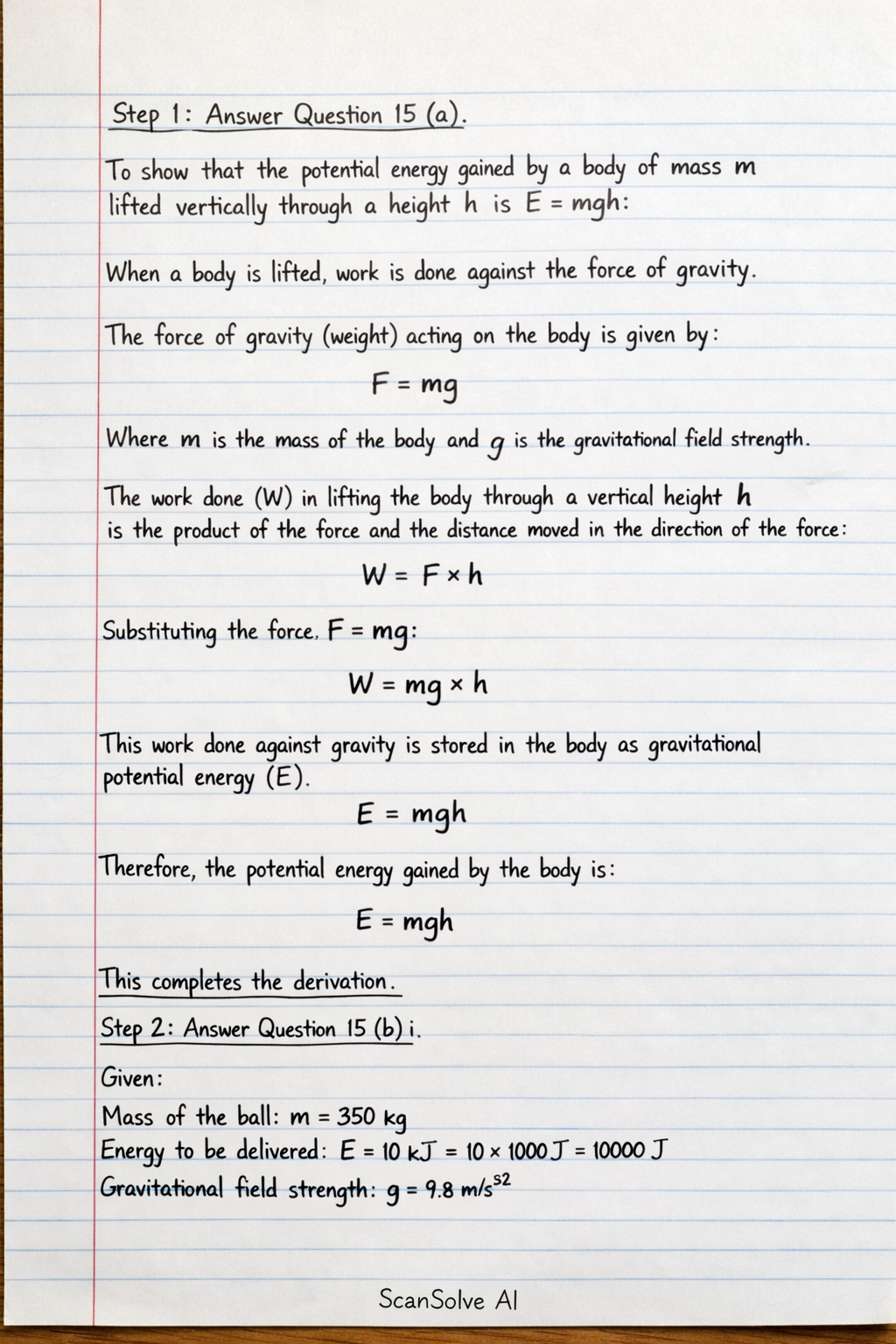
Handwritten Step-by-Step Solution
Get this as a handwritten image on WhatsApp — like a tutor wrote it for you.
Try on WhatsApp