
We read your photo as:
What are the answers to the following questions about units of length, types of motion, and transportation?
Physics
ScanSolve AI Answer
Here are the solutions to the exercise questions:
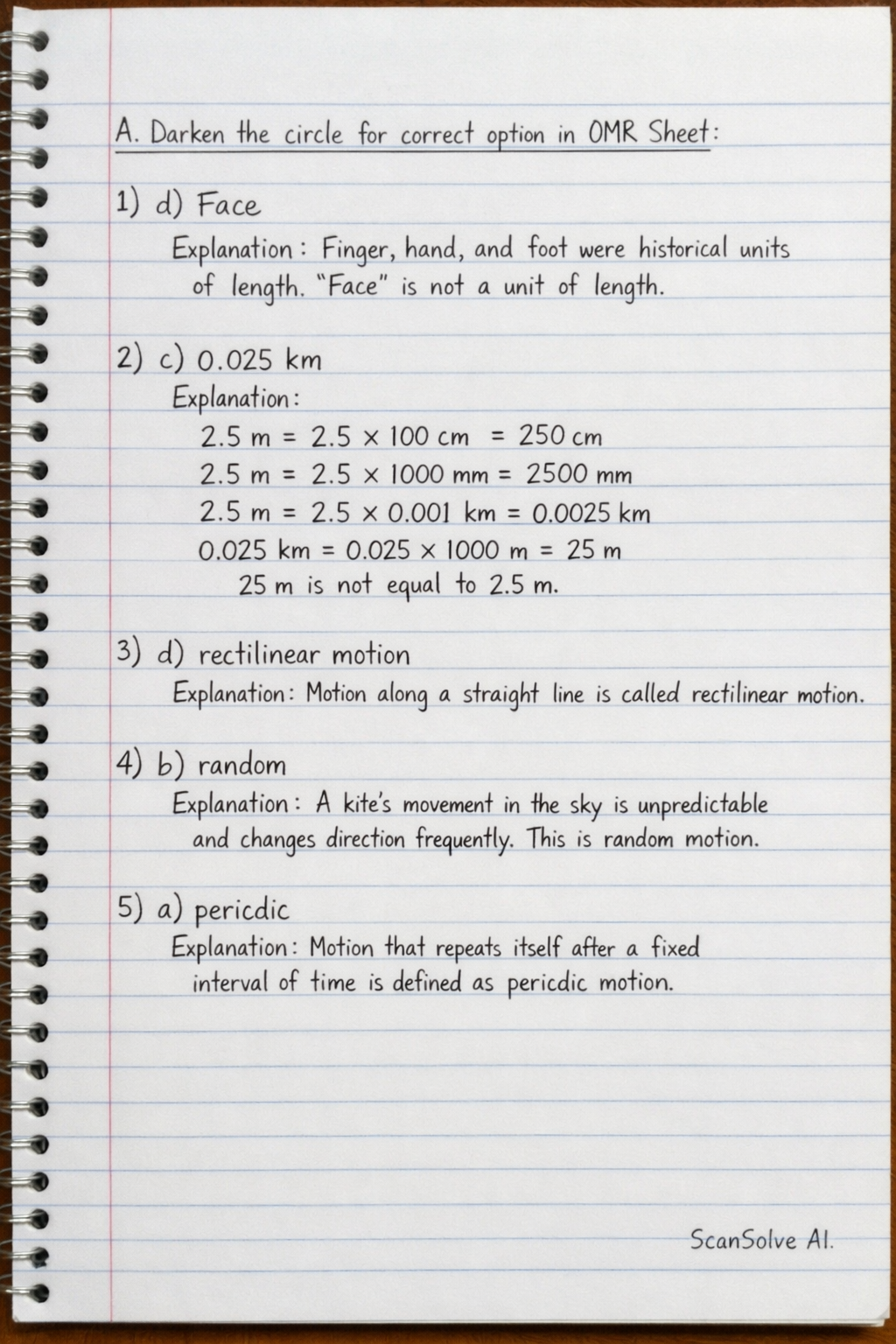
A. Darken the circle for correct option in OMR Sheet:
- d) Face
- Explanation: Finger, hand, and foot were historical units of length, though not standardized. "Face" is not a unit of length.
- c)
- Explanation:
- , which is not equal to .
- Explanation:
- d) rectilinear motion
- Explanation: Motion along a straight line is called rectilinear motion.
- b) random
- Explanation: A kite's movement in the sky is unpredictable and changes direction frequently, which is characteristic of random motion.
- a) periodic
- Explanation: Motion that repeats itself after a fixed interval of time is defined as periodic motion.
B. Fill in the blanks:
- The early people used modes of transport to help them move from one place to another.
- The invention of the wheel proved to be a revolution in our means of transportation.
- One metre is equal to 1000 millimetre.
- Rest and motion are relative terms.
- When you push a box on the floor, it undergoes translatory motion.
C. Write 'T' for True and 'F' for False statements:
- When you travel by a train or a car, the person sitting next to you is at rest with respect to you. T
Was this helpful?
Still stuck on this one?
Ask a follow-up, and the answer starts from this question.
Got a different question?Ask your own question
More Physics Questions
QWhat are the answers to the following questions about industrialization and transportation?QWhat are the answers to these physics multiple-choice questions on mechanics?QWhat are the solutions to these multiple-choice questions about physics?QWhat are the answers to these basic measurement questions in mathematics?QAssertion-Reason questions on distance, displacement, rest, and motion.
Browse by topic:Mechanics
Handwritten Step-by-Step Solution
Get this as a handwritten image on WhatsApp — like a tutor wrote it for you.
Try on WhatsApp