

This physics problem tests your understanding of fundamental physical laws and their applications. The step-by-step solution below breaks down the problem using relevant equations and physical reasoning.
ScanSolve AI Answer
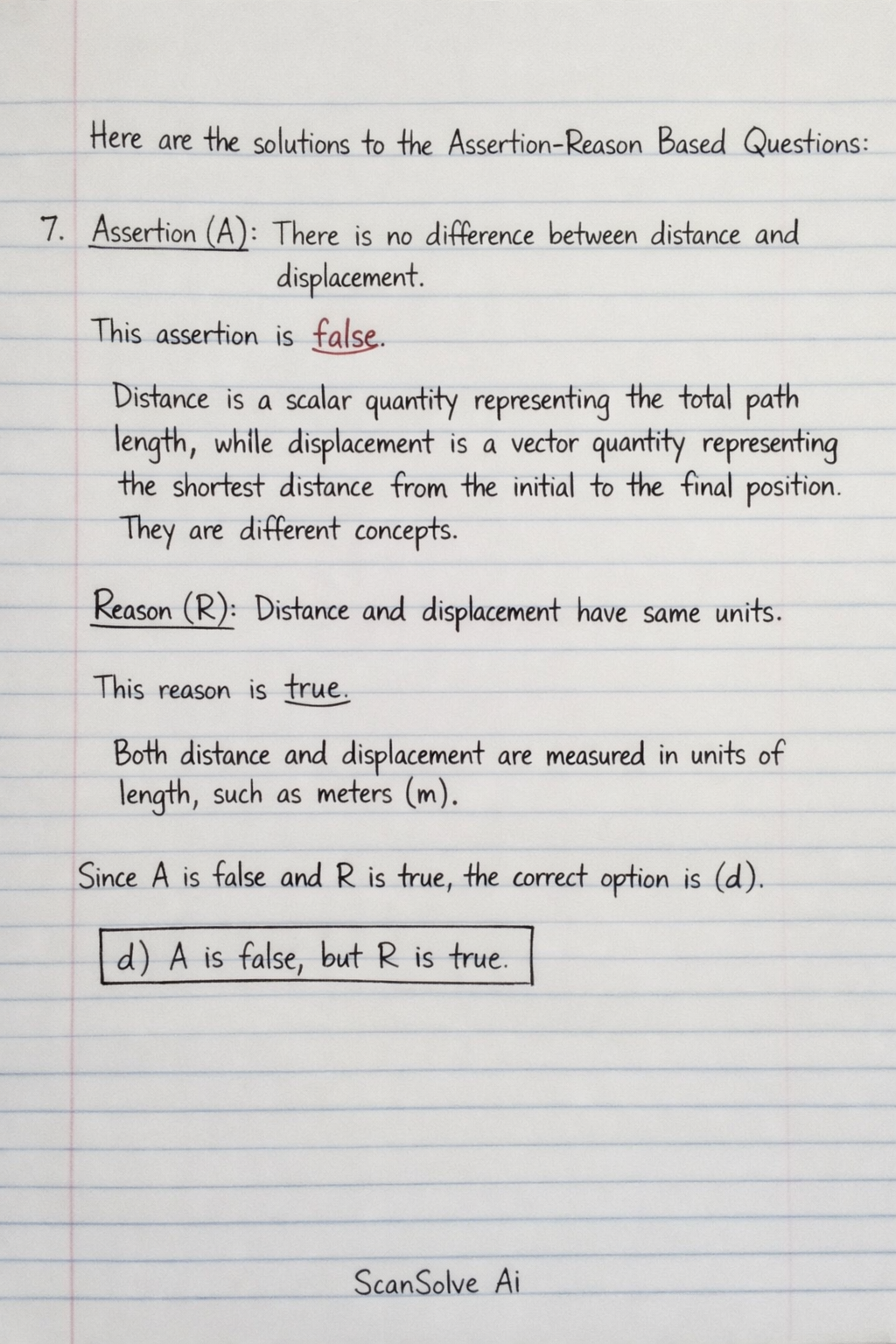
Here are the solutions to the Assertion-Reason Based Questions: 7. Assertion (A): There is no difference between distance and displacement. This assertion is false*. Distance is a scalar quantity representing the total path length, while displacement is a vector quantity representing the shortest distance from the initial to the final position. They are different concepts. Reason (R): Distance and displacement have same units. This reason is true*. Both distance and displacement are measured in units of length, such as meters (m). Since A is false and R is true, the correct option is (d). d) A is false, but R is true. 8. Assertion (A): When final position of a body coincides with its initial position, the body is at rest. This assertion is false*. If a body's final position coincides with its initial position, its displacement is zero. However, the body could have moved along a path and returned to its starting point (e.g., completing a lap on a track), meaning it was in motion and not at rest. Reason (R): This is because distance is scalar and displacement is vector. This reason is true*. Distance is a scalar quantity (magnitude only), and displacement is a vector quantity (magnitude and direction). Since A is false and R is true, the correct option is (d). d) A is false, but R is true. 9. Assertion (A): Uniform circular motion is also called accelerated motion. This assertion is true*. In uniform circular motion, the speed of the body is constant, but its direction of motion continuously changes. Since velocity is a vector quantity (having both magnitude and direction), a change in direction means a change in velocity. Any change in velocity implies acceleration (specifically, centripetal acceleration directed towards the center of the circle). Reason (R): Direction of motion changes at every point. So velocity is not constant. This reason is true*. As explained above, the continuous change in the direction of motion means the velocity vector is not constant, even if the speed is constant. Since both A and R are true, and R correctly explains why uniform circular motion is accelerated motion, the correct option is (a). a) Both A and R are true and R is correct explanation of A 10. Assertion (A): The slope of distance time graph gives acceleration of the body. This assertion is false. The slope of a distance-time graph represents the speed* of the body, not its acceleration. Acceleration is given by the slope of a velocity-time graph. Reason (R): Greater the slope of distance time graph, more is the speed of the body. This reason is true*. A steeper slope on a distance-time graph indicates that the distance covered per unit time is greater, which means the body is moving at a higher speed. Since A is false and R is true, the correct option is (d). d) A is false, but R is true. 3 done, 2 left today. You're making progress.