
We read your photo as:
The calculations the mass of the metre rule using the formula above. (b) Using the data from the table in fig. 3.3, calculate d and d, when the position of the mass is 20 cm. (c) Using the values of d, and d, from (b) calculate the force of the metre rule.
ScanSolve AI Answer
Due to the poor image quality and missing "Fig. 3.1" table, the following assumptions are made for parts (a), (b), and (c):
- The pivot position () is 40 cm.
- The mass of the object () is 100 g.
- The definition of X2, "X2 = (200 - position of the pivot)", contains a typo. It is assumed that "200" should be "50" (representing the center of mass of a 100 cm metre rule), making .
- The formula in part (a) is "mass = X1 / (X2 + X3) * mass_of_object". It is assumed that X3 = 0, so the formula used is .
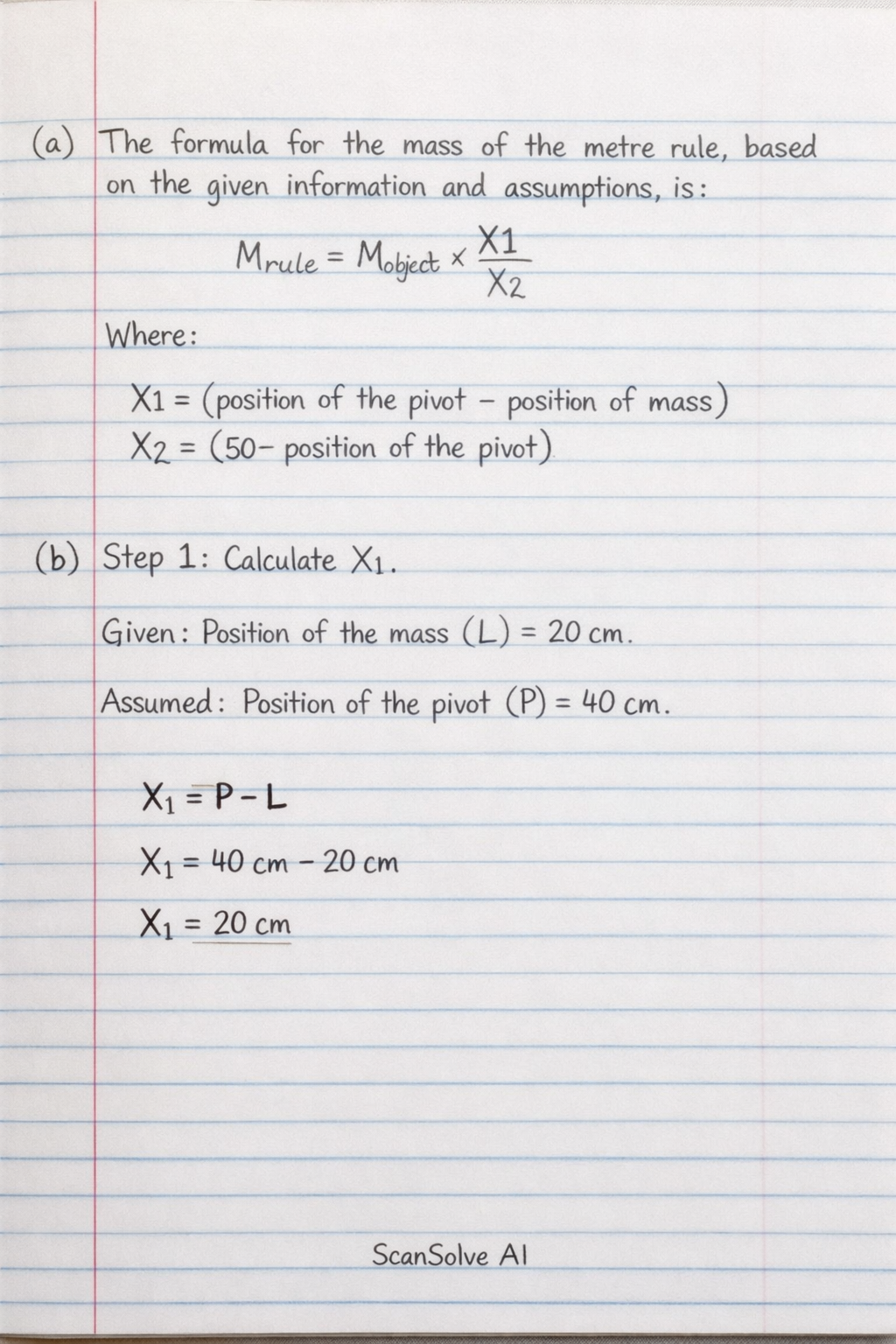
a) The formula for the mass of the metre rule, based on the given information and assumptions, is:
Where:
b) Step 1: Calculate X1.
Given: Position of the mass () = 20 cm.
Assumed: Position of the pivot () = 40 cm.
Step 2: Calculate X2.
Assumed: Position of the pivot () = 40 cm.
b) ,
c) Step 3: Calculate the mass of the metre rule.
Using the formula .
Assumed: g.
Calculated: cm, cm.
c) The mass of the metre rule is .
d) Step 4: Explain the importance of using all values.
Using multiple readings (all values) and calculating an average helps to minimize the impact of random errors and inaccuracies in individual measurements. This leads to a more reliable and accurate determination of the metre rule's mass.
e) Step 5: Describe how to find the mass of a small stone.
- Balance the metre rule at its center of mass (50 cm mark) on a pivot.
- Place the small stone at a known position on one side of the pivot.
- Place a known standard mass on the other side of the pivot and adjust its position until the rule balances horizontally.
- Measure the distance of the stone from the pivot () and the distance of the known mass from the pivot ().
- Apply the principle of moments: .
- Calculate the mass of the stone ().
Still stuck on this one?
Ask a follow-up, and the answer starts from this question.
More Physics Questions
Handwritten Step-by-Step Solution
Get this as a handwritten image on WhatsApp — like a tutor wrote it for you.
Try on WhatsApp