
We read your photo as:
What is the definition of the angle between two vectors, and how are direction cosines related to the angles a vector makes with the coordinate axes?
ScanSolve AI Answer
Answers
3 partsStep-by-step solution
6 stepsHere are the solutions to the questions:
Part 1· 1 step
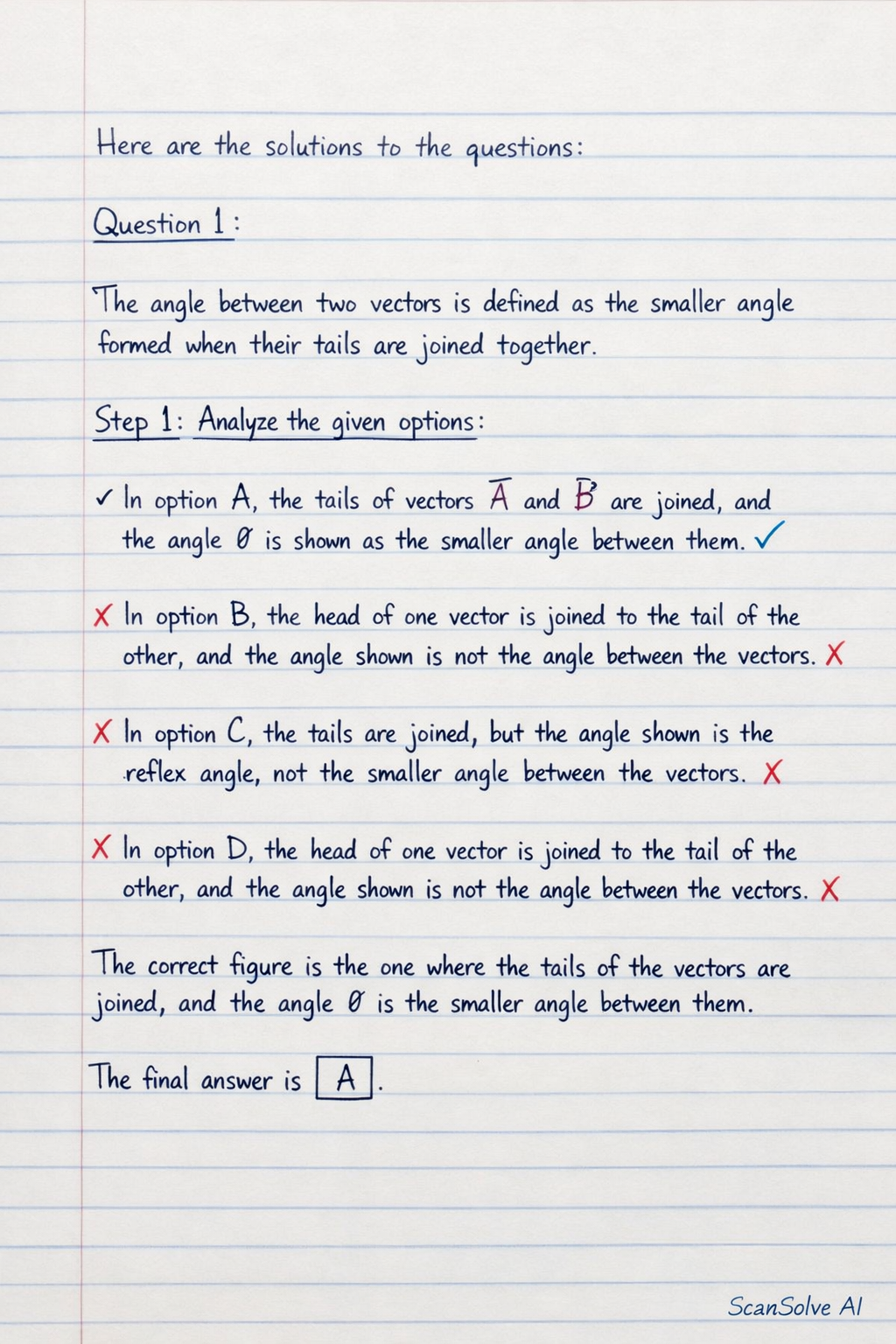
The angle between two vectors is defined as the smaller angle formed when their tails are joined together.
Analyze the given options.
- In option A, the tails of vectors and are joined, and the angle is shown as the smaller angle between them. This is the correct representation.
- In option B, the head of one vector is joined to the tail of the other, and the angle shown is not the angle between the vectors.
- In option C, the tails are joined, but the angle shown is the reflex angle, not the smaller angle between the vectors.
- In option D, the head of one vector is joined to the tail of the other, and the angle shown is not the angle between the vectors.
The correct figure is the one where the tails of the vectors are joined, and the angle is the smaller angle between them.
The final answer is .
Part 2
Let , , and be the angles a vector makes with the and axes, respectively. These are called direction angles.
Recall the property of direction cosines.
The direction cosines are , , and . They satisfy the relation:
Use the trigonometric identity .
We need to find .
Substitute the identity into the expression:Simplify the expression.
Substitute the relation from Step 1:
The final answer is .
Part 3
This question refers to the resolution of a vector into its components.
Understand vector resolution.
Any vector can be resolved into two or three component vectors whose vector sum is the original vector. The most common and useful way to do this is by resolving it into mutually perpendicular components.
Evaluate the options.
- A) Parallel vectors: If a vector is replaced by parallel vectors, their resultant will also be parallel to them. This does not allow for resolving a vector in an arbitrary direction into components that are not parallel to the original vector.
- B) Perpendicular vectors: A vector in a plane can be resolved into two perpendicular components (e.g., along X and Y axes). A vector in 3D space can be resolved into three mutually perpendicular components (e.g., along X, Y, and Z axes). The vector sum of these perpendicular components equals the original vector. This is the standard method of vector decomposition.
- C) Coplanar vectors: While perpendicular vectors in 2D are coplanar, this option is too general. A vector can be resolved into non-perpendicular coplanar vectors, but the most fundamental and universally applicable method for "any vector in an arbitrary direction" is using perpendicular components.
- D) Unit vectors: Unit vectors define directions, but the components themselves are not necessarily unit vectors; they are vectors with magnitudes and directions. For example, a component might be , which is not a unit vector.
Therefore, a vector can always be replaced by two (in 2D) or three (in 3D) perpendicular vectors that sum up to the original vector.
The final answer is .
Try one yourself
A new problem that tests the same skill.
Still stuck on this one?
Ask a follow-up, and the answer starts from this question.
More Physics Questions
Handwritten Step-by-Step Solution
Get this as a handwritten image on WhatsApp — like a tutor wrote it for you.
Try on WhatsApp