
We read your photo as:
The diagram below illustrates a metre bridge with an unknown resistance X and 30 in the arms respectively. If the balance point is 40 cm from A, calculate the magnitude of X.
ScanSolve AI Answer
Answer
Step-by-step solution
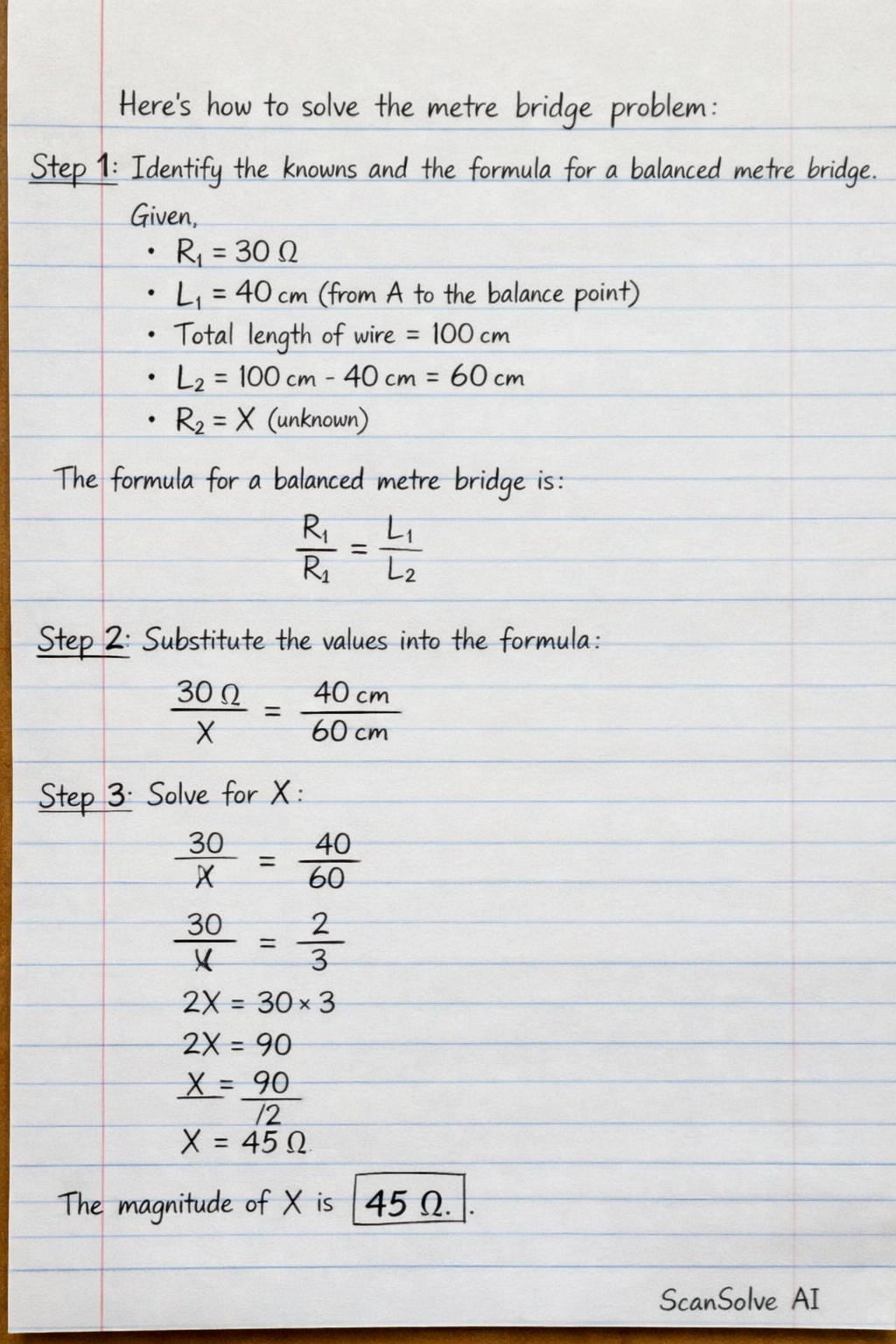
3 stepsHere's how to solve the metre bridge problem:
Identify the knowns and the formula for a balanced metre bridge.
In a balanced metre bridge, the ratio of resistances is equal to the ratio of the lengths of the wire segments.
Given:- Resistance
- Length (from A to the balance point)
- Total length of the wire is .
- Therefore, the other length .
- Unknown resistance .
The formula for a balanced metre bridge is:
Substitute the values into the formula.
Solve for X.
The magnitude of X is .
Here's the phasor diagram for the alternating currents:
(i) Two alternating currents and are defined by the expression and respectively. Draw the phasor diagram to represent the currents and .
We can express in terms of cosine: .
This means lags by (or ).The phasor diagram will show along the positive x-axis (representing ) and along the negative y-axis (representing ). Both phasors have the same amplitude .
\begin{tikzpicture}
    % Axes
    \draw[->] (-2,0) -- (2,0) node[right] {Real Axis};
    \draw[->] (0,-2) -- (0,2) node[above] {Imaginary Axis};

    % Phasor I2
    \draw[->, thick, blue] (0,0) -- (1.5,0) node[above right] {$I_2 = I_0 \cos(\omega t)$};

    % Phasor I1
    \draw[->, thick, red] (0,0) -- (0,-1.5) node[below right] {$I_1 = I_0 \sin(\omega t)$};

    % Angle
    \draw[dashed] (0,0) -- (1.5,0);
    \draw[dashed] (0,0) -- (0,-1.5);
    \draw[<->, gray] (0.5,0) arc (0:-90:0.5);
    \node[gray] at (0.7,-0.7) {$90^\circ$};
\end{tikzpicture}
Try one yourself
A new problem that tests the same skill.
Still stuck on this one?
Ask a follow-up, and the answer starts from this question.
More Physics Questions
Handwritten Step-by-Step Solution
Get this as a handwritten image on WhatsApp — like a tutor wrote it for you.
Try on WhatsApp