The engine of a beach buggy develops 40 kW at a speed of 900 r/minutes.

Physics
The engine of a beach buggy develops 40 kW at a speed of 900 r/minutes.

ScanSolve AI Answer

Answer

94.25 rad/s

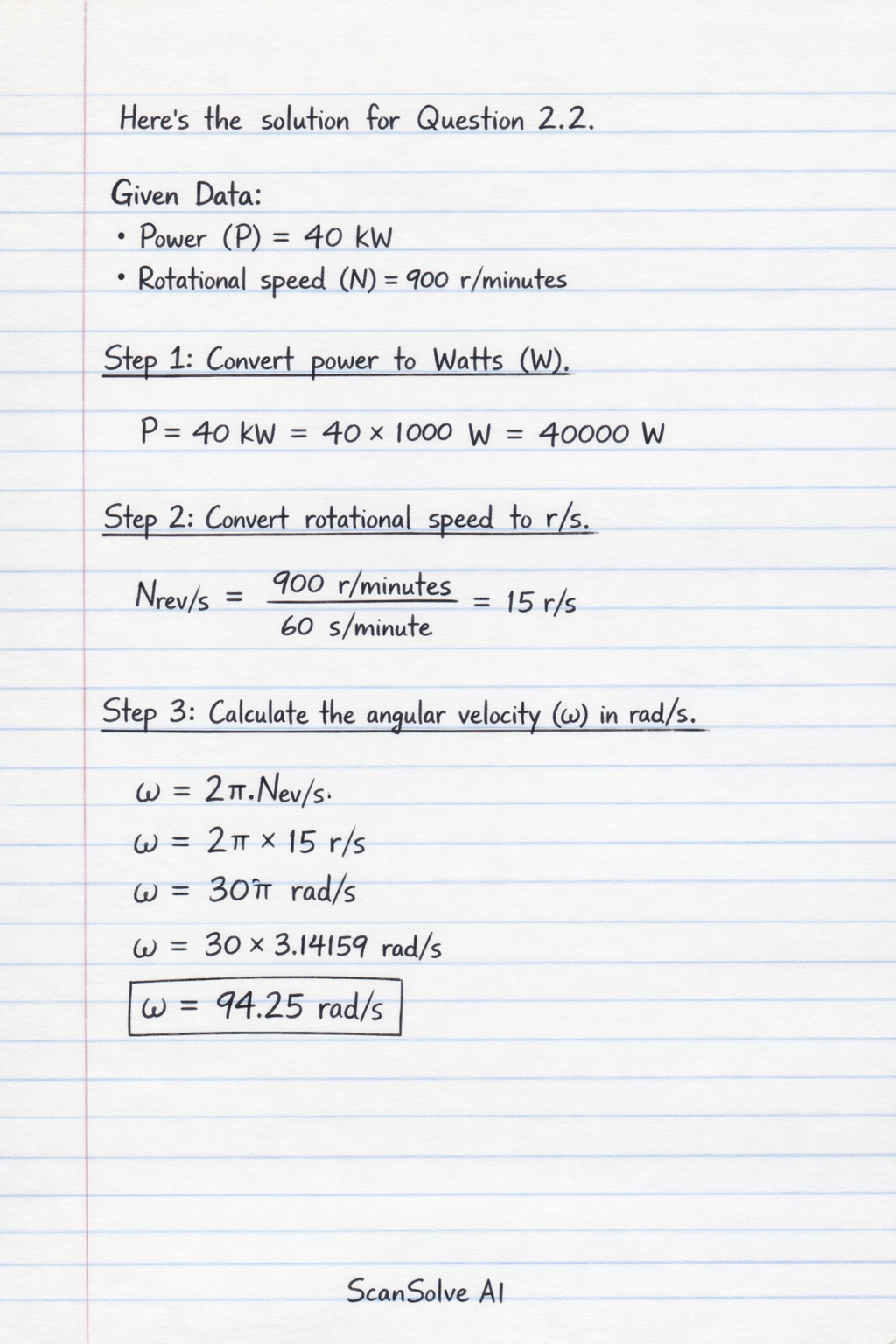
Here's the solution for Question 2.2.

Given Data:

  • Power (PP) = 40 kW
  • Rotational speed (NN) = 900 r/minutes

Step 1: Convert power to Watts (W). P=40kW=40×1000W=40000 WP = 40 kW = 40 \times 1000 W = 40000 \text{ W}

Step 2: Convert rotational speed from revolutions per minute (r/minutes) to revolutions per second (r/s). Nrev/s=900r/minutes60s/minute=15 r/sN_{rev/s} = \frac{900 r/minutes}{60 s/minute} = 15 \text{ r/s}

Step 3: Calculate the angular velocity (ω\omega) in radians per second (rad/s). The angular velocity is given by ω=2πNrev/s\omega = 2 \pi N_{rev/s}. This is the value for 's' in the context of angular speed. ω=2π×15 r/s\omega = 2 \pi \times 15 \text{ r/s} ω=30π rad/s\omega = 30 \pi \text{ rad/s} ω30×3.14159 rad/s\omega \approx 30 \times 3.14159 \text{ rad/s} ω94.25 rad/s\omega \approx \text{94.25 rad/s}

Step 4: Calculate the Torque (TT). The relationship between power, torque, and angular velocity is P=TωP = T \omega. T=PωT = \frac{P}{\omega} T=40000W30πrad/sT = \frac{40000 W}{30 \pi rad/s} T=4000030πNmT = \frac{40000}{30 \pi} N\cdot\text{m} T=40003πNmT = \frac{4000}{3 \pi} N\cdot\text{m} T40003×3.14159NmT \approx \frac{4000}{3 \times 3.14159} N\cdot\text{m} T40009.42477NmT \approx \frac{4000}{9.42477} N\cdot\text{m} T424.41 N\cdotmT \approx \text{424.41 N\cdotm}

That's 4 down. 1 left today — send the next one.

Was this helpful?

Need help with your own homework?

Get instant step-by-step solutions to any question. Free to start.

Ask Your Question
Handwritten step-by-step solution preview

Handwritten Step-by-Step Solution

Get this as a handwritten image on WhatsApp — like a tutor wrote it for you.

Try on WhatsApp

Still have questions?

Quick Answer

Here's the solution for Question 2.2. Given Data: Power (P) = 40 kW Rotational speed (N) = 900 r/minutes Step 1: Convert power to Watts (W).

The engine of a beach buggy develops 40 kW at a speed of 900 r/minutes.
Physics

This physics problem tests your understanding of fundamental physical laws and their applications. The step-by-step solution below breaks down the problem using relevant equations and physical reasoning.

ScanSolve AI Answer
Here's the solution for Question 2.2. Given Data: Power (P) = 40 kW Rotational speed (N) = 900 r/minutes Step 1: Convert power to Watts (W). P = 40 kW = 40 × 1000 W = 40000 W Step 2: Convert rotational speed from revolutions per minute (r/minutes) to revolutions per second (r/s). N_rev/s = 900 r/minutes60 s/minute = 15 r/s Step 3: Calculate the angular velocity () in radians per second (rad/s). The angular velocity is given by = 2 N_rev/s. This is the value for 's' in the context of angular speed. = 2 × 15 r/s = 30 rad/s ≈ 30 × 3.14159 rad/s ≈ 94.25 rad/s Step 4: Calculate the Torque (T). The relationship between power, torque, and angular velocity is P = T . T = (P)/() T = 40000 W30 rad/s T = (40000)/(30 ) N·m T = (4000)/(3 ) N·m T ≈ (4000)/(3 × 3.14159) N·m T ≈ (4000)/(9.42477) N·m T ≈ 424.41 N·m That's 4 down. 1 left today — send the next one.