
We read your photo as:
The Figure below show coplanar concurrent force system. Find resultant and direction.
ScanSolve AI Answer
Answer
Step-by-step solution
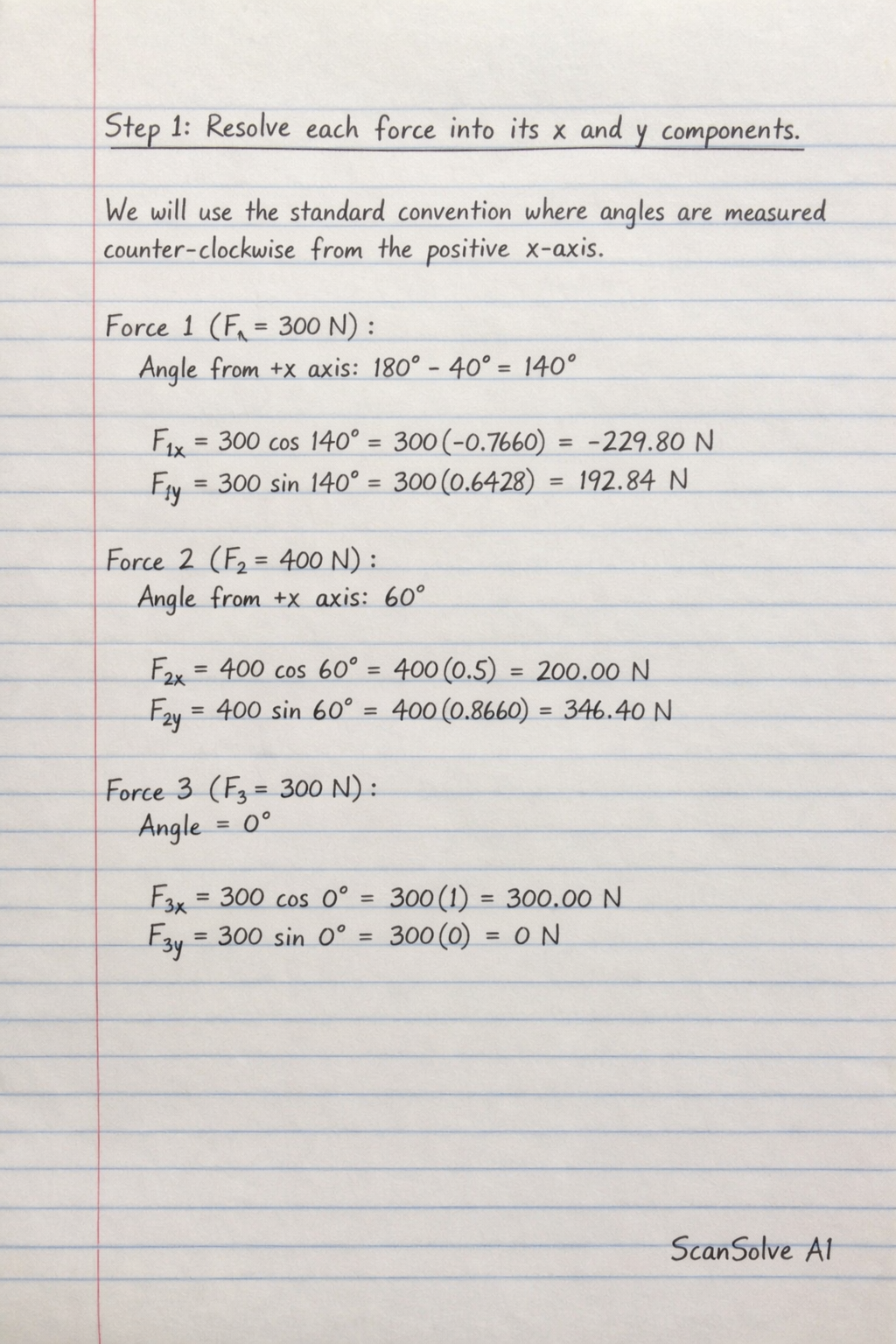
5 stepsResolve each force into its x and y components.
We will use the standard convention where angles are measured counter-clockwise from the positive x-axis.
-
Force 1 ( N): The angle with the negative x-axis is . So, the angle from the positive x-axis is .
-
Force 2 ( N): The angle with the positive x-axis is .
-
Force 3 ( N): This force acts along the positive x-axis, so its angle is .
-
Force 4 ( N): This force acts along the negative y-axis, so its angle is .
-
Sum the x-components ().
Sum the y-components ().
Calculate the magnitude of the resultant force ().
Calculate the direction of the resultant force ().
Since both and are positive, the resultant force is in the first quadrant, and the angle is measured counter-clockwise from the positive x-axis.
The resultant force is at an angle of from the positive x-axis.
Try one yourself
A new problem that tests the same skill.
Still stuck on this one?
Ask a follow-up, and the answer starts from this question.
More Physics Questions
Handwritten Step-by-Step Solution
Get this as a handwritten image on WhatsApp — like a tutor wrote it for you.
Try on WhatsApp