
The flow chart is force
Physics
ScanSolve AI Answer
Answer
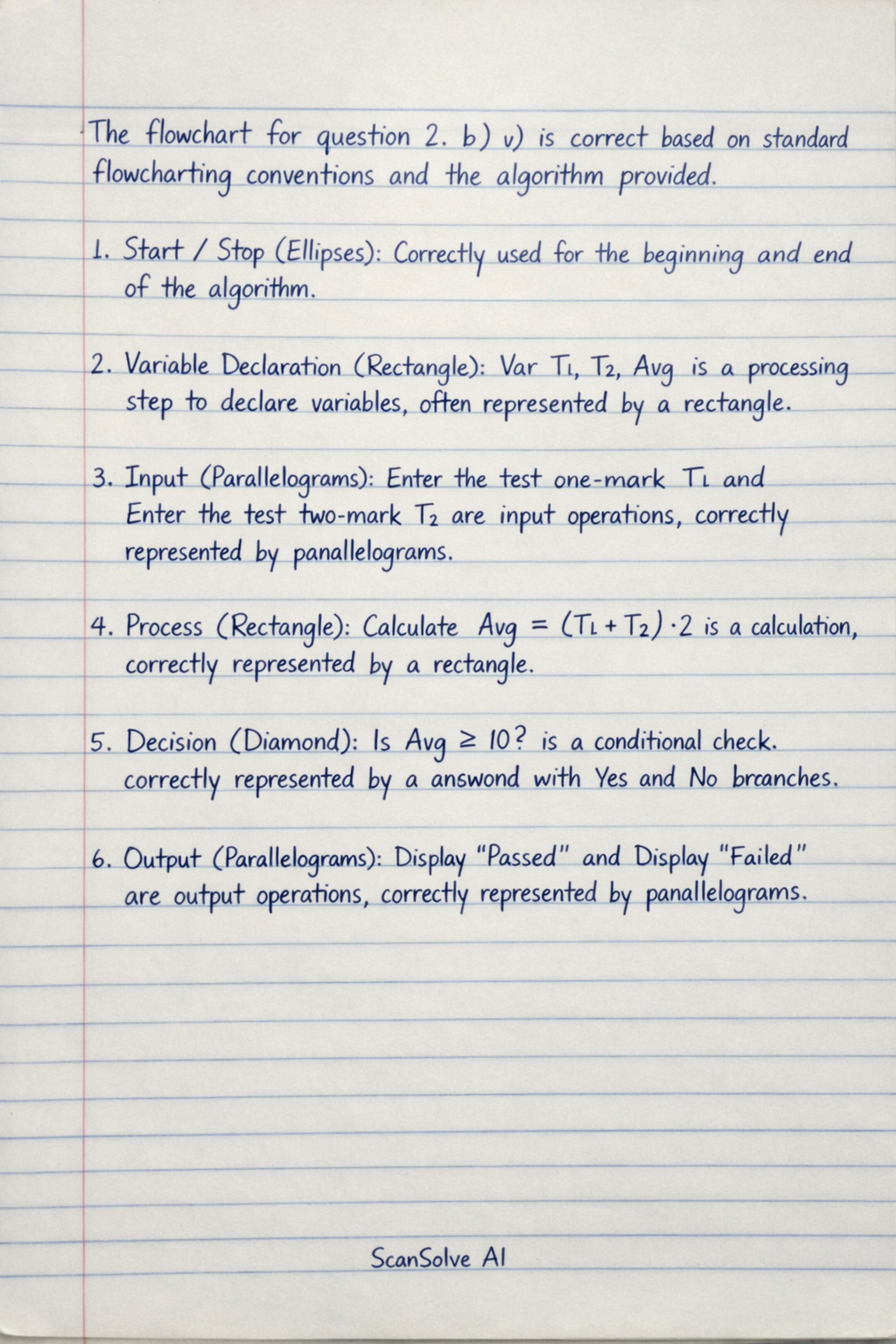
The flowchart for question 2. b) v) is correct based on standard flowcharting conventions and the algorithm provided.
Here's a breakdown of why each part is correct:
- Start/Stop (Ellipses): Correctly used for the beginning and end of the algorithm.
- Variable Declaration (Rectangle):
Var T1, T2, Avgis a processing step to declare variables, often represented by a rectangle. - Input (Parallelograms):
Enter the test one-mark T1andEnter the test two-mark T2are input operations, correctly represented by parallelograms. - Process (Rectangle):
Calculate Avg = (T1+T2)/2is a calculation, correctly represented by a rectangle. - Decision (Diamond):
Is Avg >= 10?is a conditional check, correctly represented by a diamond with two output paths (Yes/No). - Output (Parallelograms):
Display "Passed"andDisplay "Failed"are output operations, correctly represented by parallelograms. - Merging Paths: Both the "Yes" (Passed) and "No" (Failed) paths correctly merge before the
Output "Goodbye"step. This ensures that "Goodbye" is displayed regardless of whether the student passed or failed, as per the algorithm's logic. - Final Output (Parallelogram):
Output "Goodbye"is an output operation.
The flow of control is logical and accurately depicts the algorithm.
Was this helpful?
Still stuck on this one?
Ask a follow-up, and the answer starts from this question.
Got a different question?Ask your own question
More Physics Questions
QComplete the flow diagrams.QStudy the flow chart below and use it to answer the questions that follow.QComplete the flow diagram and tables below.QIdentify the following flowchart symbols and state one use of each.QFrom the above diagram to flow on it's own
Browse by topic:Mechanics
Handwritten Step-by-Step Solution
Get this as a handwritten image on WhatsApp — like a tutor wrote it for you.
Try on WhatsApp