
We read your photo as:
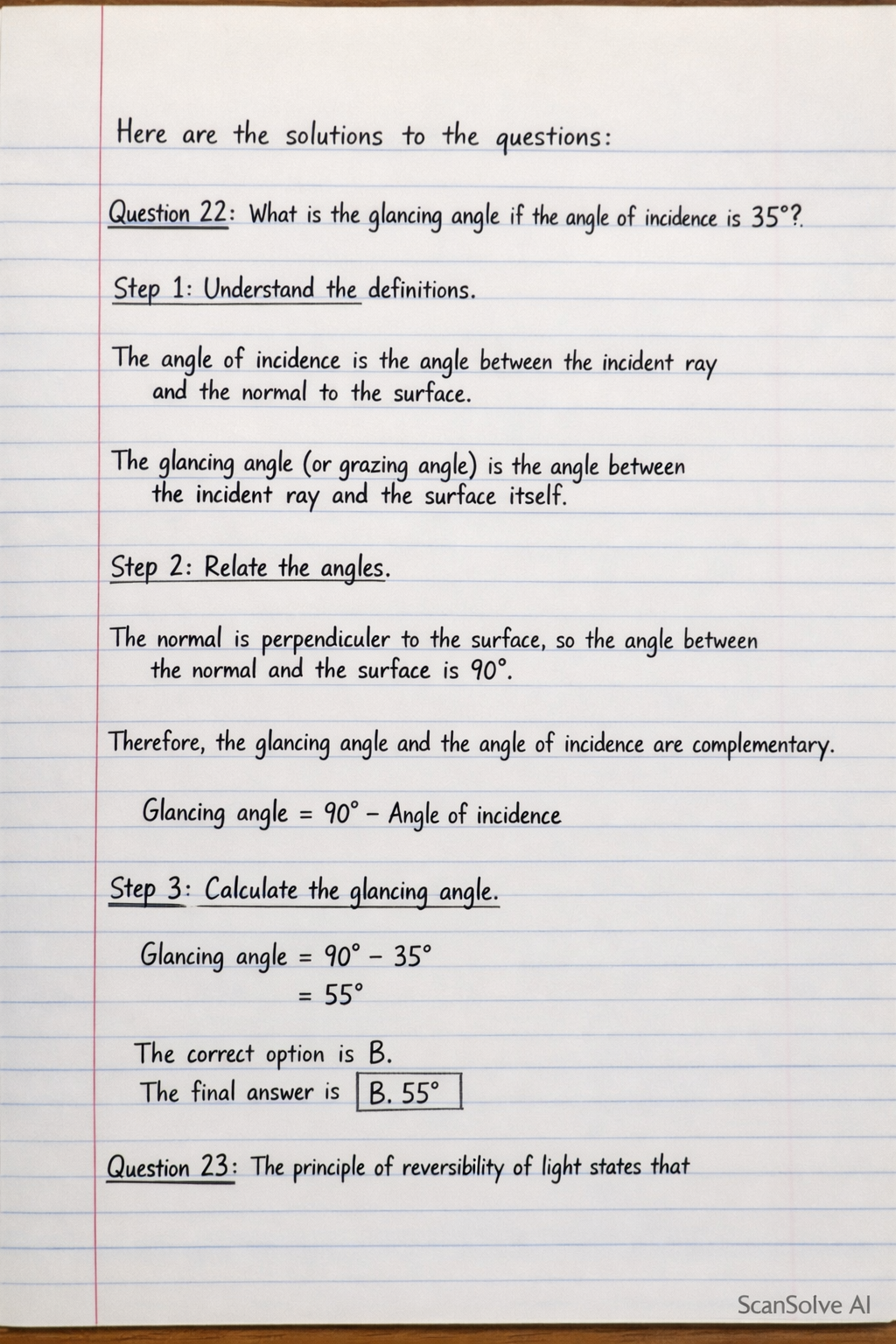
What is the glancing angle if the angle of incidence is 35^?
ScanSolve AI Answer
Answer
Step-by-step solution
10 stepsHere are the solutions to the questions:
Part 22· 3 steps
What is the glancing angle if the angle of incidence is ?
Understand the definitions.
The angle of incidence is the angle between the incident ray and the normal to the surface.
The glancing angle (or grazing angle) is the angle between the incident ray and the surface itself.Relate the angles.
The normal is perpendicular to the surface, so the angle between the normal and the surface is .
Therefore, the glancing angle and the angle of incidence are complementary.Calculate the glancing angle.
The correct option is B.
The final answer is .
Part 23· 2 steps
The principle of reversibility of light states that
Recall the principle of reversibility of light.
The principle of reversibility of light states that if a ray of light, after suffering any number of reflections or refractions, has its path reversed, it will retrace its original path.
Evaluate the given options.
- A. Light always travels in straight lines: This is a property of light propagation, not the principle of reversibility.
- B. If light travels from point A to point B along a certain path, it will travel from point B to point A along the same path if its direction is reversed: This accurately describes the principle of reversibility.
- C. Light cannot be reflected or refracted: This is incorrect; light undergoes reflection and refraction.
- D. Light always travels at the same speed: This is incorrect; light speed changes in different media.
The correct option is B.
The final answer is .
Part 24· 3 steps
Describe the image formed when an object is placed at the centre of curvature of a concave mirror.
Recall image formation by a concave mirror.
For a concave mirror, when an object is placed at the centre of curvature (C), the image is formed at the centre of curvature (C) as well.
Describe the properties of the image.
The image formed is real, inverted, and has the same size as the object.
Evaluate the given options.
- A. Virtual, upright, magnified: Incorrect.
- B. Real, inverted, same size as object: Correct.
- C. Real, upright, diminished: Incorrect (real images are inverted).
- D. Virtual, inverted, magnified: Incorrect (virtual images are upright).
The correct option is B.
The final answer is .
Part 25· 2 steps
What happens to the image formed by a concave mirror when the object is moved towards the pole?
Analyze image formation for a concave mirror as the object moves towards the pole (P).
- When the object is far away (beyond C), the image is real, inverted, and diminished, formed between F and C.
- As the object moves from C towards F, the image moves from C towards infinity, becoming real, inverted, and magnified.
- When the object is at F, the image is formed at infinity.
- When the object is between F and P, the image is formed behind the mirror, becoming virtual, upright, and magnified.
Identify the general trend.
Try one yourself
A new problem that tests the same skill.
Still stuck on this one?
Ask a follow-up, and the answer starts from this question.
More Physics Questions
Handwritten Step-by-Step Solution
Get this as a handwritten image on WhatsApp — like a tutor wrote it for you.
Try on WhatsApp