
We read your photo as:
What are the major properties for determining conductor. Given the electric and magnetic field components E(x, t) = E₀ Cos(Kx – ωt) and B(x, t) = B₀ Cos(Kx – ωt) satisfy the one-dimensional electromagnetic waves equations.
ScanSolve AI Answer
Step-by-step solution
4 stepsHere are the answers to your questions:
Part a
What are the major properties for determining a conductor?
The major properties for determining a conductor are:
- High Electrical Conductivity: Conductors have a very low electrical resistivity, allowing electric current to flow through them with minimal opposition. This is due to the presence of mobile charge carriers.
- Presence of Free Charge Carriers: Conductors contain a large number of charge carriers (typically free electrons in metals or ions in electrolytes) that are not bound to individual atoms and can move freely throughout the material.
- Band Structure: In solid conductors (like metals), the valence and conduction energy bands overlap, meaning there is no energy gap for electrons to overcome to become mobile.
Part b· 4 steps
Given the electric and magnetic field components and , do they satisfy the one-dimensional electromagnetic wave equations?
To satisfy the one-dimensional electromagnetic wave equations, both and must satisfy the wave equation:
where represents either or , is the permeability, and is the permittivity of the medium. The speed of the wave is .
Calculate the first and second partial derivatives for $E(x, t)$.
Given .
First partial derivatives:Second partial derivatives:
Substitute the derivatives of $E(x, t)$ into the wave equation.
Dividing both sides by :
This relationship is consistent with the speed of an electromagnetic wave . Thus, satisfies the wave equation.
Calculate the first and second partial derivatives for $B(x, t)$.
Given .
First partial derivatives:Second partial derivatives:
Substitute the derivatives of $B(x, t)$ into the wave equation.
Dividing both sides by :
This relationship is also consistent. Thus, satisfies the wave equation.
Both the electric and magnetic field components satisfy the one-dimensional electromagnetic wave equations, provided that the wave speed is equal to .
The answer is:
Still stuck on this one?
Ask a follow-up, and the answer starts from this question.
More Physics Questions
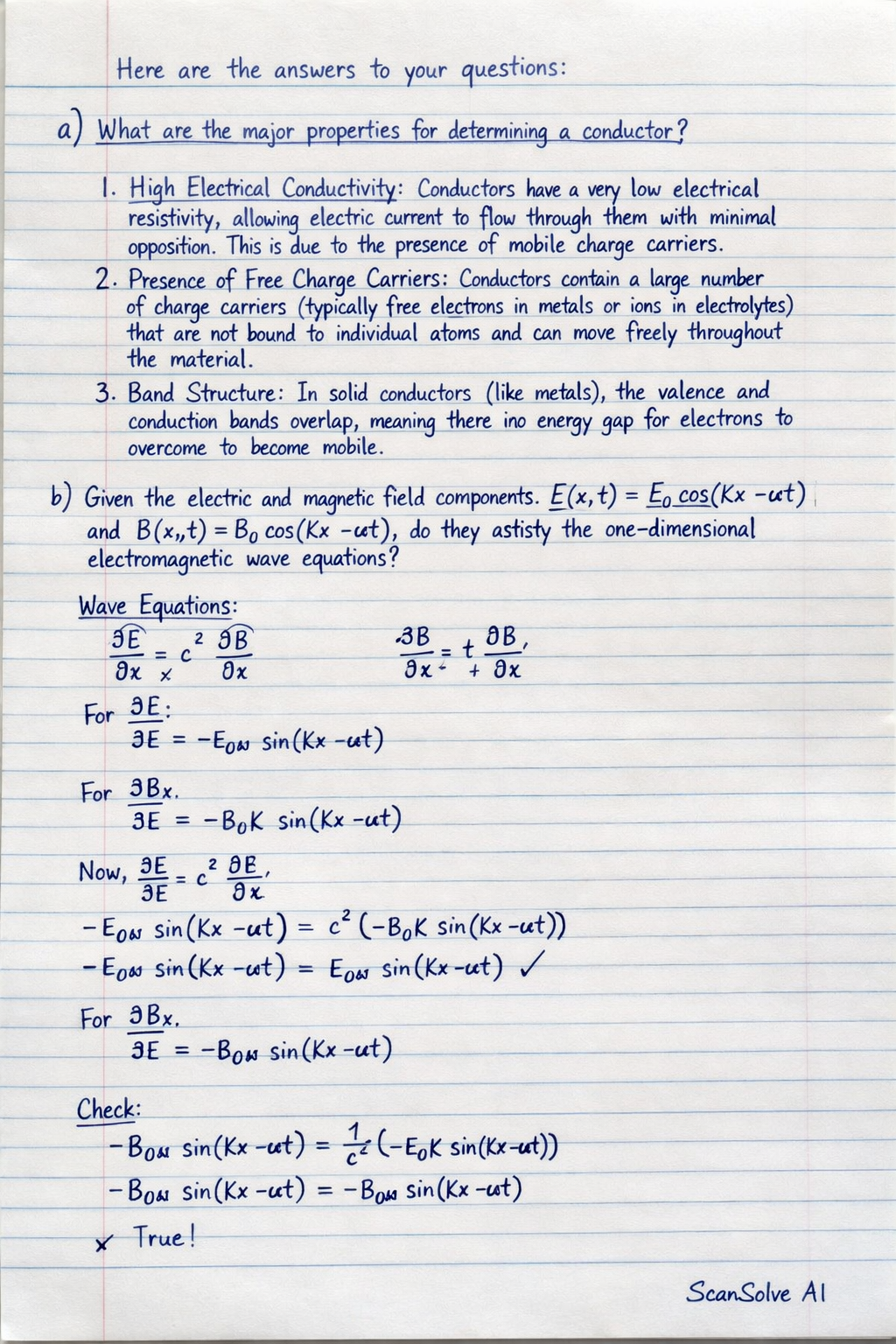
Handwritten Step-by-Step Solution
Get this as a handwritten image on WhatsApp — like a tutor wrote it for you.
Try on WhatsApp