
We read your photo as:
What are the major types of weathering and how does temperature affect them? Calculate the current and resistance for a 100W device at 240V.
ScanSolve AI Answer
Step-by-step solution
5 stepsHere are the solutions to all the questions from the image:
1.
a)
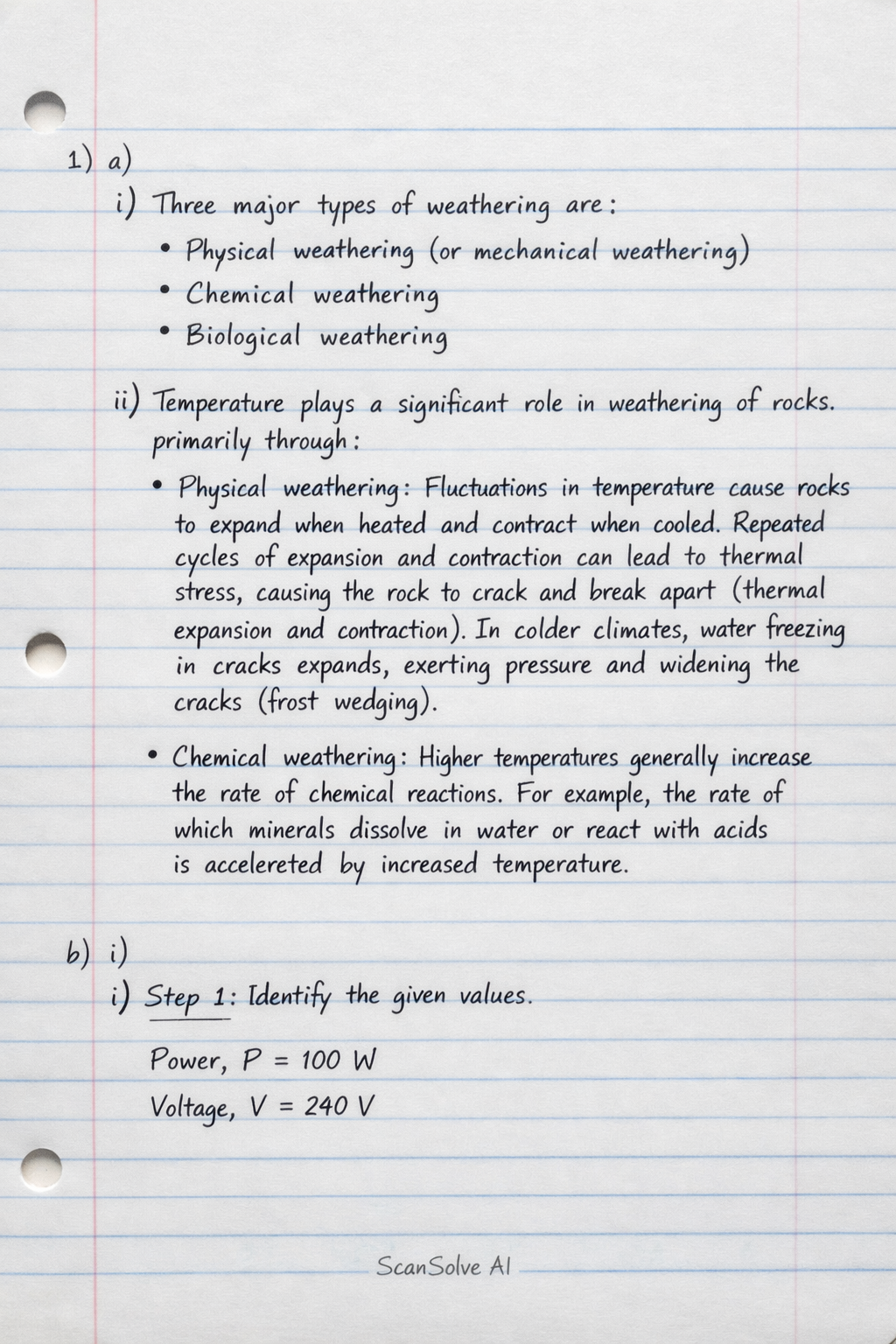
i) Three major types of weathering are:
- Physical weathering (or mechanical weathering)
- Chemical weathering
- Biological weathering
ii) Temperature plays a significant role in weathering of rocks primarily through:
- Physical weathering: Fluctuations in temperature cause rocks to expand when heated and contract when cooled. Repeated cycles of expansion and contraction can lead to thermal stress, causing the rock to crack and break apart (thermal expansion and contraction). In colder climates, water freezing in cracks expands, exerting pressure and widening the cracks (frost wedging).
- Chemical weathering: Higher temperatures generally increase the rate of chemical reactions. For example, the rate at which minerals dissolve in water or react with acids is accelerated by increased temperature.
b)
i)
Identify the given values.
Power,
Voltage,Use the formula for power to find the current.
Substitute the values and calculate the current.
The current drawn is .
ii)
Use Ohm's Law to find the resistance.
Substitute the values and calculate the resistance.
Using the calculated current :
Alternatively, using :
The resistance of the heater is .
c)
i) Three compounds which have electrovalent (ionic) bonds are:
- Sodium chloride ()
- Magnesium oxide ()
- Potassium bromide ()
ii) Two characteristics of electrovalent compounds are:
- They typically have high melting and boiling points due to the strong electrostatic forces of attraction between ions.
- They are generally soluble in polar solvents like water and conduct electricity when molten or dissolved in water, as their ions become mobile.
d)
i) Rhesus factor (Rh factor) is a specific type of protein (antigen) found on the surface of red blood cells in some people. Individuals who have this protein are Rh-positive, while those who lack it are Rh-negative.
ii) The rhesus factor in humans could result in miscarriage if an Rh-negative mother carries an Rh-positive fetus. During pregnancy or childbirth, fetal blood can enter the mother's bloodstream, causing her immune system to produce antibodies against the Rh factor. In subsequent pregnancies with another Rh-positive fetus, these maternal antibodies can cross the placenta and attack the fetal red blood cells, leading to hemolytic disease of the newborn, which can cause severe anemia, jaundice, and potentially miscarriage or stillbirth.
2.
a)
i) Solar energy is used to generate electricity primarily through photovoltaic (PV) cells (solar panels). These cells contain semiconductor materials (like silicon) that absorb photons from sunlight. When photons strike the semiconductor, they excite electrons, causing them to flow and create an electric current. This direct conversion of light into electricity is known as the photovoltaic effect.
ii) Two other uses of solar energy are:
- Solar water heating: Using solar thermal collectors to heat water for domestic or industrial use.
- Solar cooking: Using solar concentrators to cook food.
b)
i) Five ways of conserving water in the home are:
- Taking shorter showers instead of baths.
- Fixing leaky faucets and pipes promptly.
- Using water-efficient appliances (e.g., low-flow toilets, energy-efficient washing machines).
- Collecting rainwater for gardening or other non-potable uses.
- Turning off the tap while brushing teeth or washing dishes.
c)
i) Three management practices to ensure high yield in maize production are:
- Proper fertilization: Applying appropriate amounts of nitrogen, phosphorus, and potassium.
- Pest and disease control: Implementing measures to prevent and manage pests (e.g., fall armyworm) and diseases (e.g., maize streak virus).
- Timely planting and harvesting: Planting at the optimal time for the region's climate and harvesting when the crop reaches physiological maturity.
ii) Two of the management practices stated in (i) help in ensuring high yield of maize by:
- Proper fertilization provides essential nutrients that maize plants need for healthy growth, robust stalk development, and optimal grain filling, directly leading to higher yields.
- Pest and disease control protects the maize plants from damage and stress caused by insects and pathogens. By minimizing crop loss due to pests and diseases, more plants survive and thrive, contributing to a higher overall yield.
d)
i) Two effects of air masses on the environment are:
- They dictate weather patterns, bringing specific temperature and moisture conditions (e.g., cold, dry air masses bring clear, cold weather; warm, moist air masses bring humidity and rain).
- They can transport pollutants over long distances, affecting air quality in regions far from the source of pollution.
ii) Three ways by which global warming can be reduced are:
- Reducing the use of fossil fuels by transitioning to renewable energy sources like solar, wind, and hydropower.
- Improving energy efficiency in homes, transportation, and industries to decrease overall energy consumption.
- Promoting reforestation and afforestation to increase carbon dioxide absorption from the atmosphere.
3.
a)
i) Aluminium resists corrosion but iron does not because aluminium forms a thin, tough, and impermeable layer of aluminium oxide () on its surface when exposed to air. This oxide layer is highly stable and acts as a protective barrier, preventing further oxidation or corrosion of the underlying metal. This process is called passivation. In contrast, when iron corrodes, it forms hydrated iron(III) oxide (rust), which is flaky, porous, and does not adhere tightly to the surface, allowing oxygen and water to reach the underlying metal and continue the corrosion process.
ii) Two methods of preventing iron from rusting are:
- Painting or coating: Applying a layer of paint, oil, grease, or plastic to create a barrier between the iron surface and oxygen/moisture.
- Galvanizing: Coating the iron with a layer of zinc. Zinc acts as a sacrificial anode, corroding preferentially to protect the iron.
b)
i) The term culling as used in livestock management refers to the selective removal of animals from a herd or flock based on specific criteria, such as poor health, low productivity, undesirable genetic traits, or old age.
ii) Three benefits of practising culling are:
- Disease control: Removing sick animals prevents the spread of diseases within the herd.
- Genetic improvement: Eliminating animals with undesirable traits helps improve the overall genetic quality and productivity of the herd.
- Resource optimization: Reducing the number of unproductive animals frees up resources (feed, space) for more productive ones, improving efficiency and profitability.
*c
Still stuck on this one?
Ask a follow-up, and the answer starts from this question.
More Physics Questions
Handwritten Step-by-Step Solution
Get this as a handwritten image on WhatsApp — like a tutor wrote it for you.
Try on WhatsApp