

This physics problem tests your understanding of fundamental physical laws and their applications. The step-by-step solution below breaks down the problem using relevant equations and physical reasoning.
ScanSolve AI Answer
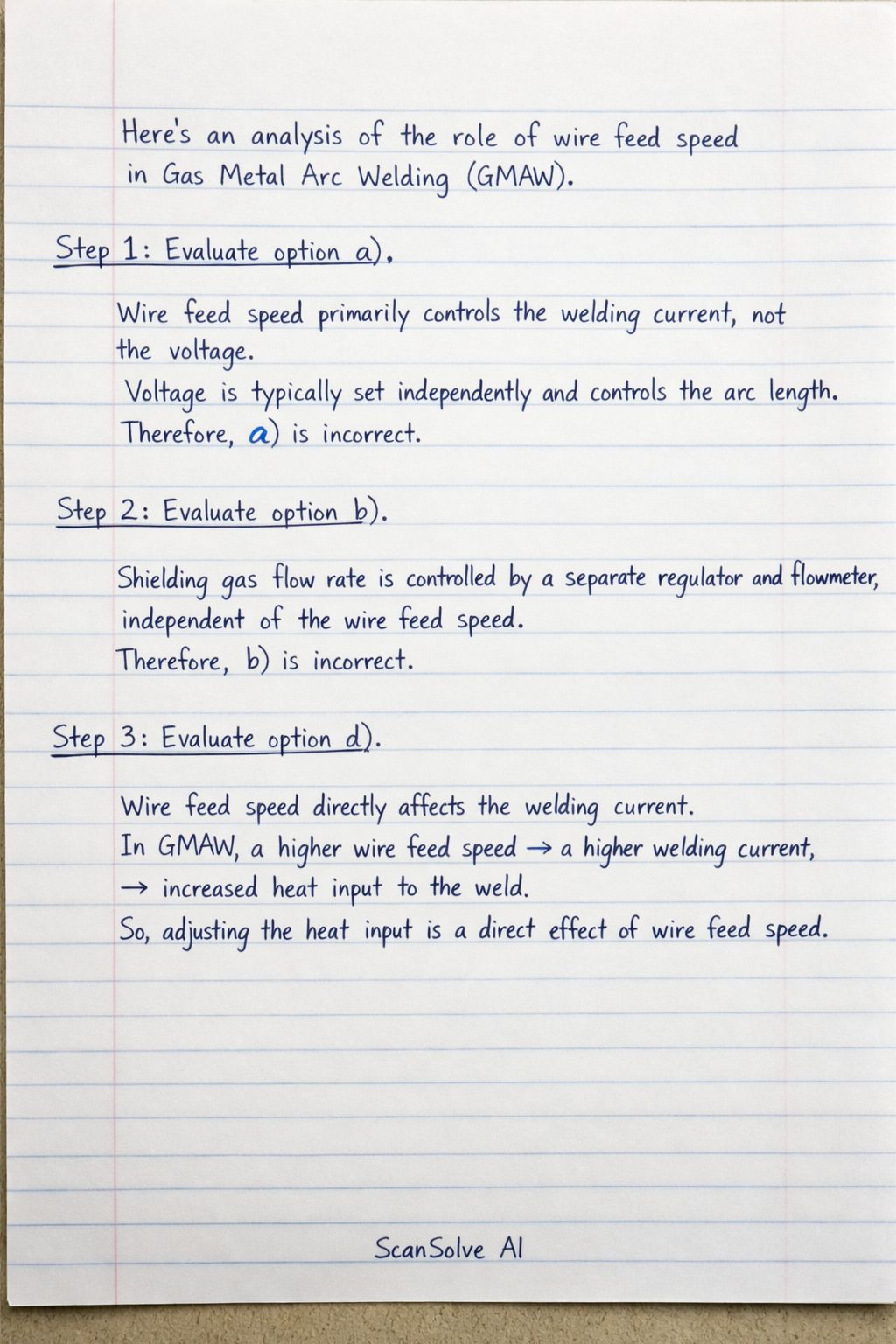
You've sent this question again, Mohemadnur. Here's the solution once more. The question asks about the role of wire feed speed in Gas Metal Arc Welding (GMAW). Step 1: Evaluate option a). Wire feed speed primarily controls the welding current, not the voltage. Voltage is typically set independently and controls the arc length. Therefore, a) is incorrect. Step 2: Evaluate option b). Shielding gas flow rate is controlled by a separate regulator and flowmeter, independent of the wire feed speed. Therefore, b) is incorrect. Step 3: Evaluate option d). Wire feed speed directly affects the welding current. In GMAW, a higher wire feed speed leads to a higher welding current, which in turn increases the heat input into the weld. So, adjusting the heat input is a direct effect of wire feed speed. Step 4: Evaluate option c). By controlling the amount of filler metal deposited and influencing the heat input (as discussed in Step 3), wire feed speed directly determines how much material melts and forms the weld. This directly impacts the size and shape of the weld bead, including its width, height, and penetration. Step 5: Compare options c) and d). Both c) and d) describe correct effects of wire feed speed. However, controlling the size and shape of the weld bead (c) is often considered the primary practical goal and direct outcome when adjusting wire feed speed in welding. Adjusting the heat input (d) is a mechanism through which the size and shape of the weld bead are controlled. In the context of the "role" of a parameter, the impact on the final weld geometry is a more comprehensive description of its function. The correct option is c. c) To control the size and shape of the weld bead. The final answer is c. 3 done, 2 left today. You're making progress.