
We read your photo as:
The problem describes a technician sliding from a tower of height 80 m. We are given the acceleration due to gravity g = 10 N/Kg. We will assume the technician starts from rest and
Physics
ScanSolve AI Answer
Answer
Step-by-step solution
4 stepsThe problem describes a technician sliding from a tower of height . We are given the acceleration due to gravity . We will assume the technician starts from rest and the question asks for the speed just before hitting the ground.
Given:
- Initial velocity, (assuming the technician starts from rest)
- Height,
- Acceleration due to gravity,
We need to find the final velocity, .
Identify the appropriate kinematic equation.
To find the final velocity when initial velocity, acceleration, and displacement are known, we use the following equation:
Substitute the given values into the equation.
Calculate the square of the final velocity.
Calculate the final velocity by taking the square root.
The speed of the technician just before hitting the ground is .
Was this helpful?
Try one yourself
A new problem that tests the same skill.
Still stuck on this one?
Ask a follow-up, and the answer starts from this question.
Got a different question?Ask your own question
More Physics Questions
Q• Initial velocity, u = 0 m/s (assuming the technician starts from rest)QGiven final velocity v = 0 m/s (at rest at the highest point), time t = 4 s, and acceleration due to…QA 60 kg object is to be accelerated vertically upwards at 10 m/s2. Calculate the upward force needed…QThe mass of an elevator is 500 kg. Calculate the tension in the cable when the elevator is (i)…QGiven mass m = 45 kg, initial velocity v = 5 m/s. We assume acceleration due to gravity g = 9.8…
Browse by topic:Mechanics
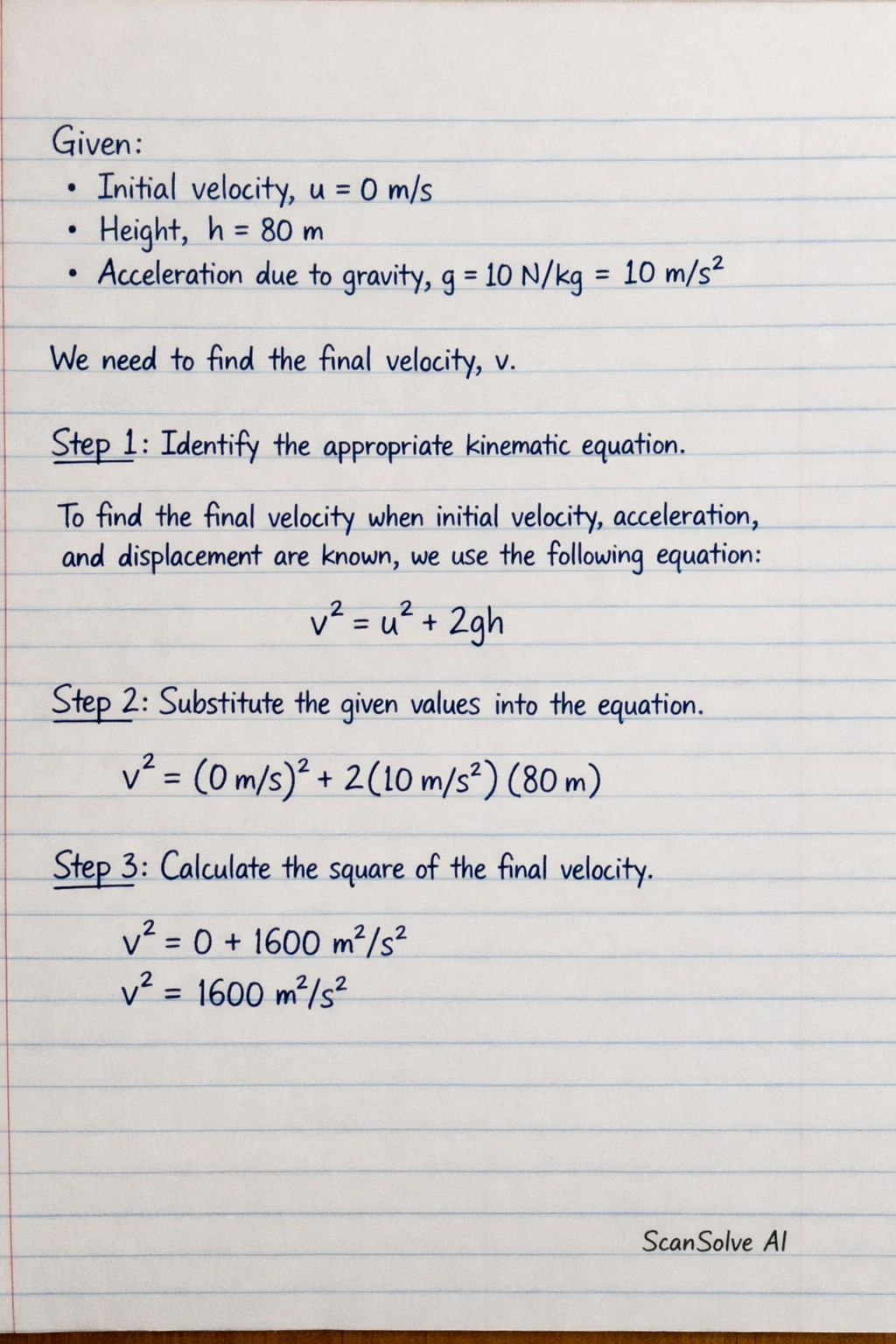
Handwritten Step-by-Step Solution
Get this as a handwritten image on WhatsApp — like a tutor wrote it for you.
Try on WhatsApp