
We read your photo as:
The question states: "A motorcycle starting from rest accelerates uniformly to a velocity of 24 km/h in 10 seconds.
Physics
ScanSolve AI Answer
Step-by-step solution
6 stepsHere's the solution to the problem from the image.
The question states: "A motorcycle starting from rest accelerates uniformly to a velocity of in .
a) What is its acceleration?
b) How far does it travel during this time?"
First, convert the final velocity from to .
Given:
Initial velocity, (starting from rest)
Final velocity,
Time,
a) What is its acceleration?
Use the kinematic equation relating initial velocity, final velocity, acceleration, and time.
The formula is .
Substitute the given values into the formula.
Solve for acceleration ().
The acceleration is .
b) How far does it travel during this time?
Use the kinematic equation for displacement.
The formula is .
Substitute the known values, including the acceleration found in part (a).
Calculate the displacement ().
The distance traveled is .
Was this helpful?
Still stuck on this one?
Ask a follow-up, and the answer starts from this question.
Got a different question?Ask your own question
More Physics Questions
QA car accelerates uniformly from rest at 3 m/s2. Its velocity after travelling a distance of 24 m…QA car starts from rest and accelerates uniformly to a speed of 40 m/s in 1 min 40 s. It then travels…QA car starts from rest and accelerates uniformly at 5 m/s² for 8 seconds. Calculate the distance it…QA car starts from rest and accelerates uniformly to a velocity of 15 m/s in 20 s. Calculate its…QA car starts with a velocity of 10 m/s and comes to rest in 25 m. Calculate its acceleration.
Browse by topic:Mechanics
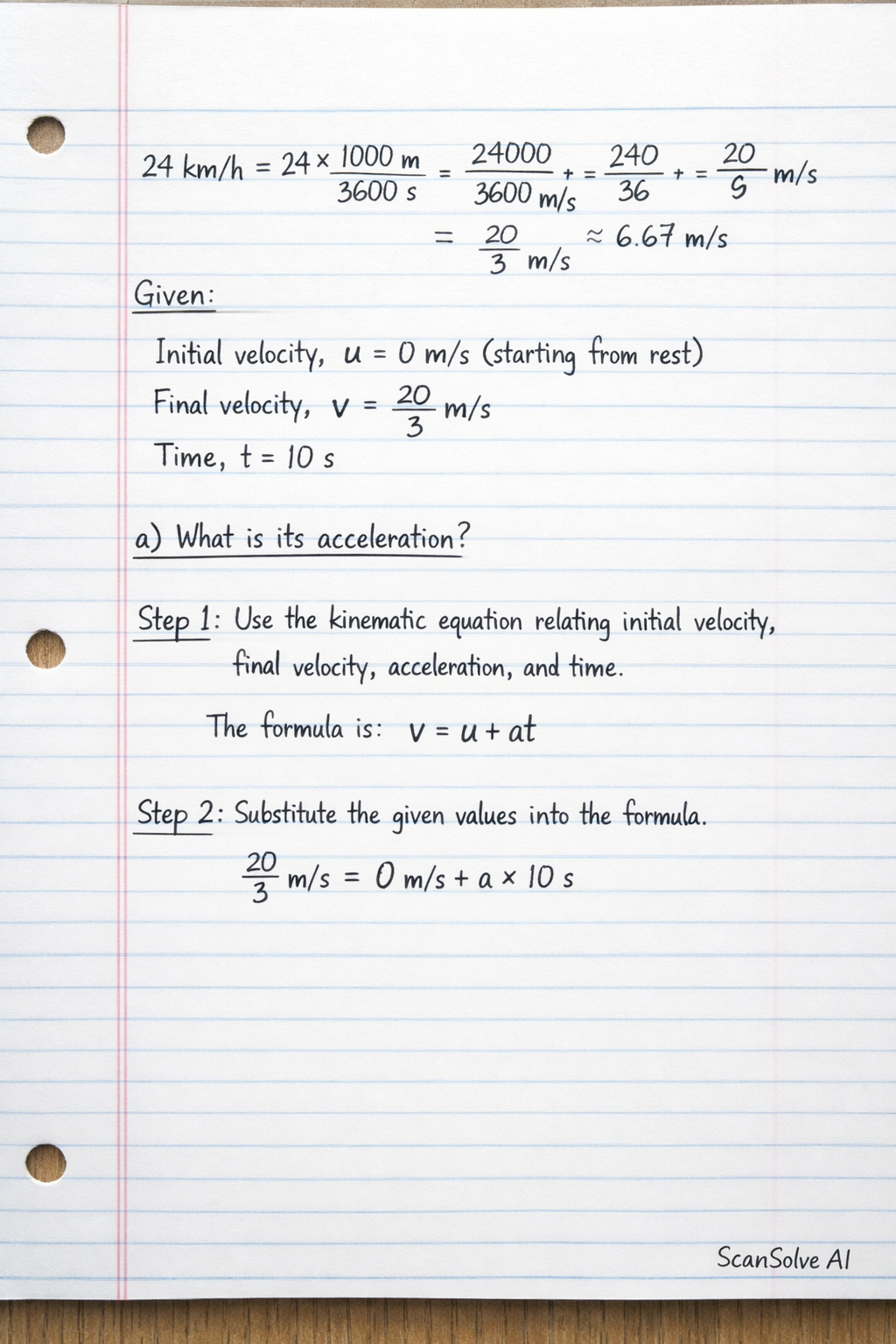
Handwritten Step-by-Step Solution
Get this as a handwritten image on WhatsApp — like a tutor wrote it for you.
Try on WhatsApp