
We read your photo as:
What are the recommended settings and preparations for oxy-acetylene welding based on plate thickness and technique, and what are the different flame types?
Physics
ScanSolve AI Answer
This image contains three tables related to oxy-acetylene welding:
Table I & II: Plate thickness, preparation, settings, filler rod and tip section
This table provides welding parameters based on the technique, plate thickness, and number of operators.
- Technique:
- DOWNHAND:
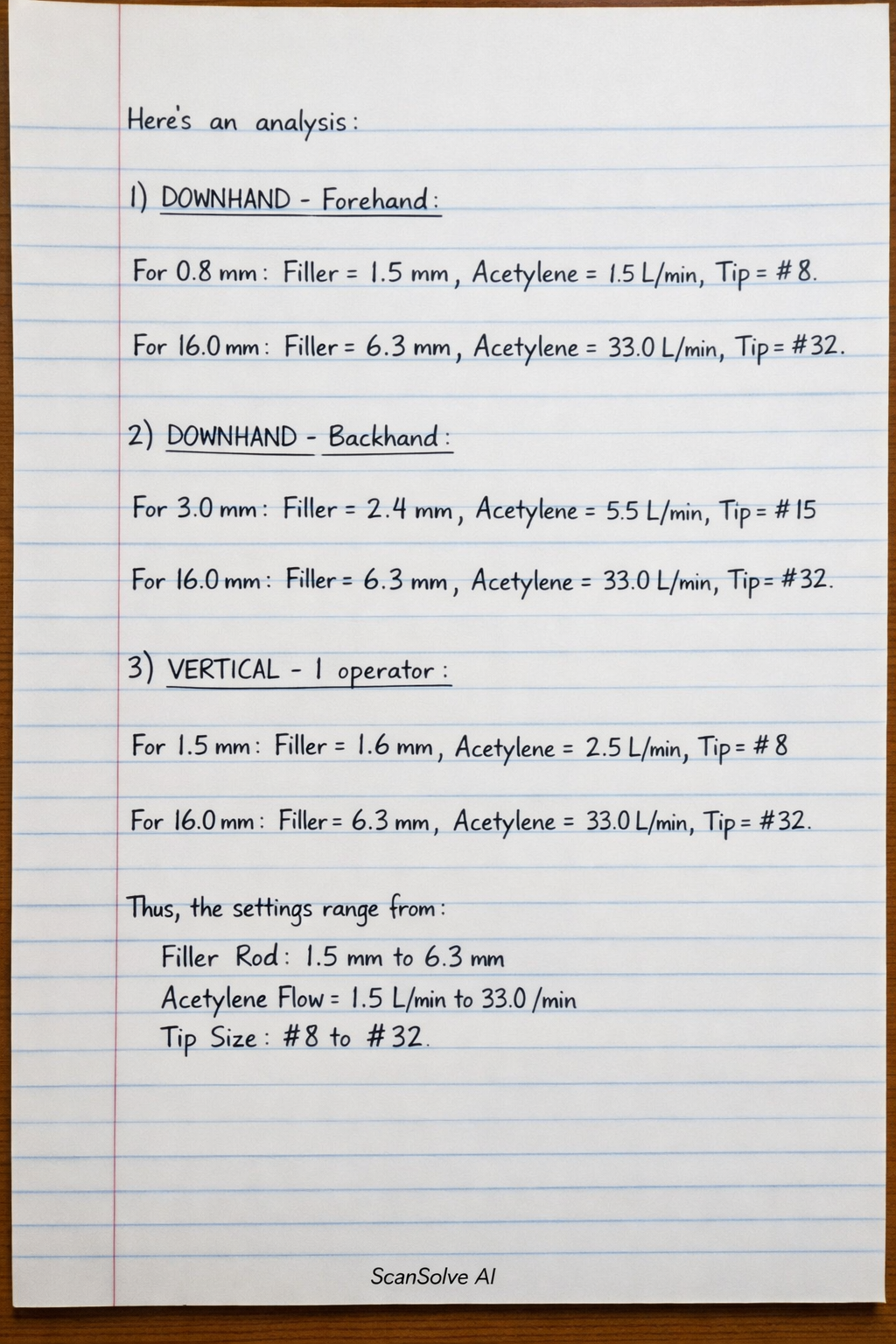
- Forehand: For plate thicknesses from 0.8 mm to 16.0 mm. Specifies filler rod diameters (1.5 mm to 6.3 mm), acetylene flow rates (1.5 l/min to 33.0 l/min), and tip sizes (8 to 32).
- Backhand: For plate thicknesses from 3.0 mm to 16.0 mm. Specifies filler rod diameters (2.4 mm to 6.3 mm), acetylene flow rates (5.5 l/min to 33.0 l/min), and tip sizes (15 to 32).
- VERTICAL:
- 1 operator: For plate thicknesses from 1.5 mm to 16.0 mm. Specifies filler rod diameters (1.6 mm to 6.3 mm), acetylene flow rates (2.5 l/min to 33.0 l/min), and tip sizes (8 to 32).
- 2 operators: For plate thicknesses from 5.0 mm to 16.0 mm. Specifies filler rod diameters (2.4 mm to 5.0 mm), acetylene flow rates (4.0 l/min to 8.0 l/min), and tip sizes (10 to 15).
- DOWNHAND:
- Preparation: Diagrams illustrate different joint preparations, such as square butt joints and V-grooves with varying angles (e.g., 60°).
Table III: Flame settings
This table describes three types of oxy-acetylene flames, their characteristics, and visual appearance.
- Neutral:
- Description: No excess of oxygen or acetylene. The inner flame cone has a faint flicker at the end, indicating a pre-carburising state.
- Visual: An illustration shows a flame with a distinct inner cone and a larger outer envelope.
- Oxidising:
- Description: Excess of oxygen. The inner flame cone is reduced. The greater the reduction compared to a neutral flame, the greater the excess oxygen.
- Visual: An illustration shows a shorter, sharper inner cone compared to the neutral flame.
- Carburising:
- Description: Excess of acetylene. The inner cone becomes ragged. A luminous, feathery secondary cone becomes visible. The greater the relative length of this secondary cone to the inner neutral cone, the greater the excess of acetylene.
- Visual: An illustration shows a longer, less defined inner cone with a visible feathery secondary cone.
Was this helpful?
Still stuck on this one?
Ask a follow-up, and the answer starts from this question.
Got a different question?Ask your own question
More Physics Questions
QWhat are the recommended filler rod, flame, and flux selections for oxy-acetylene welding of various…QExplain the use of oxygen in welding and mountain climbing, the right to safety info on flammable…QExplain the functions of the following oxygen acetyleneQWhat are the uses of oxygen in welding and mountain climbing, why is safety information on flammable…QState the difference between a luminous flame and Bunsen flame. (b) Name one type of a flame used in…
Handwritten Step-by-Step Solution
Get this as a handwritten image on WhatsApp — like a tutor wrote it for you.
Try on WhatsApp