
We read your photo as:
The relationships between, velocity of light in air and velocity of light in a medium is given by
ScanSolve AI Answer
Answer
Step-by-step solution
6 stepsHere are the solutions to the questions:
3. The relationships between, velocity of light in air and velocity of light in a medium is given by
The refractive index () of a medium is defined as the ratio of the speed of light in a vacuum (or approximately in air) to the speed of light in the medium.
The correct option is B.
4. A ray of light from air to glass is incident at an angle 35°. Calculate the angle of refraction in the glass if the refractive index of glass is 1.50
Identify the given values.
Angle of incidence in air,
Refractive index of air, (approximately)
Refractive index of glass,Apply Snell's Law.
Snell's Law states .
Solve for the angle of refraction, .
Rounding to one decimal place, .
The correct option is A.5. The critical angle of a certain refracting material is 30°. Calculate the refractive index of the material.
Identify the given value.
Critical angle,
Use the formula for critical angle.
The critical angle is related to the refractive index () by the formula:
Solve for the refractive index .
The correct option is B.
6. Which diagram in Fig. 12.94 correctly shows a ray of light passing through a rectangular glass block?
When light passes from a rarer medium (air) to a denser medium (glass), it bends towards the normal. When it passes from a denser medium (glass) to a rarer medium (air), it bends away from the normal. For a rectangular block, the emergent ray is parallel to the incident ray.
- Diagram A: The light ray bends towards the normal upon entering the glass and bends away from the normal upon exiting the glass. The emergent ray is parallel to the incident ray. This is correct.
- Diagram B: The light ray bends away from the normal upon entering the glass, which is incorrect.
Therefore, the correct diagram is A.
Try one yourself
A new problem that tests the same skill.
Still stuck on this one?
Ask a follow-up, and the answer starts from this question.
More Physics Questions
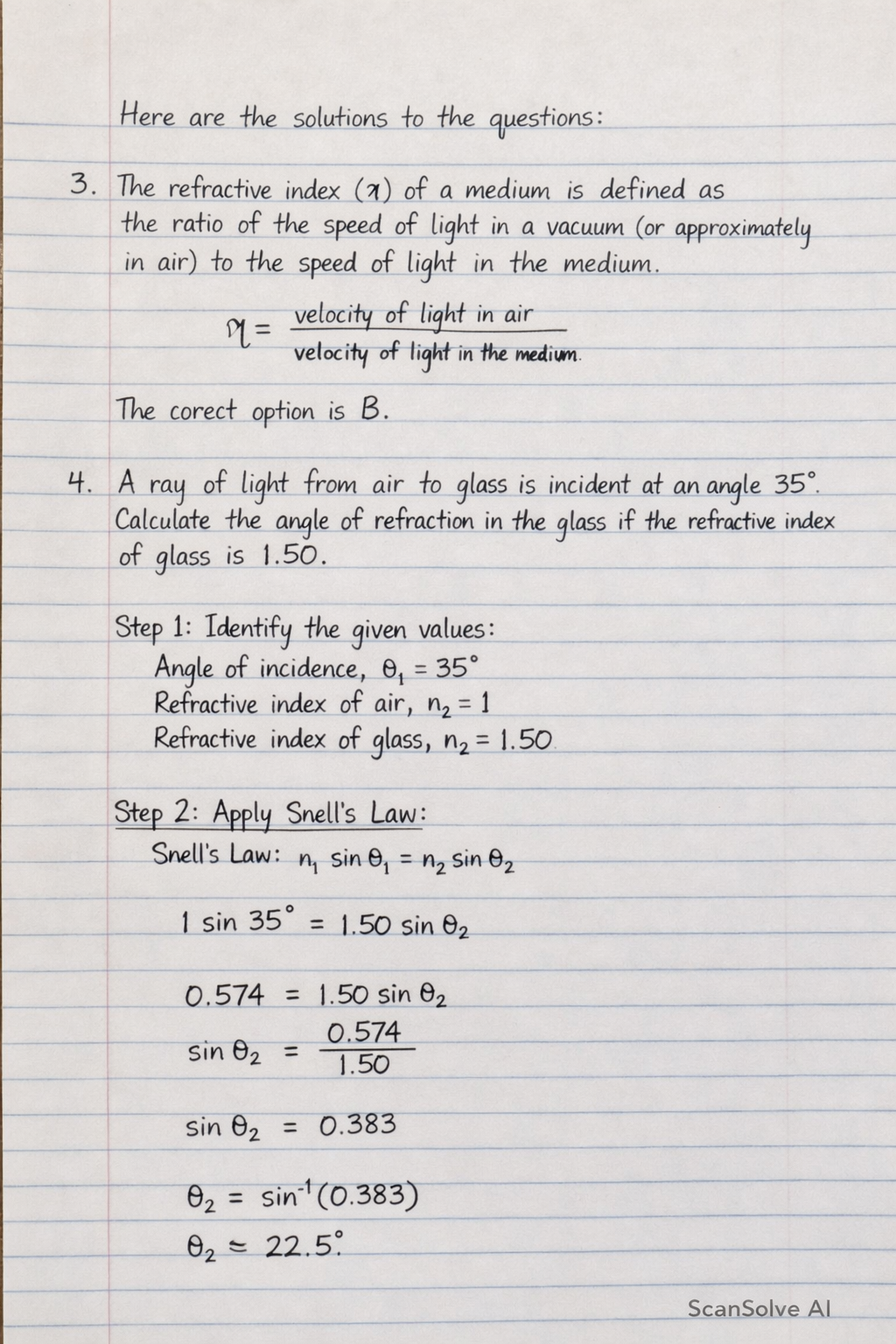
Handwritten Step-by-Step Solution
Get this as a handwritten image on WhatsApp — like a tutor wrote it for you.
Try on WhatsApp