
We read your photo as:
1 The simple wave speed equation is represented by:
ScanSolve AI Answer
Answer
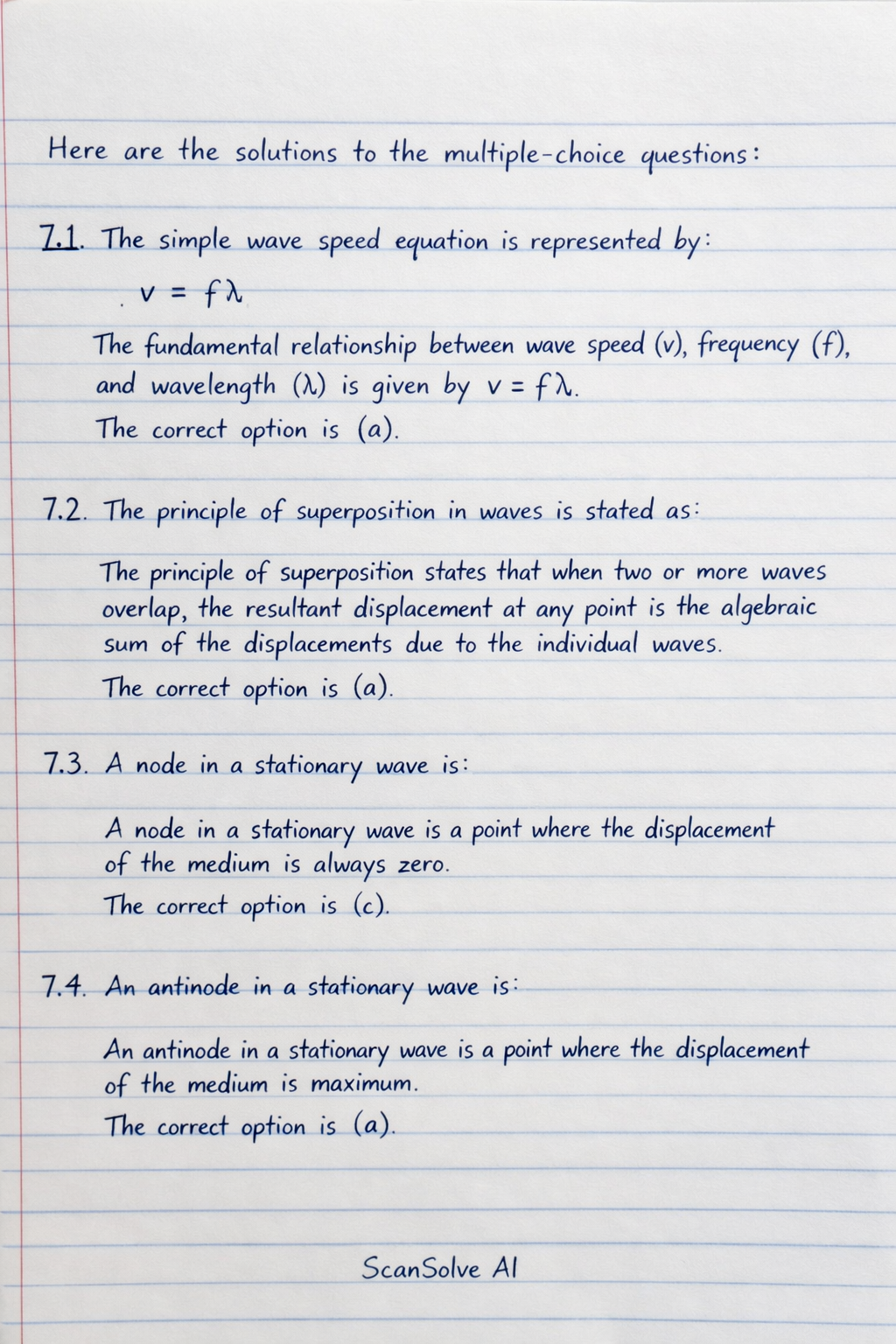
Here are the solutions to the multiple-choice questions:
7.1 The simple wave speed equation is represented by:
The fundamental relationship between wave speed (), frequency (), and wavelength () is given by .
The correct option is (a).
7.2 The principle of superposition in waves is stated as:
The principle of superposition states that when two or more waves overlap, the resultant displacement at any point is the algebraic sum of the displacements due to the individual waves.
The correct option is (a).
7.3 A node in a stationary wave is:
A node in a stationary wave is a point where the displacement of the medium is always zero.
The correct option is (c).
7.4 An antinode in a stationary wave is:
An antinode in a stationary wave is a point where the displacement of the medium is maximum.
The correct option is (a).
7.5 Stationary waves are defined as:
Stationary waves, also known as standing waves, are formed when two waves of equal amplitude and frequency traveling in opposite directions superpose. They appear to stand still, with points of zero displacement (nodes) and maximum displacement (antinodes) at fixed positions.
The correct option is (c).
7.6 Harmonics are:
Harmonics are frequencies that are integer multiples of the fundamental frequency of a vibrating system.
The correct option is (a).
7.7 The result of constructive interference between two waves is represented as:
Constructive interference occurs when two waves meet in phase, causing their amplitudes to add up, resulting in a wave with a larger amplitude.
The correct option is (b).
7.8 If the amplitude of the wave is tripled, then the amount of energy is increased by:
The energy () carried by a wave is proportional to the square of its amplitude (), i.e., . If the amplitude is tripled (), the new energy will be proportional to . Thus, the energy increases by 9 times.
The correct option is (c).
7.9 What type of waves do headphones use to produce sound?
Sound waves are mechanical waves that require a medium to travel. They are characterized by oscillations of particles parallel to the direction of wave propagation, making them longitudinal waves. They are also pressure waves. Among the given options, "Longitudinal waves" is the most specific and fundamental classification for sound waves.
The correct option is (d).
7.10 The typical frequency range of microwaves is:
Microwaves are a part of the electromagnetic spectrum with frequencies typically ranging from to . This corresponds to to .
The correct option is (d).
7.11 The bending of waves around an obstacle is called as:
Diffraction is the phenomenon where waves spread out as they pass through an opening or around the edges of an obstacle.
The correct option is (c).
7.12 The Doppler Effect used in astronomy is for:
In astronomy, the Doppler Effect is used to determine the relative velocity of celestial objects (like stars and galaxies) by observing the shift in the frequency (or wavelength) of the light they emit. A redshift indicates movement away, and a blueshift indicates movement towards the observer.
The correct option is (b).
Try one yourself
A new problem that tests the same skill.
Still stuck on this one?
Ask a follow-up, and the answer starts from this question.
More Physics Questions
Handwritten Step-by-Step Solution
Get this as a handwritten image on WhatsApp — like a tutor wrote it for you.
Try on WhatsApp