
We read your photo as:
The root means square value of an a.c. mains supply is 220 V. Calculate its peak voltage
ScanSolve AI Answer
Answers
3 partsStep-by-step solution
11 stepsHere are the solutions to the physics problems:
Part 25· 3 steps
We need to find the tension in the cable suspending the elevator.
Identify the forces acting on the elevator.
The weight of the elevator acts downwards, and the tension in the cable acts upwards. Since the elevator is accelerating downwards, the net force is downwards.
The net force is given by Newton's second law: .
The forces are:
Weight () = (downwards)
Tension () (upwards)
Since the acceleration () is downwards, the equation of motion is:Rearrange the equation to solve for tension ().
Substitute the given values
mass (), acceleration due to gravity (), and elevator's acceleration ().
The tension in the cable is .
Part 26
We need to calculate the peak voltage of an AC mains supply given its RMS value.
Recall the relationship between RMS voltage () and peak voltage () for a sinusoidal AC supply.
Rearrange the formula to solve for peak voltage ().
Substitute the given RMS voltage ().
Rounding to the nearest whole number, the peak voltage is .
The peak voltage is .
Part 30
We need to find the resistance of the rheostat required to achieve a specific current.
Identify the components and their values.
The circuit consists of a battery (), a fixed resistor (), and a rheostat (). The desired current is . The internal resistance of the battery is negligible.
Since the components are in series, the total resistance () is the sum of the individual resistances.
Use Ohm's Law to find the total resistance required for the given voltage and current.
Substitute the values for voltage and current.
Now, calculate the resistance of the rheostat.
The resistance of the rheostat must be adjusted to .
Try one yourself
A new problem that tests the same skill.
Still stuck on this one?
Ask a follow-up, and the answer starts from this question.
More Physics Questions
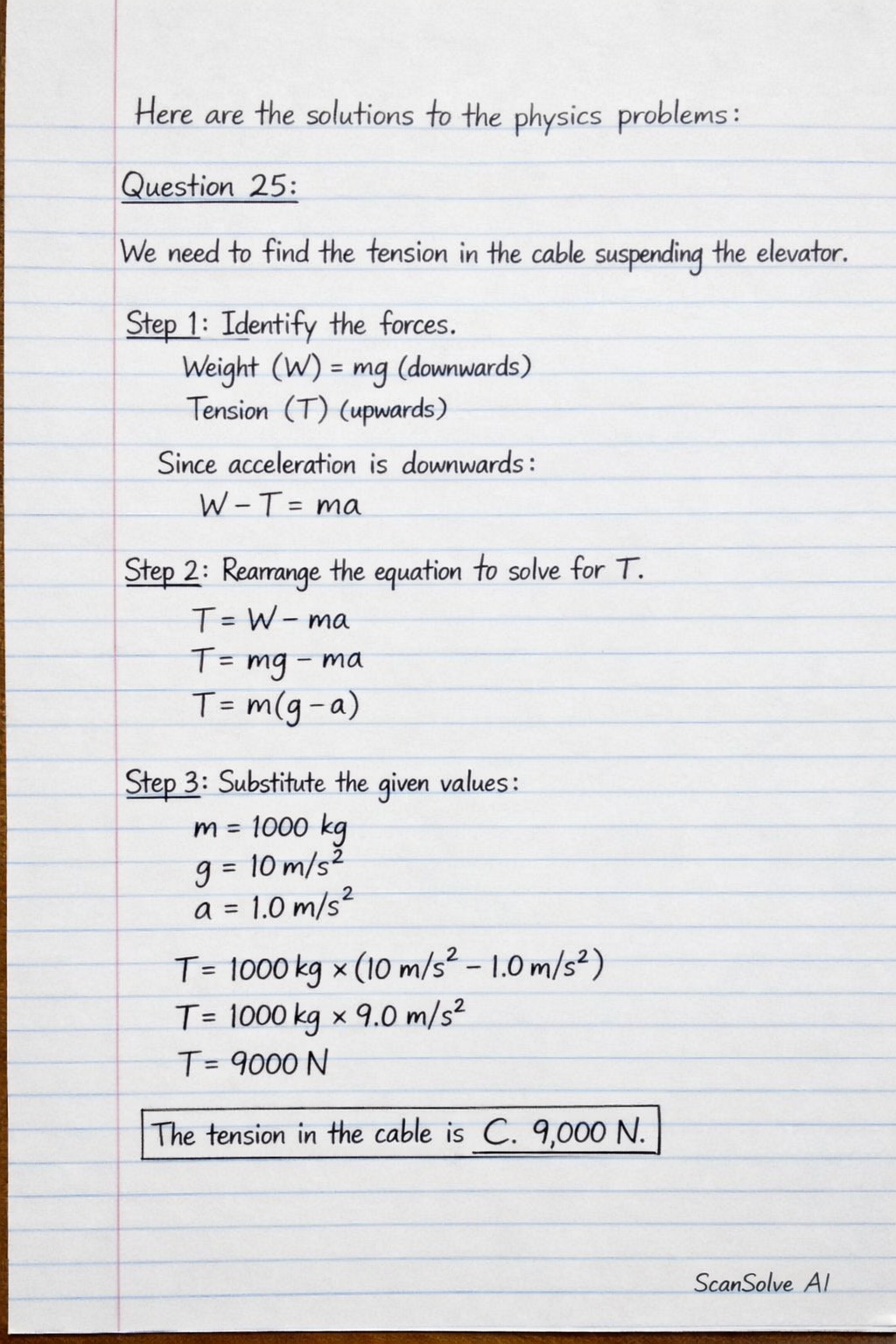
Handwritten Step-by-Step Solution
Get this as a handwritten image on WhatsApp — like a tutor wrote it for you.
Try on WhatsApp