
We read your photo as:
What are the solutions to these physics problems?
ScanSolve AI Answer
Answer
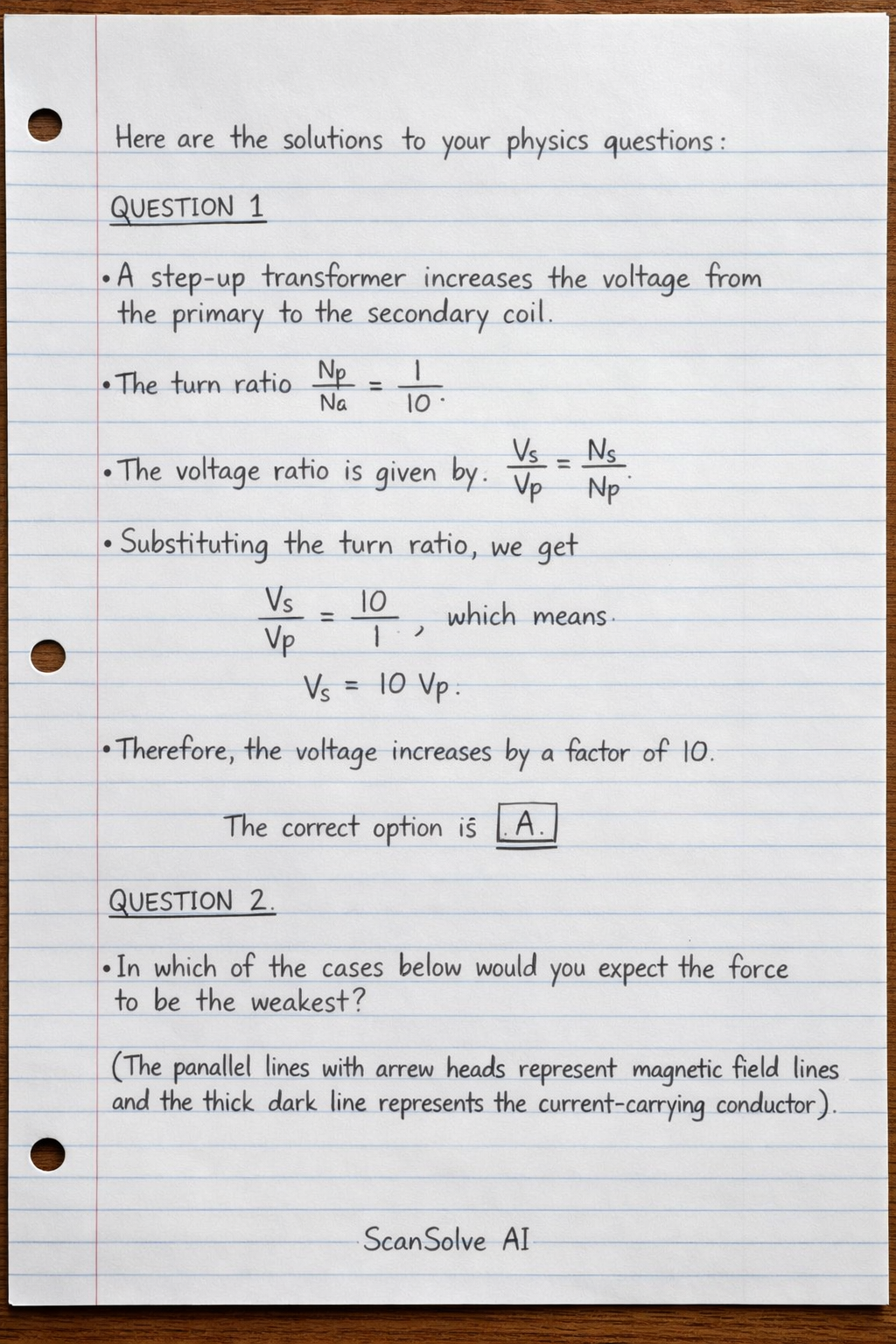
Here are the solutions to your physics questions:
QUESTION 1
A step-up transformer has a turn ratio of between the primary and the secondary coils. Which of the following is true?
- A step-up transformer increases the voltage from the primary to the secondary coil.
- The turn ratio .
- The voltage ratio is given by .
- Substituting the turn ratio, we get , which means .
- Therefore, the voltage increases by a factor of 10.
The correct option is A.
QUESTION 2
In which of the cases below would you expect the force exerted on the conductor to be the weakest? (The parallel lines with arrow heads represent magnetic field lines and the thick dark line represents the current-carrying conductor)
- The magnetic force on a current-carrying conductor in a magnetic field is given by the formula , where is the angle between the direction of the current and the magnetic field lines.
- The force is weakest when is at its minimum value. The minimum value of is 0, which occurs when or . This means the conductor is parallel to the magnetic field lines.
- Looking at the options:
- A: The conductor is perpendicular to the field lines (), so (maximum force).
- B: The conductor is parallel to the field lines (), so (zero/weakest force).
- C and D: The conductor is at an angle to the field lines, resulting in a non-zero force, but not necessarily the weakest unless the angle is close to or . Option B clearly shows the conductor perfectly parallel.
The correct option is B.
QUESTION 3
Which of the following techniques/methods will not result in a maximum induced voltage?
- According to Faraday's Law of Induction, the induced voltage () is given by , where is the number of turns in the coil and is the rate of change of magnetic flux.
- To achieve a maximum induced voltage, we need a large number of turns () and a large rate of change of magnetic flux ().
- Let's analyze the options:
- A. Adding more turns to a coil: Increases , which increases induced voltage.
- B. Faster relative movement of a magnet to a coil: Increases , which increases induced voltage.
- C. Both coil and the magnet moving at the same speed: If both move at the same speed in the same direction, there is no relative movement between them. This means the magnetic flux through the coil does not change (), resulting in zero induced voltage. This will certainly not result in a maximum induced voltage.
- D. Relative fast movement of a coil with respect to a magnet: Increases , which increases induced voltage.
The correct option is C.
Try one yourself
A new problem that tests the same skill.
Still stuck on this one?
Ask a follow-up, and the answer starts from this question.
More Physics Questions
Handwritten Step-by-Step Solution
Get this as a handwritten image on WhatsApp — like a tutor wrote it for you.
Try on WhatsApp