
This physics problem tests your understanding of fundamental physical laws and their applications. The step-by-step solution below breaks down the problem using relevant equations and physical reasoning.
ScanSolve AI Answer
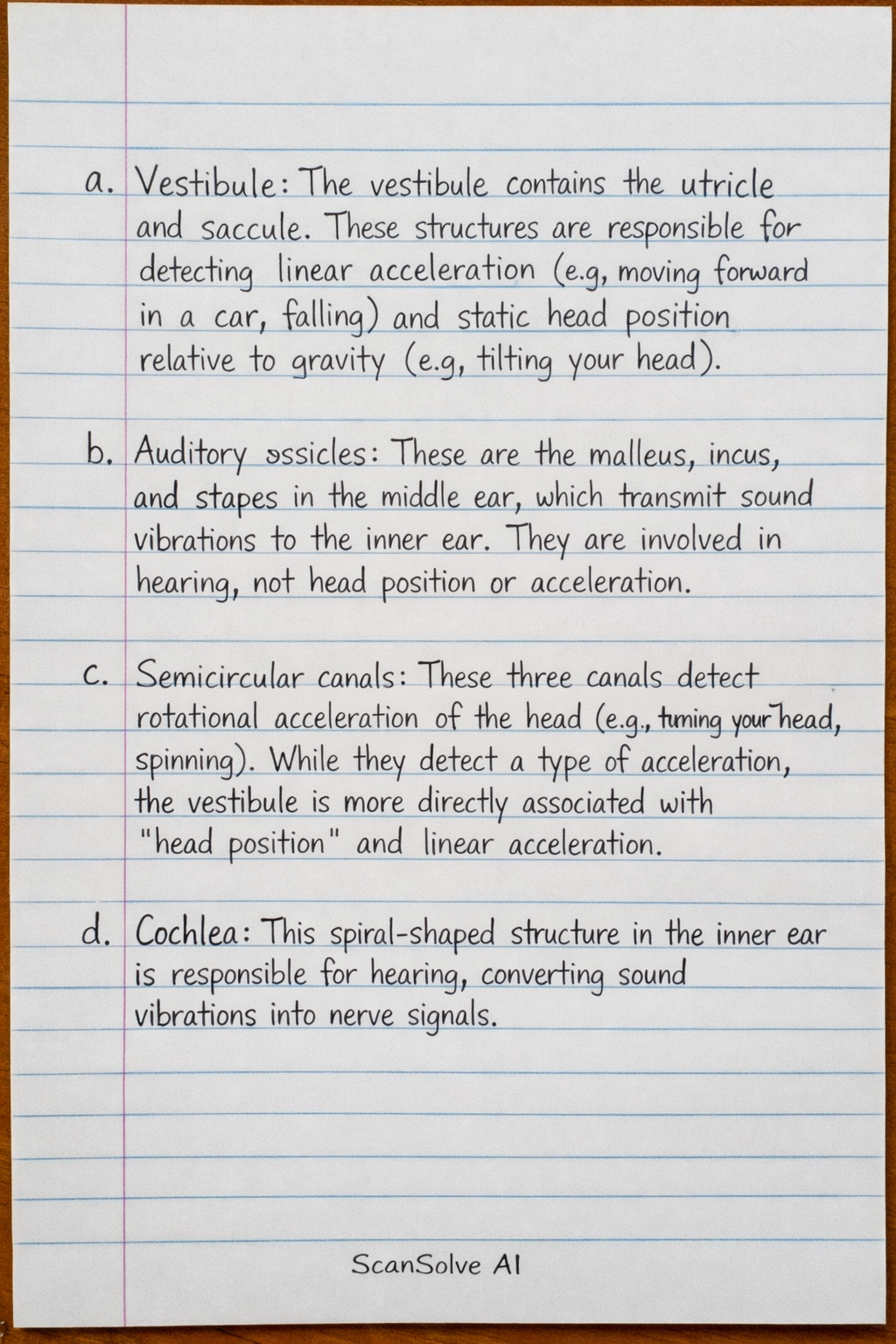
The tiny structures in the inner ear responsible for detecting changes in head position and acceleration are part of the vestibular system. a. Vestibule: The vestibule contains the utricle and saccule. These structures are responsible for detecting linear acceleration (e.g., moving forward in a car, falling) and static head position* relative to gravity (e.g., tilting your head). b. Auditory ossicles: These are the malleus, incus, and stapes in the middle ear, which transmit sound vibrations to the inner ear. They are involved in hearing, not head position or acceleration. c. Semicircular canals: These three canals detect rotational acceleration* of the head (e.g., turning your head, spinning). While they detect a type of acceleration, the vestibule is more directly associated with "head position" and linear acceleration. d. Cochlea: This spiral-shaped structure in the inner ear is responsible for hearing, converting sound vibrations into nerve signals. Considering the phrase "head position and acceleration," the vestibule is the most comprehensive answer as it detects both static head position and linear acceleration. The final answer is a. Vestibule