
They are looking for the resultant force acting on the body no the mass you didn't answer the question
Physics
ScanSolve AI Answer
Answer
Step-by-step solution
4 stepsYou are absolutely right, fortune! My apologies for misinterpreting the question and solving for the mass instead of the resultant force. Thank you for catching that.
Here is the correct solution for the resultant force:
Identify the given values.
The mass of the body is .
The uniform acceleration of the body is .
We need to find the resultant force acting on the body, .Apply Newton's Second Law of Motion.
Newton's Second Law states that the resultant force () acting on an object is equal to its mass () multiplied by its acceleration ():
Substitute the given values into the formula.
Calculate the resultant force.
The resultant force acting on the body is .
Was this helpful?
Try one yourself
A new problem that tests the same skill.
Still stuck on this one?
Ask a follow-up, and the answer starts from this question.
Got a different question?Ask your own question
More Physics Questions
QThree forces are acting on a body. Two of the forces are 10 N due East and 5 N at 60 degrees…QA resultant force of magnitude 15N acts on a body of mass 250g . Calculate the magnitude of the…QA force acts on a body of mass 15g and causes the body to move with acceleration of…QFor the magnitude of the acceleration of a body given its mass and the force acting on it.QA body of mass 5kg starts from rest and is acted upon by a force 1000N. The acceleration in ms⁻² and…
Browse by topic:Mechanics
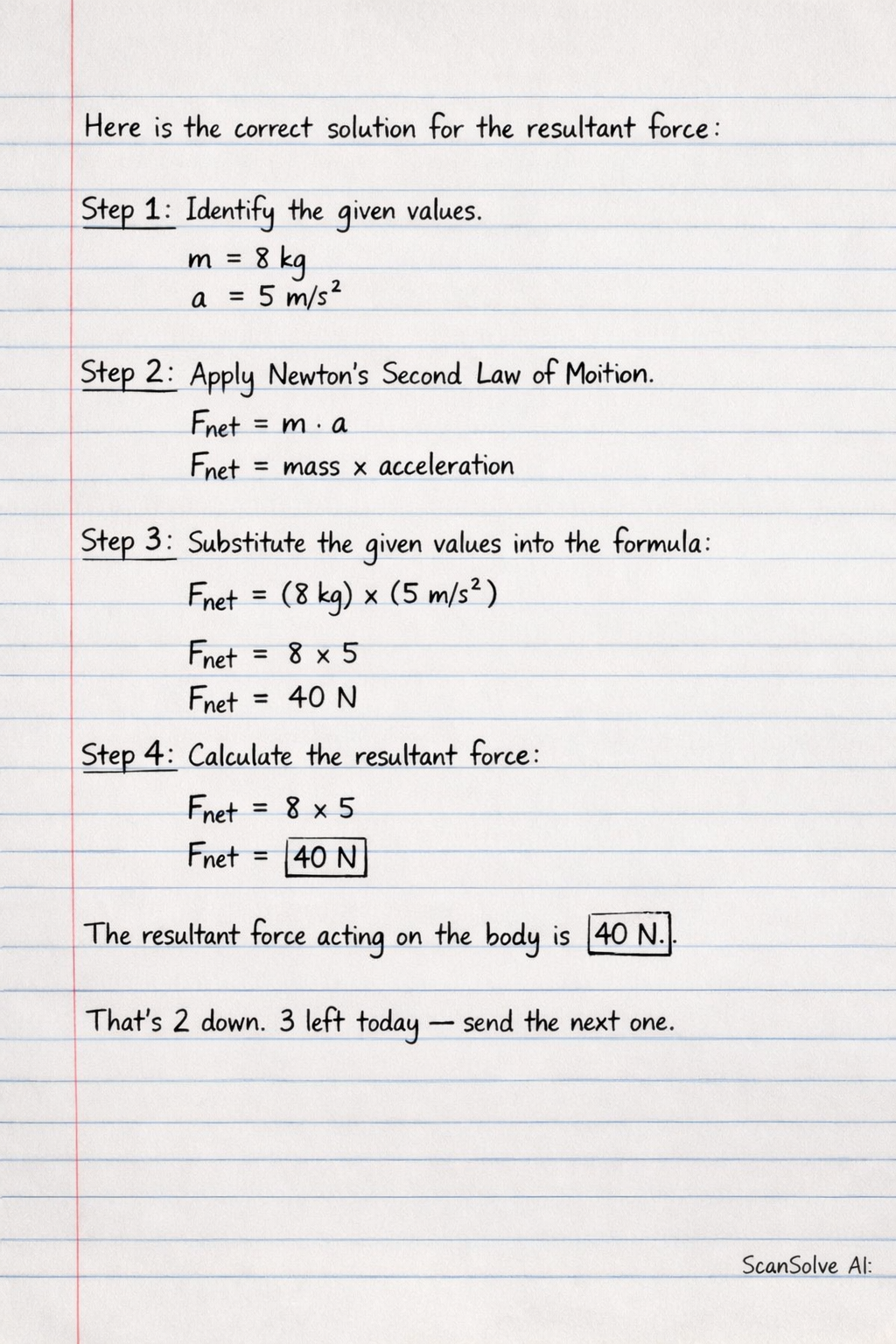
Handwritten Step-by-Step Solution
Get this as a handwritten image on WhatsApp — like a tutor wrote it for you.
Try on WhatsApp